The benefit of jumping practice from canter for horse and rider
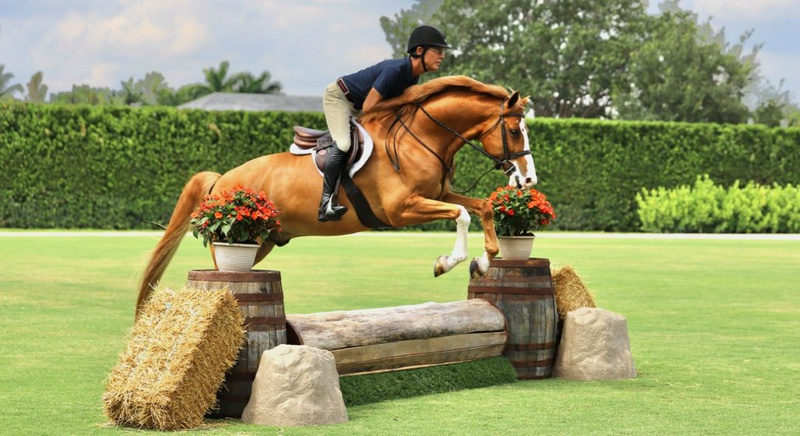
Are you practicing enough jumping from the trot?
Many people do not know how beneficial this exercise can be.
Even if you do not use it in the competition arena — for example, in equitation classes or hunter classes — it can still be a valuable part of your training program.
Jumping from the trot is very effective for working on the balance and timing of a young horse over small obstacles, when its canter is still developing.
At this stage, for most young horses, adjusting the trot stride is easier than adjusting the canter stride.
When you sit quietly and still in the saddle as you approach the obstacle, you give your horse the opportunity to find its take-off spot.
This helps it find its "eye" for the jump and learn to adjust its stride without being completely dependent on you for distance control.
After that, you can gradually advance the exercise; first by entering from the trot to an obstacle and then continuing with a quiet canter in a line to the next obstacle.
This process teaches your young horse to maintain its rhythm and calmness when jumping from the canter.
For nervous or sensitive horses, jumping from the trot is a great way to build confidence.
It gives them more time to assess the obstacle as they approach.
When they realize how easy it is to clear small obstacles at this slower speed, they quickly understand that they do not need to rush to the jump and push off hard from the ground to get over it.
The more they learn to be calmer and more relaxed at the moment of take-off and landing, the better the quality of their jump becomes.
For horses that are used to approaching obstacles with speed, if you choose a jump from the trot that is solid and impressive, like a wall or flower box, this jump will "hold" the horse back; meaning it will respect the obstacle enough to actually jump over it, rather than just step over it.
This also allows you to keep your leg on the horse and push it forward towards the obstacle, instead of pulling back on the reins as you approach.
The latter can cause the horse to raise its head higher than desirable — which is slightly above the withers — or to tuck its neck and pull its nose in; a position that disrupts its balance and ability to execute a quality take-off.
To get the best jump from a horse, I always like its nose to be aimed at the obstacle and its neck to soften in the last few strides before the jump, and even to stretch a little.
The trot jump exercise is just as valuable for riders.
This exercise gives you time to focus on staying with your horse's stride; not falling ahead of its movement or lagging behind, so that you are in perfect balance in the air.
It is also an excellent exercise for patience: it teaches you to wait calmly for the jump to come to you, so that the horse's body sits back at the moment of take-off, rather than you searching for the right distance and sometimes making a move at the wrong moment that disrupts its balance.
In addition to using trot jumps in my training at home, I also utilize them when buying a horse.
This exercise is a great way to assess a horse's natural eye for the obstacle and its balance.
Some horses do not know where to place their feet or simply step over small jumps.
However, truly talented horses maintain their beautiful balance until the moment they reach each obstacle and jump cleanly and neatly over it every time.
Jumping with a canter is often useful in the warm-up arena as well.
For some horses, this is a good tool for setting the mood for the round.
I used to ride a horse named Calgary, and whenever we started warming him up with canter jumps, he performed much better.
He had a long counter canter that was difficult to adjust, and at the same time, he was a bit nervous.
If I didn't jump any obstacles with a canter in his warm-up, I always felt I had to hold him back from the jumps in the competition arena.
He was so talented that he could jump obstacles from 3 feet 6 inches to 3 feet 9 inches from a canter.
After doing this a few times, I could ride him a little more forward in his canter; instead of constantly trying to keep his canter collected, I could put my leg more on him without worrying about him getting too forward.
He became more rideable and confident, resulting in much better rounds in the arena.
Calgary later won the reserve champion title in the Junior Hunter division at the 1994 National Horse Show with Elise Haas.
If you are going to jump canter obstacles in the competition arena, it is important to remember that the challenge is not just the obstacle itself.
You must remain balanced, steady, and straight throughout all phases, from the downward transition from the canter, approaching the obstacle, the effort on the jump, and the recovery afterward.
I recommend starting with the following exercise.
Transitioning from canter to canter over cavalettis is one of the most common mistakes I see in canter jumps in the competition arena, where the rider leans back too much during the transition from canter to canter; this causes the horse to fall into an unbalanced canter.
After that, the rider gets left behind and their body becomes stiff and tense.
This, in turn, throws the horse in front of the rider, causing it to rush towards the obstacle, putting weight on the rider's hands, and it may even revert back to the canter; a mistake that the judge has to penalize.
Another common problem I see in the arena is horses that drop their noses down and tuck them towards their chests during and after the transition, thus pulling the rider out of the saddle.
In this case, the horse often falls behind the rider's leg and loses its desired forward momentum, and the rider ends up ahead of the horse, putting their balance on its neck.
When the horse's nose is tucked like this, it cannot judge the distance correctly and gets too close to the obstacle.
This situation prevents it from transferring its weight correctly onto its hindquarters at the moment of take-off and turning its shoulders up and forward.
The result is a short and unimpressive jump; so much so that the horse practically "jumps on the forehand."
To avoid both mistakes, set up 3 to 5 cavalettis with a distance of about 3 feet 6 inches to 4 feet apart.
1.
First, establish a good, rhythmic canter and before gently turning towards the canter poles, make sure your balance is maintained on the stirrups and your hip angle is slightly closed.
About 60 feet before the jumps, prepare for the downward transition; keep your upper body stretched and held high — think "taller and stronger" — without changing the angle of your pelvis.
Step 1: Establish a good and rhythmic canter.
2.
To request the transition, close your legs on both sides of the horse to support its balance.
Then, shorten the reins to increase the pressure.
At the same time, focus on keeping your core tight; that is, your abdominal and back muscles, so that your upper body remains balanced on the horse and does not lean too far back or forward.
Most importantly, make sure the reins are short enough that you are not tempted to pull your hands back behind your shoulders or change the angle of your pelvis.
The better the connection between your leg and hand, the less likely these mistakes will occur.
Think of this transition like when you want to collect the horse in a neat and balanced line: soft and balanced, without any change in the height of its head carriage.
The best way to ensure this is to not change your own balance.
If it tends to lower its head below the withers, focus on using your core and legs to lift it back up instead of your hands.
If it tries to pull you out of the saddle, bring it to a complete halt.
Then circle back and start the exercise again from the beginning.
Step 2: Request the transition.
3.
When passing over the jumps in sitting canter, keep your body balanced over the center of the horse.
Follow the movement of its neck forward with your hands while maintaining a light connection with its mouth.
Repeating this exercise several times on both leads will teach you and your horse to remain balanced and patient in the approach.
With repeated practice over time, you will eventually be able to perform this transition faster, yet still smoothly.
The goal is to always avoid rough transitions.
Common mistakes here allow Babylon's head to drop below its withers; an issue that disrupts its natural and relaxed balance and topline.
After the transition to canter, its neck becomes collected and short, preventing it from using its head and neck properly in the approach to the jumps.
Here, because I applied too much pressure on the reins during the transition from canter to sitting canter, Babylon has raised its head and shortened its neck; as a result, it can no longer pass over the jumps with calm and even strides.
Exercise line: Enter with canter and exit with sitting canter to create a line of 84 feet that includes a small canter jump followed by a sitting canter jump; the second jump can be a small filled jump or a short vertical.
(Note that the canter jump at the beginning should be very small so the horse does not feel it has to exert too much effort over it.
For the sitting canter jump, do not use gates or other jumps that have holes where the horse might accidentally catch its foot.
) Place a sitting canter pole 8 to 9 feet in front of the sitting canter jump.
If your horse typically rushes after landing from jumps, set up this line so that the sitting canter jump is only a few strides away from the end of the arena.
This way, the horse thinks about turning to the next corner when landing, rather than rushing toward the large open space.
Note: If your horse is inexperienced and has not yet started jumping over obstacles in canter, just work on the second part of this line with the jumping stick and practice the transition from canter to trot as you did in the jumping stick exercise.
1.
Establish a slightly collected canter and approach the first obstacle with a soft turn.
As you approach, keep your upper body calm and steady, and do not apply pressure to find the take-off point so that the horse does not overexert itself over the obstacle.
(Since the obstacle is very small, it’s okay if you get a little closer than usual at the moment of take-off.
) In the air, focus your gaze on the obstacle in trot while being careful not to interfere with the horse’s jumping effort.
2.
After the horse has completed the jump, apply the same soft aids for the downward transition that you used in the canter to trot transition — with the emphasis on using more of your torso and legs than your hands — but this time ask the horse to come to a complete stop.
At the stop, pause briefly; just enough for the horse’s neck to relax and soften; then turn and calmly walk away in a trot.
(If it drifts to either side before the stop, turn it in the opposite direction.
For example, if it drifts left, turn it right.
) If you have trouble getting the horse to stop within the space of this line, make the line a bit longer, approach the first obstacle with an even more collected canter, and/or take a sharper turn on the approach.
3.
Repeat the exercise until you can easily and without changing the level of the horse’s head perform the transition to a stop in the middle of the line.
Then approach the obstacle in canter again as you did before.
This time, instead of coming to a stop, ask for the transition to trot.
Just like the jumping stick exercise, immediately check that your balance is right in the middle of the horse’s stride and that the horse is in front of your leg; meaning it maintains the desired forward energy without you having to constantly push it, while also being “on the hand”; meaning it has a light and appropriate contact with the bit, without pulling you out of the saddle.
Mastering this timing can be difficult.
During the downward transition, you may feel that the horse wants to come all the way down to a trot.
Be ready just before that moment to engage your leg and seat so that the horse goes forward in a steady rhythm — neither slow and lifeless nor rushed.
Again, if the horse is shortening its neck or holding its head higher than the ideal level, which is slightly above the withers, check that you have kept your upper body tall and upright and that you are not using too much pressure on the reins during the transition.
Step 3: Repeat the exercise until you can easily and without changing the level of the horse’s head perform the transition to a stop.
4.
Continue to focus on your balance as you approach the trot obstacle and at the same time, count the steps out loud — one, two, one, two — to maintain a steady rhythm and resist the temptation to rush for the take-off point.
Do not look for the distance; instead, try to sense what the horse is doing beneath you and let it determine the timing of leaving the ground itself.
At the same time, with your hands, follow the horse’s nose forward so that it can correctly use its neck in the last few strides before the obstacle.
Note: Allow the horse to use its neck naturally in the last strides before the jump.
As you get closer to the jump, keep your gaze up and focus on the path you want to take after the jump.
This, in turn, helps keep the horse's gaze up as well.
Unless your horse is exceptional at jumping from the canter and never loses its balance while taking off, resist the temptation to completely release the reins in front of the jump.
Maintaining a light contact helps you keep the horse's balance until the moment of take-off and ensures that you move with it when it leaves the ground.
In the meantime, keep your hip angle slightly closed and your hands in front of your shoulders.
Whether you sit or post in the last few strides before the jump depends on the quality of your horse's canter.
If its canter is flatter and less energetic, continue posting to maintain an active rhythm in its strides and make it clear that you do not intend to come down to a full seat.
In the last one or two strides, just after passing the jump pole, it’s fine to sit lightly in the front of the saddle while maintaining the same hip angle to stay better in sync with the horse's movement when taking off from the ground.
If your horse has a lot of energy and suspension in its canter, sit a few strides before the jump pole to help its stride become calmer and reduce its tendency to rush.
Try not to anticipate the take-off.
Instead, wait for the horse's body to reach you.
When the horse leaves the ground, keep your upper body tall and lifted while maintaining the hip angle, and engage your core muscles to stay in harmony with its movement.
If you are a hunter rider and usually operate a bit more relaxed and softer on counter jumps in your upper body, this is where you should have a more classical and organized form.
Be patient and firm in your upper body so that you neither unintentionally jump ahead of the movement nor fall behind it.
When the horse lands and moves away in the canter, maintain contact with its mouth and keep rhythm, straightness, and balance under control.
The quicker you collect the horse after the jump, the better your turn or line to the next jump will be.
If the horse becomes too quick or lowers its head and neck too much, use the same soft aids for downward transitions that you used earlier to gradually bring it back to a walk without pulling its nose toward its chest.
Then repeat the exercise and transition to the walk until the horse calms down and learns to maintain its balance and collection after the jump without changing the position of its head and neck.
Note: Try not to anticipate the distance.
Before practicing the turns to the right and left after landing, continue straight in the canter a few times after the jump and always focus on maintaining a consistent rhythm, balance, and the same position of the horse's head and neck.
Also, gradually try longer approaches to the counter jump to ensure that your horse can maintain its balance and rhythm in a more open and longer space.
Since jumping small obstacles from the canter puts very little pressure on the horse's legs, you can do this exercise even three or four times a week.
If your horse is a bit nervous, occasionally incorporate jumping from the canter into its dressage training.
This work teaches him that jumping is not such a big deal.
Common mistakes here have allowed the reins to become too long, resulting in my hands being positioned behind my shoulders.
This situation makes creating a balanced transition to canter more difficult.
Here, during the transition, I have leaned back too much and pulled on the reins with hands that are too high.
This causes me to lag behind the horse's movement when taking off for the jump.
For horses that tend to rush after landing, I place the jump closer to the end of the arena and set a landing pole at a distance of 8 to 9 feet from the jump.
This helps slow them down.
In the competition arena, when you have practiced enough at home jumping from canter, you will have a good understanding of what works best for your horse in the competition arena.
For example, if your horse tends to anticipate and counter in the last few strides before the jump, it’s better to design a tighter turn on the approach to the jump.
This way, it will have less opportunity to think about it.
If your horse is a bit timid and quick to react, it’s better to give it a longer approach to allow enough time to focus on the jump and build its confidence.
If your horse tends to rush after landing, plan to turn earlier after jumping from the canter.
This gives it less time to accelerate.
If you have done the necessary exercises well, your horse will impress the judge with its best performance.
About John French John French, a renowned hunter/jumper rider, entered the circuit in the junior category by riding other people's horses and ponies.
He won the Maryland Equitation Final with his own training and a borrowed horse.
Since then, he has represented the United States in Nations Cups and FEI World Cup Finals, won the title of World Champion Hunter Rider four times, been named California Professional Horsemen's Association's Horseman of the Year three times, and has earned the title of Hunter Derby Horseman of the Year in the United States Hunter Jumper Association for the western region every year since 2016.
He became the National Professional WCHR Champion in 2019 and was inducted into the National Show Hunter Hall of Fame the following year.
John is now based in Wellington, Florida, where he manages the hunter division of Kent Farrington's business, a show jumper, known as KPF.
This article was first published in the Fall 2021 issue of Practical Horseman magazine.
Source: Practical Horseman – Training