George Morris's lessons for eventing riders on balance and position
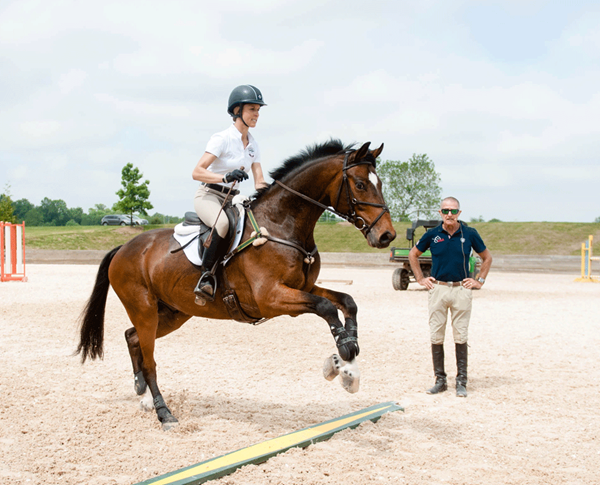
George Morris taught the subtle points of equitation to eventing riders for two days last spring at the Windora Farm owned by Boyd and Silva Martin in Cochranville, Pennsylvania.
He began each session of the second day with flatwork, focusing on correcting the rider's position, and then added work over oxers and cavalletti to the program.
He then moved on to small, simple jumps, gradually making the courses more complex.
Boyd said, "George's lessons were a great reminder for me about the importance of the subtle points of equitation.
He made all of us learn something new and was very precise in what he wanted from us as riders.
He is a very demanding but fair coach."
Focusing on body position, in addition to Boyd, the first group included higher-level riders such as Kate Hicks, Molly Kinman, Jessica Bramblefield, Jenny Karas, and Caitlin Seilman.
This session began with a more precise adjustment of the riders' body positions.
Mark Beecher, an Irish rider in the steeplechase competitions, and Lacanatosa maintained a steady rhythm over their raised cavalletti.
| © Amy Key.
In classical style, the correct hand position means that a straight line should be formed from the rider's elbow to the hand, through the reins, to the horse's mouth.
George repeatedly returned to hand position and often encouraged riders to keep their hands higher.
He said, "You need to have a straight line to the horse's mouth.
If the horse's head is up, you need to raise your hands higher.
Horses hate it when you pull your hands down because it puts pressure on the bars of their mouths.
Then they will push against you.
If you raise your hands, they accept it and start to lower their head."
George examined a horse's bit with his keen eye and said, "If you have a problem in the mouth, you go for a stronger bit.
But first, you need to ask if the problem is with the rider.
Are you sitting behind the movement of the horse?"
As he adjusted the rider's stirrups, he continued, "Your leg is your point of support when you come out of the saddle; in posting, cantering, and jumping.
The shorter you make the stirrup, the further back your seat comes; if you sit on the horse's back, the horse will hollow its back.
The modern trend is often to sit behind the vertical, but classical books say not to do that.
Even in a standing position, I want to be with my horse, meaning your upper body should be slightly ahead of the vertical line.
When I post, canter, and jump, my shoulders come slightly forward."
He reminded the riders to focus on impulsion, alignment, and contact.
He asked them to execute transitions between the movement gates so that the horses would respond to the leg and accept the hand.
He reminded Caitlin, "Impulsion does not mean speed.
Don't let the horse work above its rhythm."
He also reminded her to keep her hands steady.
He said, "You don't bring the horse back to the bit by shaking your hands."
When Caitlin successfully entered a transition in the forward movement, George praised her for executing it correctly while reminding her to apply pressure with her leg, not her knee.
As the riders first went over the poles on the ground and then over slightly raised cavalletti, George explained that the goal is to maintain a steady rhythm and not let the horse anticipate the poles.
He said, "This is the first practice for show jumping.
Cavaletti are small obstacles.
" After working on the poles, when the horses were more warmed up and using their backs better, George asked the riders to perform shoulder-in and haunches-in to soften the horses laterally.
Then they went in a collected trot along the diagonal of the arena and in the long side of the arena, they rode a regular trot.
George explained the process of this exercise: "After performing shoulder-in, you gain more forward stretch, better alignment, and more engagement.
The horse naturally tends to move with the shoulder out and the haunches in; keep him straight with the inside leg and maintain the shoulder slightly in with both hands that are slightly inward.
" As the riders lengthened their horses' strides, he reminded them to keep their hands steady: "Friends, this is a classic recommendation that ensures proper contact!
In both of these exercises, keep your hands steady.
Once you achieve the stretch, that is enough.
Balance the horse and do not apply more pressure.
" Show jumping: go down, don't sit George continued and, entering the show jumping section, explained that for dressage, flatwork, jumping, and Chaharnal, there are different positions for the legs, which shorten the stirrup length at each stage.
He said about jumping: "The best support is a clear contact with the lower part of the calf.
You apply pressure and when the horse responds, you release.
Do not kick or jab the horse with your leg, and do not hold him with the upper part of your leg.
About a quarter of the rider's foot should be inside the stirrup, allowing the ankles to flex.
This is your support.
Do not apply pressure on the stirrup, drop your heel down.
It is important that your aids do not interfere with each other.
When using your hands, do not use your heel and spur.
" To create better forward stretch, alignment, and engagement, Boyd Martin executes the shoulder-in movement on Santos.
| © Amy K.
Drago, after a single preparatory jump, had the riders work repeatedly on a three-stride curved line that included a distance of 75 feet in 6 strides and then a distance of 65 feet in 4 strides.
Boyd's horse covered the 6-stride section in 7 strides on the first attempt.
George said, "6 short strides give you 4 short strides.
" When Boyd rode this line well, George asked him to do it again and stop after a few strides.
He said, "If you stop a horse after a jump by sitting and pulling on its mouth, poor horse.
Raise your hands and close your hands.
Do not be afraid of your hands.
You want the horse to hold itself.
Stop, take a few steps back, and make him carry his shoulder.
This is great for that horse.
" The next exercise involved jumping a triple bar, then a right turn towards a one-stride distance that consisted of an oxer with a plank, a Swedish oxer, and a narrow jump.
George said, "Most people overprepare the horse for the triple; let the jump come to you.
" He added, "If the horse jumps up on the second oxer, keep your leg and move with the horse, not stay behind the horse.
" George explained the two-point jumping position: "The upper body is inclined forward for Chaharnal and jumping.
In the three-point position, your body is still inclined forward, but your seat is deep and secure.
When you approach the obstacle, take a crouched position.
If you have to take a defensive position, you will be behind the horse.
For example, when you turn towards the triple bar, crouch down and go down in the saddle; go down, but don’t sit back again.
In show jumping, we use both of these positions.
I don’t care what distance you take, you should not sit.
Are you reaching that distance hard?
Leg.
And I don’t care where the horse's head is; what matters is that you keep your hands up.
"After Jessica's horse stopped a few times at the triple bar, George said, "When the going gets tough, we have to be tougher too.
Get on!
Then stop it softly.
" After repeating an exercise several times, Philip Dutton's young horse gained more confidence and jumping ability.
He advised the riders to rebalance the horse with a half halt after the triple bar.
He said, "When the horse rises in front, lower your hands.
When the horse becomes heavy on the hands and front of the body, raise your hands.
Use encouraging sounds for the timid horse.
Believe me, this sound is your best friend.
" Although George gets angry very quickly when riders are not careful enough or a horse misbehaves, these short outbursts soon give way to calmness.
This is exactly the reflection of the reaction he wants from riders towards their horses: if a problem arises, address it right there and then continue calmly.
He encourages riders to be assertive if necessary, but not to constantly and relentlessly pressure the horse.
When everything is going well, he often says with encouragement: "That's it.
Well done, that's it.
" Balancing the horse of the second group of riders included Boyd, Philip Dutton, Lauren Balcomb, and Matt Brown, Canadian Vaillant Roberts in eventing, and Mark Beecher, an Irish jockey and winner of the steeplechase; someone who rode a young eventing horse that was raised on their family farm, Laconatusa Stud in County Waterford, and is now training under Boyd.
George said with admiration, "Philip has consistency in his program, and that means success.
" George, who is both a serious reader and the author of several reputable books, encouraged the clinic participants to read the works of Alois Podhajsky; someone who was the director of the Spanish Riding School in Vienna and had Olympic dressage experience.
While discussing position with these riders, George emphasized once again that he does not get influenced by fads and fleeting trends in riding.
He said, "Classical style is based on mechanical evidence, not fashion and exaggeration.
Classical is built on old principles.
" For example, he addressed the half halt.
He said, "There are different types of half halts.
"A half halt collects the horse and raises the shoulder.
"In most cases, it engages the horse, which is very important.
He explained, "There are three ways to balance the horse; a horse that naturally carries about 70 percent of its weight on the front hand: George practiced the flying change on Matt Brown's horse and worked until the horse presented several clean and flawless changes.
"1.
Lighten the front of the horse.
"2.
Engage the hind leg to shift the center of gravity back and make the horse move up more.
That's why we do shoulder-in and haunches-in.
"3.
Engage the hindquarters and keep the front of the horse lighter.
Think of Valegro.
In every transition, you are teaching the horse.
Yes, I am very strict about every single detail.
You need to coordinate the aids of the legs, seat, and hands together.
Transitions can be from halt to walk, from canter to walk, and so on.
If the horse does not respond to the leg, we do not force it with a kick or a click sound; we alert it with a short call.
"In riding, the function in the saddle follows the correct form."
George is very strict about both the correct foundations and the appearance.
He said, "The way you present yourself unconsciously affects the judge.
They do not give a separate score for it, but they see it.
Body position means elegance.
As Jack Le Goff used to say, 'Show your dignity.'"
He advised Mark, whose horse had become a bit strong, "I want your hands to be above the withers.
Close your hands and take two or three steps back.
Then release your hands.
Leg.
This is the first principle: leg without hand, hand without leg."
He said about jumping over the cavalletti, "If the horse goes with speed, it is not acceptable.
If it raises its head, raise your hands.
If it accepts contact, lower your hands.
If the horse becomes quick, use a bit of voice: 'whoa-whoa.'"
The first basic exercise on the flat, shoulder-in, was explained by George as making the front of the horse lighter.
He said, "The foundation of riding is in shoulder-in."
Then the horses came down along the centerline and performed a half-pass to the right.
Mark's horse was a bit crooked in the canter, and George said, "The alignment of the horse in the canter is very difficult.
He wants to bring the hindquarters in.
Think of the inside leg and the outside rein and see how straight the beginning of the canter can be.
Keep your upper body close to vertical, not behind that.
A half-halt means taking and giving."
The next exercise consisted of a serpentine: riders would canter left over a pole, come to trot in the first curve of the serpentine, go straight over three cavalletti, then take canter again in the next curve and pass over another pole with the right hand at the other end of the arena.
Then George got on Matt Brown's horse for the flying change exercise.
When he noticed that the stirrup lengths were set in two different holes, he reminded Matt to carefully check his tack every time someone else saddles his horse.
He said, "If the seat is crooked and unbalanced, it is very easy to fall."
If your stirrup leathers have stretched and become uneven, you should get a new pair.
After working the horse in both directions on the circle to accept the bit, George took the canter and tried to execute the flying change.
The horse resisted, and George said he wanted the horse to initially perform this change only from the aids of the legs; first, by fully transferring the weight of the seat to the saddle and then with a lighter seat.
He sat down when exiting the turn and kept the horse straight with the inside leg in the corner, towards the outside rein.
To request the change, he brought the new inside leg to the corner, applied a little pressure, and simultaneously made gentle contact with the new outside rein.
His outside leg was back and played a passive role.
He continued the work in both directions until the horse made several clean changes, then dismounted and handed the reins back to Matt.
The top eventing riders gathered at the Windora Farm owned by Olympian Boyd Martin to receive training from George Morris, the former head coach of the United States Show Jumping Team.
George said, "Met is an outstanding student, and that's why he will make great progress."
During the jumping review, when the show jumpers began to go over the curved line, George gave this advice to Met: "Every transition makes the horse better or worse. Don't just stop the horse with your hands, and when you see the distance, don't push him with your legs; just be soft and maintain your position. Be steady and let him come out of the turn."
Boyd Martin and Santos jump the triple bar.
When Mark was countering through the exercise, George pointed out his excellent position and jokingly said he should do a formal registration to qualify for the McLeay Equitation Finals.
He told this rider, "Of course, you need to keep your heel lower. It doesn't matter how short the stirrup is; the heel should be lower than the toe."
When the horse knocked a rail, George encouraged Mark to let the horse make mistakes and learn from them.
Lauren continued to choose the long distance to the third jump on the curved line, and George asked her to reach the jump at a Chaharnal, keep her upper body up, and bring the horse to a shorter distance.
He said, "He hates this style of riding!"
He explained the order of aids for Boyd like this: "Inside leg, outside rein, outside leg back, and inside hand light; always in that order. Don't even talk about the hand without the inside leg."
Philip's young horse was clearly trying to understand the exercise, and George asked him to go through it several times until he finally got it.
George said, "Repetition brings confidence for this very cautious horse, and that confidence gives him scope."
Kate Hicks and CC Top jump a narrow obstacle to complete one of George's exercises.
Finally, the riders set up the course together: triple bar, then left to a vertical with related distance, then a sharp turn to the right towards the rail with a compressed approach to a combination (two strides to one), then left to an oxer, and then back through the same combination in the opposite direction (one stride to two).
When Violin went off course, George said sharply, "Violin, what a distraction! All those pretty girls are distracting you!"
Alongside practical advice, it's these jests and jokes that make participants come back time and again to hear George Morris speak.
Violin quickly organized the course in his mind and delivered a completely flawless round.
This article was first published in the September 2015 issue of Practical Horseman.
Source: Practical Horseman – Training