Entraînez votre cheval à aller à contre-galop avec des exercices d'Ashki, Chaharnal.
Chaharnal contre est très utile pour développer l'équilibre, la direction, la puissance et l'obéissance aux aides équestres.
Ce mouvement est également visible dans les tests de dressage à des niveaux plus avancés, du niveau débutant en dressage pur à l'événementiel.
Cependant, Chaharnal contre est également une méthode très efficace pour améliorer la qualité globale du galop et le port du cheval lui-même.
Cependant, lorsque vous introduisez Chaharnal contre à votre cheval pour la première fois, comme pour tout nouveau mouvement, il est préférable de procéder étape par étape.
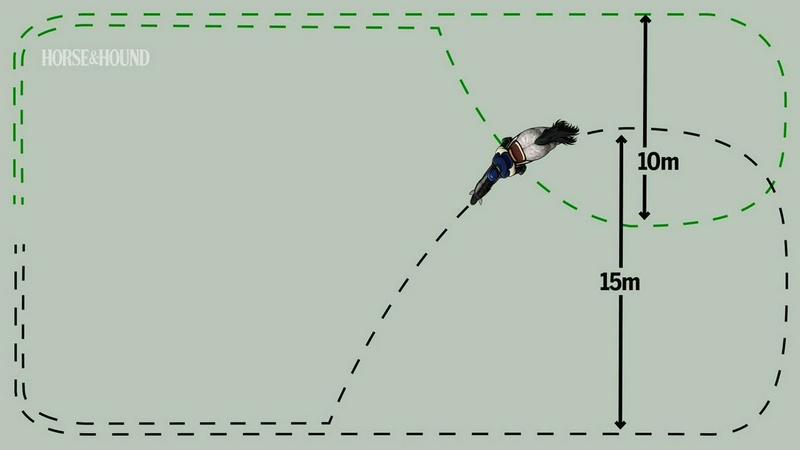
Ce motif en forme de larme est une méthode pratique pour enseigner quelques pas de Chaharnal contre de manière simple et sans pression, afin que votre cheval gagne en puissance et comprenne mieux les aides avant de passer à des exercices au sol plus difficiles.
L'objectif est d'exécuter quelques pas de Chaharnal contre tout en maintenant la direction et l'équilibre.
Aucun aménagement n'est nécessaire.
Cet exercice peut être effectué dans le manège ou sur le terrain, mais si vous optez pour la deuxième option, il est préférable de délimiter le manège avec une planche ou une barre pour rester plus discipliné dans le maintien des lignes droites et la taille des cercles.
(Crédit photo : Future) Comment exécuter cet exercice Échauffez le cheval au pas, au trot et au galop sur les deux mains et effectuez des cercles de différentes tailles.
Cet exercice de spirale peut aider à améliorer l'engagement, l'activité et l'équilibre dans un cercle plus petit.
Prenez un galop actif et déplacez-vous sur la grande piste à main gauche.
À l'extrémité courte du manège, effectuez un demi-cercle de 15 mètres.
À la fin du demi-cercle, revenez au bord de la piste sur une ligne diagonale et changez ainsi de main.
Maintenez le contrôle des épaules du cheval et gardez vos aides de jambe pour le contre-galop gauche afin que le cheval ne sorte pas de la ligne ou ne pense pas qu'il est temps de changer de pied en l'air.
Maintenez quelques pas de Chaharnal contre sur une ligne droite et avant le coin, passez au trot.
La qualité et l'équilibre du galop doivent être maintenus et le rythme ne doit pas être perdu.
Répétez le même exercice sur l'autre main.
Ensuite, essayez le même motif avec un demi-cercle de 10 mètres.
Cette version, en raison de la taille plus petite du cercle, nécessite plus de rassemblé et de récupération de l'équilibre et offre l'occasion d'exécuter plus de pas de Chaharnal contre lors du retour au bord de la piste.
Conseils et résolution de problèmes 1.
Taille du cercle Si le cercle est trop serré, le cheval peut perdre son équilibre ou tomber vers l'extérieur de l'épaule.
L'objectif est d'entrer dans Chaharnal contre avec un bon équilibre et de maintenir la même qualité de pas ; choisissez donc la taille du cercle en fonction de la souplesse et de la flexibilité de votre cheval.
Au fur et à mesure que le cheval progresse, vous pouvez réduire la taille du cercle.
2.
Anticipation du changement de pied de galop Certains chevaux sont tellement habitués à changer de pied automatiquement qu'ils changent de pied dès que vous revenez vers le bord de la piste.
Travaillez sur la création d'un galop équilibré et de qualité et maintenez vos aides pour le pied de tête.
Par exemple, si vous commencez à main gauche, la jambe gauche du cavalier est à la sangle, la jambe droite est légèrement en arrière et la flexion de l'encolure est légèrement vers la gauche ; ce qui, dans Chaharnal contre, est considéré comme légèrement vers l'extérieur.
3.
Passez à l'étape suivante Si votre cheval exécute ce motif facilement et avec confiance, essayez de maintenir Chaharnal contre dans le virage et enfin continuez-le dans le motif en huit.
Cependant, si le cheval revient au trot, perd le rythme, change de pied ou devient déséquilibré, revenez d'une étape en arrière.
Établissez à nouveau un galop de qualité et essayez encore une fois.
La priorité est la qualité du galop, pas simplement de compléter le schéma.
Source : Horse & Hound