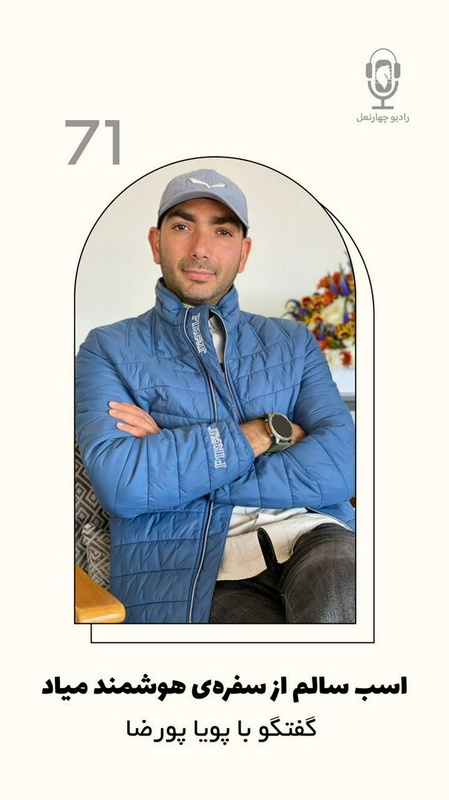
The seventy-first episode of Radio Chaharnal is a conversation with Pouya Pourreza about the very important and practical topic of nutrition in horses.
خلاصه
In the seventy-first episode of Radio ChaharNal, Mohsen Pourheidari talks with Dr. Pouya Pourreza about the importance of proper nutrition for horses. Dr. Pourreza emphasizes the sensitivities of horses' digestive systems and the impact of nutrition on their performance, examining the necessity of addressing the nutritional needs of horses based on age, weight, and life stage. The type and quality of forage, especially alfalfa, and the effect of seasonal changes on the diet are also key points of this discussion. In cold seasons, attention to the quality of water and forage and providing the necessary energy from fiber instead of concentrate to maintain the health of horses is essential. Additionally, the importance of consulting with nutrition specialists and using appropriate supplements for muscle recovery and the skeletal health of horses is emphasized. This interview is an invitation to scientific thinking and a move away from old traditions in horse nutrition.
موضوعات کلیدی
- Horse feed
- Horse breeding
- Horse Nutrition
- digestive system
- Professional equestrianism
- Muscle recovery
- Sports supplements
- Horse care
- Veterinary Physiology
- Water trough
- High-quality hay
- Winter season
- Probiotic
- Horse movement
- Diet writing
- Veterinary consultation
متن کامل گفتگو
In the name of God, I greet all of you good listeners of Radio Chaharnal.
I am Mohsen Pourheidari and I will be with you dear ones again with the seventy-first episode of Radio Chaharnal. This conversation that you are about to hear is about the very important topic of horse nutrition, and my guest is the dear Dr. Pouya Pourreza, who is one of the experienced and knowledgeable individuals in the horse industry, with expertise in both physiology and nutrition. He agreed to be a guest on Radio Chaharnal because the digestive system of horses.
Has a lot of its own specific sensitivities. I tried in this conversation to explain these topics as simply as possible for you with the help of dear Pouya Pourreza. I hope you enjoy listening to these talks, and my request is to share it with your friends to preserve our horses and allow them access to this useful information. As always, my colleagues in the episodes of Radio Chaharnal, dear Farshid Jahangbazi.
The Instagram poster designer and the poster for this episode, dear Negar Goodarzi, and Erfan Moghadam are the composers of the opening and closing themes of Radio Chaharnal. Let's listen to episode 71 on horse nutrition together.
In the name of God, Mr. Pouya Pour, thank you very much for accepting the invitation and giving us the honor to talk about a very important topic on Radio Chaharnal.
For many years, at least personally, I know that we have had many problems in this area, and that topic is nutrition. Many of us are unaware and unfortunately enter this topic and define food for a horse based on our knowledge and experiences, depending on the amount of work it does. If you have anything to say, greetings, please start so we can get into the topics. I also greet you, dear Mohsen, and all friends and horse and equestrian enthusiasts, and indeed this lovable creature. Thank you for taking the time and giving us the honor. Well, I want to ask your permission to call you Pouya because of the friendship we have since the atmosphere here is not very formal.
What do you see as the most important thing for horse nutrition as someone with a PhD in animal and horse nutrition? Dear Mohsen, first let me give a very brief explanation. My field of study is veterinary physiology, but for many years, nearly twenty-some years, I have specialized in nutrition. Now, we have worked in other areas of equestrian and all other parts, but I have always been very interested in nutrition from its foundation and have always had a good feeling about it. Always when.
I approached horses, I wanted first of all to go and feed the horse. I would go towards its trough, go looking for chopping carrots. That's why I personally had a very special interest in nutrition. This interest led me from the beginning to pursue what we should feed this horse. You see, in horse breeding, we have a very important issue, and that is what we should feed the horse we are buying. This is the most important issue. If we believe that the foal that drank colostrum for a number of days impacts its championship podium.
At the age of 12 or 13, then we are much more meticulous about the first milk or its scientific name colostrum, which is actually that volume of initial milk containing immunoglobulins, high fat, and rich proteins, which we will discuss in more detail in later discussions. If we believe that what our foal eats at six months affects its championship podium, we pay much more attention to this issue. What an interesting point this really was.
Many pursue nutrition, but either make it complicated or simply ignore it. This is very important. One point is that considering that, after all, the horse is not a ruminant like cattle and sheep, and unlike dogs and cats, it cannot vomit, and its single stomach, in my opinion, is inherently a problem. Given these conditions, the digestive system is so vulnerable, could you please explain this vulnerability?
Look, Mohsen, after all, all creatures have evolved in a certain way. In this evolutionary cycle, they have evolved and found their place in nature. We are not supposed to interfere. We must accept what is and the environment in which we want to breed and keep them, considering the evolution that has occurred. The point you mentioned is exactly correct, but the main problem is not its vomiting. The main problem is its large digestive system and the type of fermentation and the mechanism and physiology that the large volume means the dimensions of the system.
And in fact, the delicacy in the digestive system compared to ruminants. Ruminants, after passing the oral cavity and esophagus, actually the food bolus comes into a complex four-part sac that we all know as the ruminant or rumen. Well, it lacks that. In fact, the single stomach is very simple like humans. Now its stomach has two main parts: the mucosal part and the enzyme-containing part. That in its place, but it has a sensitive stomach, and for this 500 kg or 600 kg racehorse, it has a very.
This sensitivity causes us to be able to create a series of problems for the horse with the conditions of keeping it from the habit it had, meaning its evolution was such that it grazes for 24 hours, sleeps for 5 hours, naps, and grazes for 16 hours. This is a very important point. We have put this animal in a steppe, in a box, feeding it at a certain time. What do we give it? What is our climate? What does our country have? What does our concentrate company have?
What does our supplement maker have? These are what cause this interference that I mentioned to you to come out with an episode. There is a lot to say, it is very important for the listeners of the radio to pay attention, to be a little more careful because after all, beyond our interest in it, the most important point is that it is valuable to us.
We act a little based on taste, I say for myself because I really understood that I have to refer to its specialist. As someone who is an expert in the field, what normal ration do you suggest for a working horse or a normal sport horse and what do they need? I don't mean to say now, for example, give so much alfalfa. What do they need? Dear Mohsen, I often tell friends, those who ask us questions where we are busy and consider it worthy, I say feeding a horse is not filling the trough. We should not just fill the horse's trough. We need to recognize the animal's needs.
We should know this need based on its age, its work, its weight, and the expectations we have from this animal. Breed mostly goes into the phase of how much the animal should weigh, whether our maintenance conditions are at a certain temperature or not. It's not really like saying one breed needs higher or more nutrition. We base our scoring and rationing on body condition or the animal's weight. Weight is a very important factor. This is one item.
But I want to say that just feeding the animal is not important; rather, what we give and at what stage of the animal's life is very important. Look, we live in Iran, and many of our horses are imported, but we must accept the change in rations and what is available in Iran. The most important of these is forage.
The most important item is forage. Look, what normally exists in clubs is that the first thing a horse owner hears when they go to a club and want to board their horse is that we give 9 kilos of alfalfa. The club might give 10 kilos, but we must be careful that in Iran, we only give alfalfa. We have several types of forage for horses. In Iran, what is commonly or routinely used is alfalfa. In fact, the alfalfa plant is used worldwide and is good for horses. On the other hand, we have agricultural by-products like alfalfa straw, barley straw, and wheat straw, which have slight differences, but the important thing is that they are good with a series of cellulose links that are not very digestible.
Our clubs tell all owners that we give 9 to 10 kilos of alfalfa. Now, this 9 to 10 kilos of alfalfa is good for a horse weighing 450 to 500 kilos, but we must consider that the alfalfa we give in Iran may have 18 to 19 percent protein.
Therefore, if our horse is at a stage in its life where it does not need protein above 14 to 15 percent, like a six-month-old foal or a foal at the peak of growth or in the last three months of pregnancy, we give 18 percent forage. This high protein forage in Iran is good; I don't want to say it's bad. Protein is an expensive substance in the world. For example, meat as a protein source is expensive.
Soybean meal and other meals that are plant protein sources are expensive worldwide. Protein is a valuable substance and has many systems and mechanisms in the body. But we must formulate it, ration it, and balance it. Now we put quality alfalfa in Iran, 9 kilos, 10 kilos, but we must also consider other items. If we give grains, we must consider their protein. If we give muscle-building supplements, with a wide range of amino acids.
The 21 amino acids all increase the physiological load on the liver. What we put in the trough is a big discussion. Some say alfalfa is for cows, not horses. It's not like that. What is common and what I am often asked is that we don't have hay in Iran. The word hay or the hay system that I have seen in Europe is a spectrum of forage plants that includes alfalfa or alfalfa, but depending on the country and climate, it also includes other forages, like timothy, which is a forage plant with a lower protein percentage than alfalfa and good digestible fiber. We don't have it in Iran at all. This is an agricultural expert discussion, and as far as I know, it has no market.
In addition, or next to it, it can have timothy or clover. The nature of the horse's digestive system is such that in nature, the amount of water it receives is through fresh plants and forage. One of the reasons for the colics we have is that we give dry feed with low moisture content, which causes constipation or slow movement of the digestive system. But this manual feeding has this story. I'm not saying that all friends should go and give their horses fresh forage. Everything in the horse world has its own processing and evolution.
We intensify. As someone who has several horses under my coaching, I can say that due to human resource limitations and the structure of our work, which has its own complexities, I may not be able to make it routine. They have lunch and rest time. I want to design a general ration for the number of horses. I can give a feed model for 10 horses.
Or each of them has a specialized ration and must have a specific kilogram amount. I don't like to complicate matters, and on the other hand, it shouldn't be too simple. Certainly, each horse, just as its function is unique to that horse, its maintenance and feeding are also unique. Therefore, horse feeding is exclusive to each horse.
Based on its needs, its life stage, the season it lives in, and even its stress level relative to the environment, caregiver, or group or groom, you know all these must be carefully examined. But I don't want to make it difficult. Look, we have principles, we have principles regarding feeding that we definitely have to follow. In Iran, as I mentioned, regarding the club forage or the forage we have available, my club's condition is 9 kilos. Now some clubs give barley, some give it manually, or they want it themselves. I want to say that the main principles that remain in the forage section, in Iran, we give 9 kilos or 10 kilos of alfalfa. If mixed with straw, well, that's very good. These are the points that have been general, and I serve them. If mixed with a good weight and volume ratio with wheat or barley straw, well, that's very good. We increase the fiber percentage and lower the protein, that's good. With the same 9 kilos or 10 kilos volume, it becomes more specialized in the grains section, and the evening work comes into play. This is where we are getting into details.
Regarding dietary supplements, they are also added, seasoning is also added. If we are only in the forage section, this may not make our situation, as they say, dire. From the work model, the size that impacts carbohydrates like concentrate or grains, the discussion is very broad. I wish I could now give you a good arrangement. Look, regarding the forages that I mentioned, the regular club is 9 kilos or 10 kilos. But this shouldn't always be the case.
For example, it changes in seasons. There is also a very good point that we can now open this discussion that, for example, today we talk about feeding in the winter season. That is, the cold seasons have a few points that many kids and friends may not know and make mistakes. Ask the next question, let's talk about the next question. In any case, the principles and generalities of horse feeding are the same for everyone, but depending on our horse's work, the horse's needs, and our work stage, it is different.
These are all debatable. If we have a pregnant mare, each stage of her pregnancy, each month of her pregnancy is possible. I don't want to make it difficult by saying month 1 to 2, but month 2 is different from month 9. We have a foal, a foal under 6 months has one type of nutrition. When it starts eating solid food, when it begins to eat dry matter, it has another type of nutrition. When it comes up to two or three years old when no work is done, the animal is just learning some basic principles and being maintained, it has another diet. Among the phases of animals, in horses, we must recognize the needs, needs according to the work phase.
To the maintenance phase, to the stage. We can, if you like, if you are interested, if the audience finds it appropriate, we can arrange our talks in such a way that we come to discuss the topic of feeding sport horses, the needs of sport horses before work, after work, even in a part of the supplements we can talk about this. We can only mention a few points in this program.
And we can discuss for those interested in breeding and maintenance, points about breeding foals and pregnant mares and mares that, for example, we can discuss, we can have a program about winter season and feed. Pouya talks about how the feed ration differs in different seasons, especially we have a challenge in the cold season, the issue of colic which is present and we are all dealing with it. Now many say it's due to the cold weather, the system gets stuck. Some say it's due to the horse's dehydration, it drinks less water, its sweating has a problem, or the water available to it may not be as it should be. So if you agree, we can talk a bit about the water issue afterward. Now we are recording the program in winter, we are in autumn but eventually, we will reach winter. We have a cold night, yes, it's a cold night for now. For the cold season, if we have a seasonal change, what should this model be? In summer, in the first six months, I think it would be a better definition. Yes, in the first and second six months, what is this change?
Look, you mentioned a very good and fundamental point. Look, a horse needs a constant volume of water daily. This need exists but behavior changes in winter. That is, the horse's tendency to drink water decreases in winter. The reason is that usually, we have a very cold water source, that is, we have a very cold water source available. Our horses in every season, now I say even winter, some winters consume less. Whereas in winter, many times the horse does not sweat. We work with our horses considering the volume of competitions we have.
That is, it still needs 30 to 40 liters per day. It's true that it didn't see the summer heat, but that dehydration behavior change due to the horse's reduced tendency to drink water causes its body to become dehydrated and consequently prone to colic. As a result, the amount of fiber it has in its forage and feed, it eats more in winter. Consequently, it is more prone to accumulation. That's why the water point is very important. We always need to have quality water at a lukewarm temperature, lukewarm temperature means in winter 7 to 15 degrees, this becomes lukewarm temperature.
Room temperature becomes 25 degrees. If we can have a lukewarm temperature of, for example, 15 degrees, how should it be discussed is very broad. Usually, if our pipes are insulated, freezing is reduced. If the bucket is insulated, it can, but anyway, in the mornings cold water is available, again at noon it may get warm from the sun, we may have to manually give water on very cold winter days, give a bucket of water.
Now in Europe, I have seen some tanks, in northern European countries, Scandinavia, that they warm the water, each has a heater, for example, they do these things. Anyway, drinking means receiving a volume of 30 to 40 liters of water minimum per day is needed for both winter and summer. This is exactly the first item. May I ask a question in the middle, excuse me. I remember if the water bucket is well monitored, that is, we make sure our worker gives the bucket on time.
Certainly, 100 you know how much water was drunk or not. Monitoring it is a very important item. But the water bucket in terms of not requiring human labor, the accuracy of work in terms of availability is more. Well, certainly. But we ourselves at the club where we are doing the work ourselves now, the first thing I say is that we are standing here telling the kids, I always tell the worker we are standing here for them to drink water. We have no other task. Don't even hit the horse today, even the wetness under the horse, now I don't mean that, but I say you just go check its water bucket today, its spring is not broken, its latch is not broken, if its float is broken...
The water issue is a very important topic that many forget. I want to tell you, the next item if we want to go one by one, is alfalfa. Look at the forage, we usually don't have access to good quality forage in winter. We usually have stored alfalfa which needs to be checked a lot. The person who is the supervisor and manager of the facility and responsible for the feed worker should pay attention to this. I always tell people to choose the smartest worker. They may not get a tip, but pay them a higher salary. This may upset managers, but really the smartest person should be chosen because we are here for our horse to eat and drink. This is a very important point. We must check our alfalfa in winter because stored alfalfa may have mold in the middle and toxins may rise. Mycotoxin and aflatoxin are actually toxins that may rise and lower the quality of the alfalfa. Alfalfa loses some of the vitamins D and K that are present in the sun.
That's why we must check our alfalfa. See if this type of cut, for example, the second cut with the seventh cut, does it have an effect? Yes, it has a great effect. Then what about the land? For example, you may buy for the club on land in Hamedan and then not find it there. Then buy land in Saveh which is less because the plant takes its needs from the soil. If it doesn't take it, it doesn't grow, and if it grows, it doesn't need it, it turns yellow and doesn't flower. Usually, it has an average, that is, the plant's physiology brings it to that quality. Now maybe the percentage of protein that accumulates in its stem or in its leaf may be less or more, but it has its fiber. But the pesticide area they use is very important. We have had poisonings where the club owner or trainer has gone to check and reached nowhere except for the pesticides that the farmer may have used. That too was actually the processing process and its cultivation process, but...
I mean, do I want to say that everyone should use this? No, it doesn't. Unfortunately, in Iran, spraying is not supervised by organizations. That is, the farmer himself can go to the veterinary pharmacy, buy his pesticide, and use it to protect his product. Yes, many of these are with selenium compounds. Then we have, it has many things. Anyway, the discussion is very broad. Well, let's go back to the feed. Yes, the second item was alfalfa, which is a very important item. The energy level of the diet should...
In winter, it's like playing with a lion's tail. Our horses work less in winter, usually with less activity. Even I, when I ride, go less in winter. I reduce 50 minutes to 35 minutes, it's cold, less activity. We increased the energy. Well, how should we provide this energy? Everyone calls me and says, "Sir, should I increase the concentrate, increase the mass, increase the grain section?" The mistake with the lion's tail is there.
The biggest mistake with horses is that many don't know. I might really say I don't know. A lot of people don't know that the energy of the diet in winter should not be from concentrate, it should only be from fiber. The reason is that you see, this fiber, to be eliminated, passes through the stomach and enters the cecum. This cecum is the place where the fermentation operation that was done in the cow's rumen and others...
What does it do there? There, the beneficial bacteria that are present, the natural microflora that is there, come and ferment and process this indigestible fiber. The fermentation that takes place warms the horse like a heater. That is, the warmth we want in winter should be compensated with fiber, not with concentrate starch and not with a high glucose level that raises blood sugar. We should use fiber. When this fiber is fermented, bacteria work and release heat and free fatty acids.
The indigestible energy source for the horse enters the bloodstream and refreshes the horse. This is the most important point. I mean, I say all the talks on one side, this point on the other. Because unfortunately, horse owners make mistakes and increase the barley. The horse's work has decreased, the digestive system becomes hyper, and it becomes refreshed from winter. Now suppose the energy level, for example, if the energy level is high...
How much can taking the horse out affect? It increases the movements of the digestive system and increases blood supply to the tissue. For this reason, activity is very important. For this reason, dear friends, we should definitely not decrease the fiber of the diet, but increase it. I'm not saying if your horse has alfalfa, you can even use straw, chaff, wheat bran, and more digestible fiber sources. But to increase grains and starch is playing with the tail...
Yes, this was a very important point that I wanted to tell you. See, other problems we can have in winter, well, is sunlight. In winter, we have less light due to the position of the earth. We should check the vitamin D level. For example, we can use more supplements that have vitamin D. Something that is not evaluated in blood biochemical factors, but it is an important point. For example, it's a good point that we come to pay attention to vitamin D and higher calcium supplements on growing foals and not let the calcium level drop.
And use supplements that are a good source of calcium and have good vitamin D. The impact of energy level on bone structure, which we compensate for and maintain the horse's activity. These are points that really must be practical in winter. In addition to stable ventilation, which should be warm and dry, but proper ventilation means many stables put heaters and warm them. Putting a heater is not a problem in the window.
The problem we see in many places, trainers who are really number one in Iran, but they close the window. It brings more respiratory problems. See, the horse is a very resistant animal. In the cold, you look at northern European countries, they just put a camel and a roof. The horse with long hair, even snow on it, is sitting in a corner with a roof. Otherwise, due to its body nature and body cover, it is resistant to cold. Now we come and clip and have to arrange, that's another discussion.
But let's not forget ventilation. We want the air to be cold, warm, and dry, but the ventilation should be proper. Now putting a heater is not important if it makes the ideal temperature, but dynamic ventilation is one of the topics that has been emphasized a lot in recent years and we are looking at it. The kids talk about it and pay attention to it. Probiotics as a supplement, yes, and as someone...
Whose specialty is in nutrition. How should this probiotic be given at all? Is it needed or not? On what basis and with what, as they say, size and scale should it be given to the horse? We have the principle of probiotics. The mother transfers the probiotic to the foal. The probiotic is actually the same manure that the suckling foal goes under its mother and licks and cools. The beneficial bacteria and the mother's natural flora are transferred and come to the same part we talked about, to that part of the cecum, that part of...
The digestive system comes there and finds its environment. In fact, the word probiotic refers to beneficial bacteria. Of course, the discussion is a bit long. We have both probiotics and prebiotics, which are distinct and different. The probiotic is transferred by the mother and the bacteria find their place according to the pH of the digestive system, grow and multiply, and stay there until something special happens in the body. Unless we come and give concentrate to our horse to the brim.
We make the digestive system prone to acidity due to high starch and volume, which causes bacteria to die at a pH lower than 7. At that time, we are forced to give probiotics to our horse manually. The horse becomes prone to gas accumulation and we have created a digestive disorder, meaning an anomaly and a so-called digestive disturbance. We can compensate for the disorder with probiotics. It's not complicated. A range of beneficial bacteria, even yeasts like Saccharomyces. Of course, these are packaged by manufacturing companies with storage and processing conditions and we can give them to the horse. So if a horse has improper nutrition or is under a lot of stress and for any reason has a disorder and has become colicky, it's good that the protocol...
Overall, its benefit is greater even if it is economical and included in the diet. The limitation for humans is the same. We use yogurt, which is a type of probiotic product. Regarding probiotics, it is a suitable environment usually composed of saccharides and sugars, creating an environment where bacteria are preserved. Some companies mention pro and prebiotics. In recent years, many have worked in the field of nutrition and physiology, but we...
I have never seen a club that says we have brought a nutritionist to provide a general diet for our horses or check our feed. Personally, in my experience and age, I have not seen it as part of the club's routine. As someone who is an expert in this field, is it necessary for the club to do this or not? Or should the horse owner bring a nutritionist? If you are explaining in detail, please do.
Well, Mohsen, this is probably an interesting discussion, and I also sometimes think about whether we should say yes or no to this topic. Many of our classmates and friends, it is a new and at the same time old field, but it is a lovely field. Nutrition is something many pursue, and it is practical anyway. First, they ask us what to feed the horse. But well, the art of nutrition is largely a game between science and experience.
If we say let's just learn nutrition from those who have studied it, I think many of our trainers understand and feel the impact of whether too much barley is consumed or not. I don't want to distinguish this from that, but to say that it should only be practiced. When you don't know the anatomy of the system, when you don't know what's in this hay, in this concentrate, in these grains, in this barley and corn, what percentages of analysis exist, you certainly can't work. A mistake that many herbalists, trainers, riders, and our friends have. I also want to say.
It is a science that is a combination of art, science, and experience. In my opinion, consultation is needed in some cases and issues. I think someone with knowledge of nutrition should be involved. We always have metabolic diseases, metabolic disorders that are indirectly connected to nutrition. In the locomotor system, but it affects the famous nerve. It is very well-known, there are many things.
Are many things meant to be helpful, or does nutrition even affect the immune system in infectious diseases? I don't want to say that friends who have studied need to gain more experience and those who haven't studied should enhance their practical experience and knowledge or seek consultation. It wasn't intended for someone to pick up a nutrition book and flip through it and read. We are not supposed to be all-knowing. That's right, but well, the person managing the facility, in my opinion, because as a coach or club manager, should have knowledge of nutrition...
That is, a manager or even a coach or a supervisor should know the difference between good and bad hay. I can't say call every day and have a nutritionist come and check. That's their job. Well, now you run the club, you've been part of the sports body for years. There is a need for someone to come once a month, a nutritionist, to tour and hold a seminar and monitor whether our feed is good or not. Do we need a change at all? For example, we want straw in winter.
This itself has created some disagreements that happen to us due to ignorance. A person who is an expert and both runs the club and has expertise in this work, there is a need for the club to bring someone as a nutritionist, for example, once a month or every two weeks, and say, sir, come here and see what we should do. I think we should categorize. Yes, it does, but it is categorized in this way. In my opinion, the person managing the facility...
Must consult with a veterinarian who has worked in nutrition and knows nutrition and has felt it, and be in contact and consult with a nutritionist for their forage and for balancing their overall diet. And on the other hand, the owner must definitely, in my opinion, adjust their supplements and concentrates and correct their diet. Look, Mohsen, consulting has no harm. If we can be in contact with someone who is either a nutrition variable that now routinely...
Or consult for advice, there is no problem. But well, we should not have a guard against this issue. Many trainers and coaches do. Now, I really don't want to say it's bold. Many of the kids who have studied don't feel well. The other side of the issue is always two-sided. For many trainers, it is good. Owners should consult. Sometimes, a question is asked of me in the drug supplement consultation store. Store Ashkan, my presence, a question is asked of me that I am surprised how this horse is still alive.
That is, they ask me questions like we gave this to the horse, is it good or bad? A series of protein sources that I don't want to name, it's laughable. I say is this good or bad? I am surprised what answer to give that this person knows what a horse should eat? A horse is a herbivore. It is not supposed to eat meat in April. It is not supposed to drink head and foot soup at all. They say I got an answer. What is the answer that I got? Look, maybe part of this fat will be removed. A part of it...
But there are some issues that science has not fully addressed yet. Some people raise questions that show they are at a lower level than expected. We must accept this and make them aware. I felt the need to talk about this topic. Now, please follow up, they suggest to me.
I have come to the conclusion that at this age and in working with horses, it is no longer like 30 years ago when you had to do veterinary, farriery, ration writing, and feed purchasing all at once. Now we need to outsource a bit and get out of that stadium hegemony. I myself admit that I don't know anything about nutrition.
You have good experience in club management. There is no ignorance, maybe we say it hasn't become complete. I don't want to say it's incomplete. We must set aside traditions and accept what science says and not be deceived by advertisements. If an advertising company says give this supplement, no.
Regarding physiology, I learned from you that, for example, on race day, we give horses between periods of dough. We don't know what the parameter is and it may have the opposite result. We must see what stage it needs. Maybe low blood pressure is created with sodium and potassium.
We need to provide these mineral electrolytes. BCAA might cause muscle cramps, and we want to recover our muscles. When our competition is a week long, we have time to recover. The pain caused by lactate has its own specific formula. The most important item is to know our horse. When we go to the store and they say this supplement is good, it might not be ideal for you, and your money might be wasted.
We must act wisely. In nutrition, like in equestrian and all other tasks, we need to act more specialized. I hope friends who hear and see this program leave their comments.
I can't keep all directions, and maybe someone has a challenge somewhere and wants to ask you. Maybe this itself becomes the start of another program. This topic is interesting and informative for me, and I don't want to wrap up quickly, but we must also pay attention to the episode's time.
For the episode where we are supposed to talk about nutrition in general, I think it's enough. If there's a point that needs to be added, say it as a closing remark. There are many points, especially practical ones. We can answer friends' questions in other episodes and go into more details.
We can do this. In sports discussions, pre- and post-competition nutrition, mare and foal care and breeding, we can do this. I ask friends to act wisely and make decisions. This is a very important item. Thank you very much.
Because I enjoy your episodes myself. The discussion of stable care and coaching is truly enjoyable. There is a gap in our equestrianism. In the discussion of fundamental training, I may not have enough knowledge and seek help from experts. Please don't take advantage of my friendship, and let's talk about this topic. We are dynamic in the equestrian industry, and we may not be recognized as an industry, but horses are in our Iranian blood.
Our population is large, but we are scattered. Those of us who live in Tehran and are involved in the more professional part of this sport are unaware of this issue. The Iranian horse community is very vast, and wherever you have traveled, you have seen that people keep horses and view them as a member of their family. Thank God that the internet and information resources are available.
The audience is kind and supports me. We must present the topics correctly and scientifically so that people become more enthusiastic, suffer less harm, and increase their knowledge. Ultimately, we feel progress in our sport. This cycle of progress might return in five years, but it is very valuable.
Thank you for your kindness and for considering me worthy. It is a great honor to serve you. I hope you have taken good points from listening to this episode and, as always, take care of your horses.