Donerhal | Donnerhall
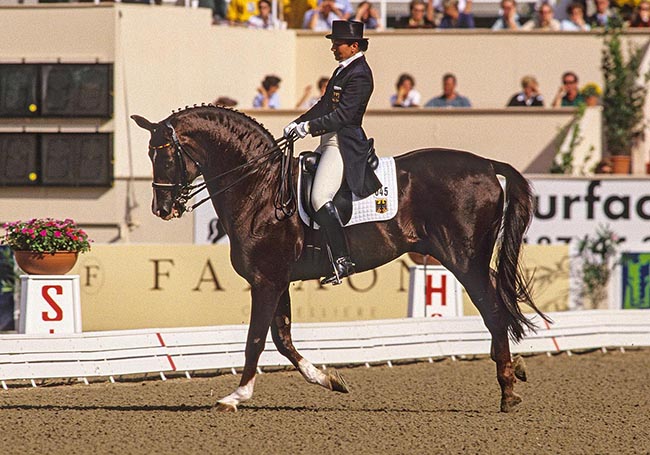
In the misty silence of the Holstein region, in the spring of 1981, a brown colt was born who was destined to transform the face of dressage forever.…
Donnerhall was born on 30 or 31 May 1981 at Otto Gärtner’s breeding farm in the Holstein region of Germany; a chestnut colt of the Oldenburg breed, out of the Hanoverian stallion Donnerwetter (from the Disput line) and the Oldenburg mare Ninette, herself a daughter of the Thoroughbred stallion Markus from the Manolete line. He was bought by Otto Schulte-Frohlinde and taken to Gestüt Grönwohldhof, one of the first and most renowned private Oldenburg horse-breeding centers.
Donnerhall was trained up to Grand Prix level under Herbert Rehbein, and then the reins were handed to Herbert’s wife and student, Karin Rehbein; she remained with him until the end of his competition career. Karin later referred to him as “the horse of my life... the true companion that does not come to a person twice.” Donnerhall also excelled as a young horse: he was runner-up in the stallion performance test in Adelheidsdorf in 1984 and became champion of the DLG stallion show in Hanover in 1986. The remarkable thing was that he achieved this while still serving as a breeding stallion at the main stud; within just two years he mastered Grand Prix movements completely, an extremely rare feat for breeding stallions.
The peak of Donnerhall’s sporting career came in the 1990s. In 1994 he became German national champion in Mannheim, and in the same year, at the FEI World Equestrian Games in The Hague, Netherlands, together with Karin Rehbein he won team gold and individual bronze. Three years later, at the European Dressage Championship in Verden, he once again won team gold and individual bronze, and in that same year and the year after, namely 1997 and 1998, he claimed the overall championship of the FEI Dressage World Cup European League.
In 1998, at the age of 17, Donnerhall won team gold for the third time at the World Equestrian Games in Rome and finished fourth in the individual standings; a brilliant final point to his competition career. After Rome, Karin Rehbein retired him at the peak of his form; a retirement accompanied by a farewell tour at German stallion shows, where Donnerhall performed one-tempis, piaffe, and passage. Throughout his sporting career he won more than 65 FEI Grand Prix titles and earned nearly 640,000 German marks in prize money; that same year he was also awarded the title of Oldenburg Stallion of the Year.
But Donnerhall’s true legacy should be sought in the generations that came after him. Kept at Gestüt Grönwohldhof and approved in the studbooks of Oldenburg, Hanoverian, Westphalian, Holstein, Bavarian, Hessen, KWPN, and Danish Warmblood, he achieved the highest recorded dressage breeding value in the history of German sport horse breeding (271). More than 77 licensed and approved stallions, more than 450 registered mares (84 of them with State Premium titles), and far more than 600 competition horses were left from his line.
Donnerhall’s offspring and descendants reshaped the face of top-level dressage worldwide. The stallions and bloodlines such as De Niro, Don Frederico, Don Schufro, Don Primero, Donatello, Damon Hill, and the Sir Donnerhall line themselves became championship-producing horses and prolific sires, and modern stars such as Fürstenball trace their bloodlines back to him several times over. In the late 1990s, foals sired by Donnerhall were being sold at auctions for record-breaking prices.
Donnerhall died on 14 January 2002 from acute intestinal poisoning, but his “D line” remains the backbone of competitive dressage horse breeding worldwide. His memory has been kept alive with a bronze statue of a rider on Lange Straße in the German city of Oldenburg.
افتخارات
- 1984 — آزمون عملکرد نریانها در Adelheidsdorf: نایبقهرمان کلاس آزمون عملکرد نریانها
- 1986 — قهرمانی نریانهای DLG آلمان، هانوفر: نریان قهرمان
- 1994 — قهرمانی درساژ آلمان، Mannheim: قهرمان ملی
- 1994 — بازیهای جهانی سوارکاری FEI، The Hague (هلند): مدال طلای تیمی و مدال برنز انفرادی همراه Karin Rehbein
- 1997 — قهرمانی درساژ اروپا، Verden: مدال طلای تیمی و مدال برنز انفرادی
- 1997 — جام جهانی درساژ FEI، لیگ اروپا: قهرمان ردهبندی لیگ
- 1998 — جام جهانی درساژ FEI، لیگ اروپا: قهرمان ردهبندی لیگ (برای دومین سال متوالی)
- 1998 — بازیهای جهانی سوارکاری FEI، رم: مدال طلای تیمی و مقام چهارم انفرادی، در سن ۱۷ سالگی و در آخرین حضور قهرمانیاش
- 1998 — پایان دوران مسابقهای / نریان سال اولدنبورگ: برگزیده بهعنوان نریان سال اولدنبورگ؛ بازنشستگی از میدان مسابقه پس از توری خداحافظی، با بیش از ۶۵ عنوان قهرمانی در سطح گرندپری FEI و درآمدی نزدیک به ۶۴۰ هزار مارک آلمان در طول دوران ورزشی