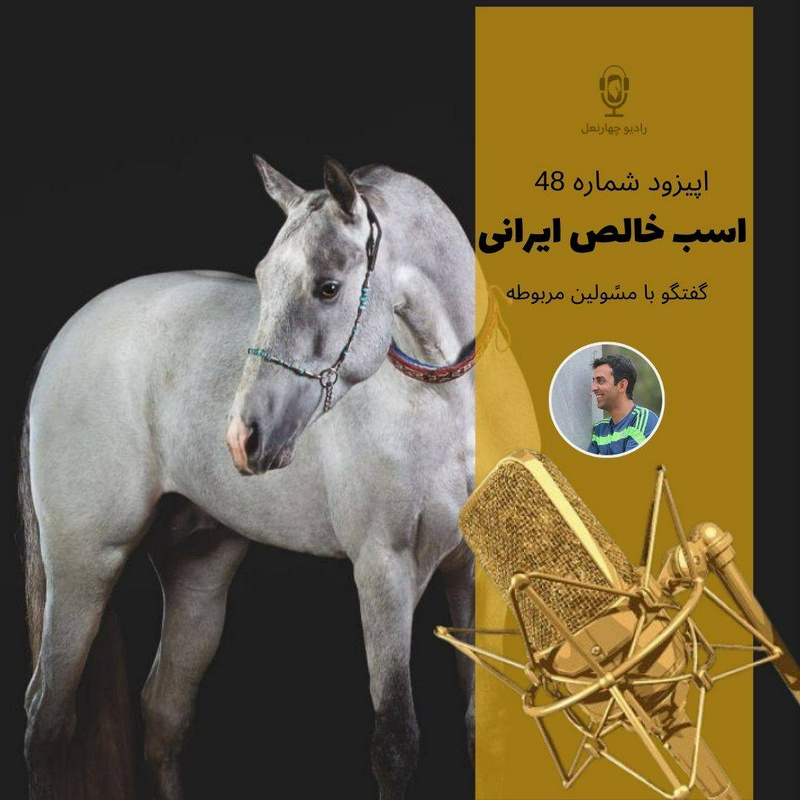
Pure Iranian horse; challenges and future of Iranian breeds
خلاصه
In the forty-ninth episode of Radio Chaharnal, the challenges and future of pure Iranian breeds, especially the ترکمن horse, are examined. The guests of this program include the president of the equestrian federation and experts in the field of horseback riding who emphasize the importance of training and educating ترکمن horses and the need for educational programs for riders. Despite the inclination to use foreign horses, there is an emphasis on focusing on the breeding and production of Iranian horses and holding related competitions to promote these breeds. Additionally, genetic counseling and collaboration among institutions are considered essential for improving the quality of breeds and addressing genetic issues. The interviewee points to the high potential of the horseback riding industry in creating jobs and economic prosperity and the necessity of holding festivals and horse auctions to attract the general public. Ultimately, the development of infrastructure and facilities for riders and breeders is raised as a necessity.
نکات کلیدی
- مسابقات اسب خالص ایرانی در باشگاه سیاهپوش به دلیل شرایط جوی برگزار میشود.
- وضعیت توجه به اسبهای ایرانی در حال بهبود است.
- کمیته اسب خالص ایرانی به دنبال حمایت از تمامی نژادهای ایرانی است.
- حمایت از اسب ایرانی ضروری است.
- عشق به اسب ترکمن باعث تداوم فعالیتها شده است.
سرفصلها
- چالشهای اسبهای خالص ایرانی — بررسی مشکلات و چالشهای پیش روی اسبهای خالص ایرانی در سالهای اخیر.
- نقش کمیته اسب خالص ایرانی — توضیح اهداف و فعالیتهای کمیته در حمایت از نژادهای مختلف اسب ایرانی.
- اهمیت حمایت از اسبهای ایرانی — بحث درباره ضرورت حمایت و ترویج نژادهای اسب ایرانی برای جلوگیری از دلسردی.
- جذب سوارکاران با استعداد — روشهای دعوت و همکاری با سوارکاران با استعداد برای استفاده از اسبهای ترکمن.
پرسشهای متداول
چرا مسابقه اسب خالص ایرانی در باشگاه سیاهپوش برگزار میشود؟
به خاطر شرایط جوی و موقعیت خاص این باشگاه، مسابقات در باشگاه سیاهپوش برگزار میشود.
چرا اسبهای ایرانی در سالهای اخیر کمتر بها داده شدهاند؟
اسبهای ایرانی در سالهای گذشته کمتر مورد توجه قرار گرفتهاند ولی وضعیت در حال بهبود است.
هدف کمیته اسب خالص ایرانی چیست؟
هدف کمیته حمایت از تمامی نژادهای ایرانی از جمله اسبهای عرب، کرد و کاسپین است.
چرا باید از اسب ایرانی حمایت کنیم؟
حمایت از اسب ایرانی باعث تقویت و ترویج این نژاد و جلوگیری از دلسردی دیگران میشود.
چگونه میتوان سوارکاران با استعداد را دعوت کرد؟
با دعوت سوارکاران به کار با اسبهای ترکمن و فراهم کردن کرهها برای آنها میتوان این کار را انجام داد.
متن کامل گفتگو
Hello. Before starting this episode, I would like to extend a special thanks to Ms. Negar Goudarzi and also dear Erfan Moghaddam for their very valuable gift to Radio Chahar Naal. What is this gift? The opening and closing music of Radio Chahar Naal episodes is a gift from these two great individuals to Radio Chahar Naal, and I am infinitely grateful to them and wish both of them health and a long life with dignity.
I am grateful to God for the existence of such people who have so much kindness and affection for me and Radio Chahar Naal. God willing, wherever they are, may they be healthy and successful.
The forty-ninth episode of Radio Chahar Naal is about the pure Iranian horse. In this conversation, my guests are Mr. Mohammad Kazemian, the president of the Equestrian Federation, dear Erfan Asiyayi, the head of the Pure Iranian Horse Committee of the Equestrian Federation and also the Equestrian Board of Tehran Province, and finally Ms. Saba Siahpoosh, the manager of the Siahpoosh Equestrian Complex. The discussions you are about to hear are about the challenges and issues that pure Iranian breeds face, as well as discussions about the future of pure Iranian breeds. I hope you enjoy listening to this episode and help us create better programs with your feedback. Also, I thank all those who supported Radio Chahar Naal during this time and did not allow me to mention their names, and if you are interested in Radio Chahar Naal continuing more powerfully, you can support Radio Chahar Naal from the link in the description of this episode. I invite you to listen to the forty-ninth episode of Radio Chahar Naal.
Listen to my conversation with my guests about the pure Iranian horse.
The sponsor of this episode is also Asian Rice. Asian Rice, relying on extraordinary knowledge and skills in collecting the best rice from the good rice fields of Iran, is ready to serve all of you dear compatriots, especially the equestrian community, and as you know, Asian Rice has always been a supporter of many equestrian competitions, especially pure Iranian horse competitions and will certainly continue to be.
I will put the address of their Instagram page and website in the description of this episode, and with a simple search, you can easily receive the products you have in mind at your doorstep without the slightest worry. In this part, I invited dear Erfan Asiyayi, who also heads the Pure Iranian Horse Committee, to have the honor of being a guest on the program because I personally am very interested in this horse breed and its identity, and it has been an attractive topic for me. Well, Erfan, thank you for giving this honor and accepting to talk with us again on Radio Chahar Naal. Before anything else, I thank you very much for the efforts that I know you are working very hard to fulfill the duty and responsibility entrusted to you in the best possible way. I know how much you follow up on the coordination, how much you spend. How did it come to be that this competition is held at the Siahpoosh club in this season of the year? Greetings to you, dear Mr. Mohsen and the good audience of Radio Chahar Naal.
Well, from the day we started the Iranian Horse Committee of the Equestrian Federation, we presented a calendar. When were you appointed? It’s been a month. Yes, we presented a calendar a month ago. In our calendar, after the Pure Horse and Zaycheh Championship of Iran, which was held at the Iran-centric club, we immediately placed the Siahpoosh competition in the calendar. Why did we choose this season? Because we felt that from now on it would be difficult due to the cold and rain. We tried to hold this competition here before the rain and cold hit, and in general, the Siahpoosh club has another position in my opinion because here, in my opinion, is at least the cradle of the Turkmen horse in Tehran Province. So many good productions are always seen in competitions, they win prizes, they always have new productions, and also their young to adult riders participate in competitions with Turkmen horses, and also there are many Zesheh horses here, and well, the previous competition was in the west, naturally, it should be in the east and after this, God willing, with the help of friends.
We will take the competitions to the counties, we have requests from different provinces that, God willing, it will be rotational. I wonder why you, meaning in general, the Turkmen horse is so oppressed that for a competition that is its natural right, the conditions are difficult? Anyway, the Siahpoosh club has a very good location, a very suitable space. Well, anyway, the competition reaches them practically, but since you cannot hold the competition inside the hall in ultimate peace, you are not worried about rain, whether the weather is cold for the spectators to come, why don’t you do this inside the hall? Yes, it is part of the routine competition schedule.
Our previous competition was indoors. Look, anyway, we have to accept that Iranian horses have been given less importance in recent years. They have always been somewhat undervalued. At least in the last 5 years, 4-5 years that I have witnessed, it is getting much better. I shouldn’t have said this in front of you, but well, you are one of those who are really pushing and trying to protect this national investment, but well, you yourself certainly know better than me from your research in many cities.
In Iran, people are keeping Turkmen horses with difficulty, and well, if there is no competition or a market is not defined for them, practically those horses will remain oppressed and overlooked just like what we have witnessed at least in the past 20 years. Look, our focus is not only on the Turkmen horse anymore. We are saying what is the definition of Iranian horses from the perspectives that are approved as pure Iranian in the technical deputy. Now they can be Arab, they can be Kurdish.
They can even be Caspian under a broader term, we want to include all of these, God willing, with the help of other committees and colleagues, and of course, let me open a parenthesis here that you are kind to me. I am not alone. The committee members, the heads of the board, the federation's presidency really support this, it’s not just a slogan. There hasn’t been a flag raised that we request Iranian horses and there is opposition. Both the boards.
And the federation, but well, I think the need is for clubs and sponsors and organizers to give more importance because I myself in these years have not had a situation where I go to request an Iranian competition and there is opposition, they say no, maybe it wasn’t a priority and it wasn’t, but really whenever we tried, we were able to do it. My request is from the organizers and club owners to give more importance to this issue. In the past competition, Sadra was well organized for Iranian horses.
I thank the world for them and also ask that it continues, and it is being done more or less, but well, it is not enough. Is it true that I see no educational program for practically training children who deal with Turkmen horses? I mean, for example, what do I know, a clinical chair somewhere that sir, there is a specialized clinic in Turkmen, now what work, what training discussion, what nutrition discussion, because after all, it has its own special breed and its own special conditions. Our committee program includes the discussion of education.
And we thought about it and collaborated. Now we want to focus more on the education of productions because many horses, especially Turkmen ones that are produced, mostly in the provinces, have not gone the right way, and it has resulted in having a horse today that, for example, has matured and is five or four years old and does not have any special ability and does not have good anatomy. We want to do educational work more in the field of productions and then get to the discussion of training and riding issues.
Now at the Siahpoosh club, one of the clubs where you really see the horses and enjoy them, really also ethically. Yesterday when I was here, we went to the stable and saw a very wise and well-mannered Turkmen horse that perhaps anyone would think is ill-tempered. Most of their horses are like this, and this shows that the productions are thought out and planned, and today their productions really lead the way. Now, it shouldn't be a slogan, but they are among those who have really worked hard in recent years.
One point that I think is very important is that now practically wherever the name of the Iranian horse comes up, Asian Erfan is behind the matter. In the last four or five years, at least I have personally seen this. My criticism is why in these few years you have not tried to make these competitions and events more visible, meaning it should not be just a few photos and programs and such talks. After all, they should understand why Mr. Siahpoosh should not be known as the main flag bearer of Turkmen at least in Tehran province. Why is this not seen and why is it neglected?
Anyway, I am now better than the professors to give an opinion. My personal opinion is that in these years, equestrianism has moved towards foreign horses. Now, whether it is easier or of better quality, I don't know. Anyway, it has moved towards foreign horses. What we have done in recent years is that from the day the Tehran board kindly allowed me to have the Iranian committee until today that...
I am also serving the federation, we tried to bring the horses back to the Turkmen manege, meaning they were not like this to be and be strangers. They were not at all. The first competition I mean there was a gap in these years, the first competition we held at the Bam Horse Club, almost 4 or 5 years ago, we had 6 horses. We advertised their championship a lot and they became 11 kids, 11 of which maybe half would be disqualified. How many were there today? Today 40, 40, 40 in the new cup which now also has a lot of problems...
They had a long way to go. How much was the first prize that the sponsors of the Siahpoosh club kindly provided, both the Siahpoosh collection and their sponsors. The first place was 20 million Tomans and it went down in order. We even put the prize for our pure horse higher than the prize for the other categories. Well, these themselves have a supportive aspect, after all, they are encouraging and influential. We saw a bit of the form of our competitions that the pure horse race was usually a garage.
It caused less experienced riders to go very fast and usually get disqualified and make a lot of mistakes. We decided to do this with the advice of the professors so that they have the opportunity to make up for some things in round 2 and there is no need to put a lot of pressure like in the round and barrage. We set the height of the cup at 110, their championship at 115, and I myself think continuity can help a lot.
The calendar we gave to the federation planned one competition per month. Well, until now that we have operated it, it was a championship, but our first calendar competition was here, which we were on its date, thank God the federation supported it and it was done on its date and day. An event that has happened in these few years, unfortunately, and I don't know, a bad market for especially my base in the national youth championship competitions. A kid who barely...
Becomes forty kilos and his leg has turned down is riding, but today I was looking at how much technique they have, how much easier they are, less feed, a lot of resistance. Plan that we are not supposed to all ride foreign horses. When we produced something like this, it confirms your words. Right now in my mind, there are two or three riders who are now winning prizes in their own championship categories, especially youth with Turkmen horses.
Like Ilya Ezzati, like Ms. if I'm not mistaken, Mania Danekar. If I'm not mistaken, she also became the champion of Alborz Turkmen, and I think Sadra became the past prize. Among all those horses, as you say, Holstein. For better communication, even someone who was watching how much for the categories, in my opinion, up to 120 at least youth, how suitable it was, meaning that young rider can ride.
Until sometimes you have definitely seen a small-bodied rider riding a big horse and really doesn't know what he is doing many times. That lady or gentleman is riding, it has less wear and tear, its costs are less, its maintenance is easier, its training is easier. I want to get a promise from you here because I really saw the potential of the horse especially in the Siahpoosh club these productions. Now the kids who jumped here, whether now the kids who came from another club, it is really a shame these have a...
Roadmap to be able to. Sir, I think if you proceed like this, you can hold 25 C next year if your kids stay in training and I practically put this on your shoulders that you have to go towards having a course class even from a foreign teacher for training these horses so that our result and height come higher. Certainly, and see, we are now trying to have at least one pure Iranian horse event a month. Now both the federation and the boards, the boards are also doing it, the Tehran board.
It is doing very well, active in Iranian horses. Now not just jumping. We now have a three-day or now beauty festival that we have integrated a bit with jumping to say that a horse that is beautiful is just its beauty, well, okay, it's nice, but it should also have a sports property. We came last May, you were present. We combined beauty and jumping. We try to have an effective event every month, at least as much as possible, at least we try to have an event every month.
But I have a request, as I said before, and I said it in your media as well, please support the producers, the owners, those who are involved with Iranian horses. Really, for their own sake, let's come and participate, support, and be present. I often see that they have purebred directly and don't bring it, and for example, when I ask why they don't bring it, they say, "Well, what for?" Well, you know, this very thing causes discouragement among others. We truly believe in the Iranian horse and we all must support it, meaning I, who have a horse, should bring it to the field.
I can hold my own student with a Turkmen horse, in any way possible, the head of the board, who has really supported very well, especially the Tehran board, all Iranians should come forward, I truly wish them health and may God grant them a long life with dignity, for which I am grateful. In any case, you are the standard-bearer of the Turkmen era, and you spend money, you invest time, you work hard, you put up banners, you go, you come.
Let's stay energetic, strong, and hardworking. Thank you for taking the time again and giving the honor of being my guest on the radio a few times. Then I wish you health. Thank you very much, dear Mr. Mohsen, who has always supported us, attended all the Iranian talks and reflected them. I have a thank you for the management of the Siahpoosh club, who really went all out today, from the federation officials who truly supported, and the members of the Iranian Horse Committee of the federation. Yes, Mr. Mehdi Bakhtiari, Mr. Misagh Si Mansouri, Mr. Ilya Mohammadi.
Mr. Hossein Vafaei and Ms. Sahel Seifi. See, those who work in these committees, especially the Iranian Horse Committee, have nothing but interest, love, and service. It is truly so, and they sincerely do so today.
All of them work hard in any way for these horses and this committee, and I am truly grateful to them.
Well, in this section, I requested from Ms. Saba Siahpoosh, the daughter of the honorable Mr. Siahpoosh. Now, because her father, Mashallah, has been very busy, very engaged in interviews, the management of the collection is with you. Thank you, ma'am, for giving the honor and providing this time. Before anything, I really thank you for organizing this very beautiful, neat, and tidy event, and I also thank you for maintaining your family mission over these years and staying away from the foreign horse market.
You have invested time in pure Iranian horses, especially Turkmen, and remained steadfast. Truly, well done. Thank you for giving the honor and providing this time to me. Well, Ms. Siahpoosh, why didn't you abandon the Turkmen era? Here, my father greets all the viewers and listeners of the radio and Mr. truly yes. My father has always been in love with the Turkmen horse, from its body anatomy, its color, from.
Their characteristics and these, and he had one of the best Turkmen stallions, which was Amigo, and now most of the Turkmen horses that are winning prizes in races and jumping competitions are from the grandchildren and daughters and sons of Amigo, who passed away a few years ago and was buried in the large field of the club, which became Amigo's field in the club. Well done, bravo. Then my father, from the beginning, because he loved the Turkmen horse, then he loved breeding improvement, in general, this Turkmen horse.
He promoted it and increased it a lot, both in the racing stage and in the jumping stage, which made everyone recognize this Turkmen horse and become more familiar with it in the riding community. The horse, because at one time, everyone only knew about the beauty of the Turkmen horse, yes, it wasn't about jumping and racing. Very true. Well, in these few years that you have worked so much, in any case, we must consider this part of the sports economy.
One thing that has been, considering that there were no competitions and only a few beauty shows, which also had a lot of talk and issues, how did you manage to pass this transition and stay away from the discussion of numbers and the market and its buying and selling?
Because my father loves the Turkmen horse and has a passion for this horse, he did not look at its commercial aspect, it wasn't about showing it off, only because there was this love and he liked this horse and this breed, he did not involve himself in these Turkmen horse games and continued in his productions and continued the Turkmen horse and his productions until now, it has become a time, a few years that everyone has fallen in love with Turkmen and it has been identified and it has become beneficial for us that.
Kids are more coming towards the Turkmen horse. Those who want to go to jumping competitions, don't want to jump very high, come towards Turkmen, and they are very good horses that kids also jump with them very easily, because they are a bit fast, they don't require much physical strength from their rider. My daughter herself is 11 years old, competes with Turkmen horses, and yes, they are very comfortable horses for kids and those who want to have a horse and put a lot of maintenance.
They can have a Turkmen horse with much less investment and are very fond of the Turkmen breed, they are not looking for foreign horses, only because of its beauty and because this horse belongs to the cradle of Iran and has always been in Iran since I think the Safavid era and these are in their paintings. The Turkmen horse has been in Iran since ancient times, yes. Well, in any case, this breed is ours, it belongs to Iran. Unfortunately, in these few years with the entry of foreign horses and the market that was created on that side, this has been neglected and worse than that.
We have forgotten that the Turkmen had the ability to jump and before the revolution, many of the greats and veterans of Turkmen really achieved results. Well, I've taken up a lot of your time. One question I have is that in these few years, have you thought about inviting a number of talented riders, for example?
And from the horses you produced in your collection, provide them to those who work outside your collection, for example, now in a city like Ilya Ezzati, have you thought about something like this until now or not. Yes, we have riders who come here, introduce themselves, come and work with Turkmen horses, and because they also have a love for the Turkmen horse, we even provide them with foals. Those who are also trainers, train the horses, compete with them themselves, and we provide that horse to that person so they can use it and also take care of the horse and prepare it. Very well. Then have you thought about, for example, I mean.
Provide some of your good products, which are your system's showcase anyway, to famous big riders so they can take these horses to higher levels. Have you thought about this? Yes, we even did this for this competition with some of our club riders who didn't have Turkmen horses. It's outside the Siyah Poush complex. Yes, if they come here and want to have a Turkmen competition and don't have a horse, we will definitely cooperate with them.
They get trained, become familiar, and can participate in the competition because we have a large number of Turkmen horses for jumping. I think you realize the number of Turkmen horses you believe jump higher than your other horses. Have you thought about, for example, Mr. Rider X in a certain club where you work, having this horse for three months, six months, work with it, and bring it to higher-level competitions regardless of Turkey? Have you ever thought about something like this? No, because they mostly jumped in their Turkmen category.
They don't buy at higher levels, mostly pure Iranian and Iranian-bred Turkmen horses, many of which today have the ability to jump in the 125 class. I have personally seen the potential in them to jump higher, but well, part of it is the rider, part of it is training, and part of it is my father who doesn't allow pressure. First, health is important, the distance of the competition is important, and first and foremost, the horse's health is important so that it doesn't come under pressure.
They don't just see the sports aspect; they see that the horse is always in good condition and not under pressure, not having too much strain, and its limbs are not injured. Your father is good, Mashallah, looking further back than us, bless him. Well, ma'am, thank you for taking the time and honoring me, it was a pleasure with you, and I hope you continue with strength and effort and preserve these national treasures. Thank you, thank you for taking your time and doing the interview about the Turkmen horse. Goodbye.
Well, in this section, I asked Mr. Engineer Mohammad Kazemi, the head of the Equestrian Federation, who, as always, was kind to me and honored me to talk about the issue of the Turkish horse and Turkmen horse competitions. Sir, again, thank you for taking this time and honoring me. I know we were busy in the middle of the competition, and you accepted my invitation. In these past few years, if we want to greet in the name of God, I also greet you and all your dear viewers, whose audience, God willing, is increasing day by day. Frankly, I tell you, you can't escape Mr. Mohsen P, I mean you're sitting in the middle of the competition watching the beautiful Turkmen horses and their competitions.
And suddenly he comes and says we have to do an interview. I also, because of the value I place on you dear audience and I always want to be responsive, it's not always that the answer is positive or a compliment. We really have mistakes too when we are working, there are many mistakes. We will always be in front of the camera and in front of the main media microphone. For this reason, we also held a meeting, invited the kids, and it's not enough to just praise each other, it causes us not to see the problems. We really have to sit down, especially the kids who work in the media like Mr. Mohsen and.
Sit down with Radio Chahar Nal and look at the flaws, find the flaws, criticize them so that we can hopefully find a solution for it and move towards improvement, God willing. Sir, thank you for having this spirit and practically being responsive. Well, sir, today is the second Turkmen horse event since Erfan Asiyayi became the head of the committee. Well, this kid has really worked hard over the past few years, I've seen up close a lot of effort from Turkmen, and wherever pure Iranian comes, Erfan Asiyayi really stands tall. I want to see in these past few years we've given a lot of slogans, I mean in the past twenty or thirty years especially when.
We didn't have a competition and it was ultimately a beauty show. Many producers really sold their bloodlines, sold their stallions because their economy wasn't turning. Now, anyway, I know you have this program in the new federation system to reach all aspects of the horse, not just competitions. I want to know if you want to give slogans or what your program for the Turkmen horse is because after all, Turkmen is our national heritage, the passport of our horse world, maybe in the main world system they know us from the Turkish era. What is Mr. Kazem's federation program for Turkey in the coming years?
The time we've been working for these six or seven months has shown that we talked and acted or more, for example, we gave slogans as you say. Look, the Turkmen horse, after all, we are a federation, meaning we have to follow sports activities, the issue of production and breeding is not our main duty, but as a main person, I can't separate and say, meaning someone who is doing the activity of maintaining the breed, doing the breed competitions, and this person doesn't do production work, no, in our club production work is also being done, breeding work is also being done.
There are many horses, now you say Turkmen horse, I was in Gilan yesterday, well, we have amazing Caspian horses, well, many of our friends are working hard there, breeding Caspian horses, when you go, for example, to Khuzestan, when different parts of the country, your own Yazd, amazing Arab horses are being maintained, we have main and pure horses in the country that are incredibly valuable. Let me put it this way, they are like jewels, like our genetic reserves, they have such valuable genes, these horses that are well maintained, now my view.
Is not just to say, sir, let's just maintain these horses, well, maintenance costs money, the owners of these, the producers, the breeders have to cover their costs, how do they cover these costs, a solution must be found for it, we have to sit down with experts, specialists, one of the things that came to our mind and the experts in the federation is that we define sports activities for them, for this reason, we came and set the category of pure Iranian horses and bred horses, meaning those produced in Iran, for them, we set the categories, maybe from the perspective of dear viewers, who of course all your audience are horse people, they know the horses, but.
Maybe if this was broadcasted through Seda va Sima, ordinary people would listen and not know what a Turkmen horse is like. Sometimes in our own jumping or in our own sports, when the Turkmen horse is mentioned, I think it is a short horse that is not suitable for sports, and for reasons that some friends give. But today we are at the Siahpoosh club, which is 40 years old, an amazing club. Mr. Siavash, in the years that I have known him, is an incredibly honorable person, and there is a good feeling, positive energy inside this club. You can feel the positive energy, but I was so tired. Well, driving was a long distance, it was raining, we had many meetings in Gilan province, but when I came here, it was as if all the fatigue was gone, and we came here with a good feeling. Well, one of these is the positive energy of this Turkmen horse.
Horses that maybe friends who have worked with Turkmen horses, we always think that the Turkmen horse is ill-tempered. I was in the stable, in the boxes, and these horses are so well-behaved, they don't bite, they are not ill-tempered, they don't lay their ears back. Well, these horses have been worked on, meaning they have given this animal that calmness and security. You know, a horse is a creature that is prey, meaning if it feels threatened, it tries to defend itself or run away. Now, if we keep it in a box, it might want to kick or bite, but these horses are not like that at all. Even though today is very crowded, many people come and go, with a very good calmness.
Our amazing productions, the number of arenas brought, how beautiful it is. Now I went to Soufian, there was a Turkmen horse festival. We went there, and many different horses related to Turkmen are being produced and bred. So what should we do to encourage and find a solution? I talked to the producers about two or three cases, including Mr. Siahpoosh himself, that the federation is ready to come and hold an auction and let people buy these beautiful horses directly from your productions.
How much are we after foreign imports and horses? As a sport, I know that in the short term, we need to go for horses that are more ready to win medals in international arenas. But if we want to plan for the long term, we can work on our own horses, work on breeding improvement, produce sports horses with a brand named an Iranian brand for jumping, for dressage, and for other disciplines that are in equestrian sports as the Olympics. We can work and use these productions. One of the ways was that I said let's hold an auction, another is holding these festivals and this beautiful radius that we have.
From the third to the twelfth of Bahman, we will have a 10-day horse festival in the 12,000-seat hall. Yes, this is one of the programs that we have now coordinated with friends, especially dear Mr. Asiayi and their committee, so that we can do it. Well, one day can be the Turkmen horse show, one day can be the purebred horse competitions, and we fill these 10 days. Now, what are we after? Why did we go to the 12,000-seat hall? We have so many clubs, we have halls. There, we have about 8,000 seats. We are after the general audience. All our current audiences are equestrian audiences, they are special audiences, but it is not enough. We can succeed when we also have a general audience.
What does that mean? It means people sit at home and follow equestrian competitions without having a horse, without being in the club themselves. They follow equestrian competitions and it matters to them. If Mahmoud Pourheidari wins a medal in the national championship, they follow the result, like many sports disciplines that sit in front of TVs and follow. The general audience can put pressure on the officials, attract attention so that the officials see us more. Being seen more is very important. Look, today the talk is about the budget. The talk that the honorable parliament representative has is paying attention to the budget. A part of it is the sports budget, and in that budget of the federations, I want our dear people and honorable representative to know that equestrian is not what they advertise and say that it is for a number of wealthy people for recreation.
We have a number of wealthy people in our society, and we are very grateful to them for investing. Anyway, you know it creates a lot of employment. What are they doing? They are covering those costs, they are supporting those jobs so that people can go about their work and lives. But most people, like our own Turkmen horse producers we talked about, like Caspian horses, like Arab, Kurd, and various pure Iranian breeds that we have, are kept and bred in different parts of our country, they need a budget. For their budget, we need help, we need to be seen.
So from here, maybe from this camera lens, we ask that they see us more. When I say we, I mean the horse community, the real horse community, meaning those horses, the producers who are working in different parts of our Islamic homeland. Soufian, I don't know if you were there or if your camera was there. It was very different. When you go to the villages of that area, people come with such love and interest and look at their productions.
When we have the Kurdish horse event, different tribes come and support that lineage, for example, the Kurdish horse, which is their pride and they are passionate about it, and they have a large population. We need to have a program for them. That's why we came with the Ministry of Agriculture to create an interaction. While following the law, we are together in holding festivals so that we can use the capabilities, potential, and facilities.
Dear friends at the National Livestock Research Institute, the Islamic Breed Center, to engage in breeding improvement.
From these good genetic reserves of Turkmen horses, Kurdish horses, Arab horses, Caspian horses, and various breeds in the country, we can produce sports horses that, God willing, we can export in the future and bring foreign currency to the country, God willing.
Well, Mr. Kazemian, your explanations were very complete. You answered many of my questions during your explanations, but one point is that the general horse population in Iran, apart from jumping horses, and perhaps the smallest main community in Iran is the jumping community, and both the horse population and the people involved in different cities of Iran.
Engaged in what program for better, more professional production and training now, or even for example, you mentioned Caspian. Many friends in Gilan province contacted me, they were very eager to talk, and I will definitely soon create this program with the kids who are working hard. I want to see you as the custodian of this sport.
Besides planning, is there any help, for example, in the direction that if it is to be produced, it should be produced with more knowledge, if it is to be trained, it should be with a more professional coach in this field. Will we have the Caspian Horse Festival program at the Taktaz Club, Mr. Afshari's Club?
We will do this in Gilan province and from here I invite dear ones who would like to participate in this festival, to be present in this activity. This activity will be nationwide. We will also announce it on our pages. This work is done with the cooperation and being together of the producer club and breeders, as well as dear friends in the promotion department in the Ministry of Agriculture.
It's one of the activities that is our program. See, we have different breeds. For example, once in our country, in some provinces, there were horses that were attached to carriages. These carriage horses were good trotting horses, horses that are used in a collar manner. Now friends know what a collar is like. The type of horse movement when the hand and foot on one side and the hand and foot on the other side move together. This collar horse has a different movement. Well, what was it for? Now we have, for example, in Mashhad itself, in areas where people who previously had carriages and used to transport people around the shrine with carriages, have kept their horses with love and interest.
But they are no longer functional for them. We came, for example, for them now, we defined a committee for them called the Rahvar Committee, which friends have named, and trotting races are now held in Mashhad. Besides the races, we are also pursuing an Olympic activity which is chariot racing. We can use these horses for chariot racing or for the same Caspian horse.
We have now planned jumping for it. Besides that, activities like polo itself, which we are collaborating with the Polo Federation to make this happen. It was discussed that endurance should be taught to the children. Let's put children's training with the Caspian horse and special competitions in our pony club for Caspian should be seen. Not just a show, but also a sports activity so that the survival of this horse can be guaranteed.
You yourself are aware of an event called Eventing, this discipline that can bring us an Olympic medal because as a federation we must also pay attention to medals and the Olympics. Because in any case, one of the main duties of the federation is to win medals and bring honor in international arenas. So Eventing can be a good application for many of our purebred horses. An application that is valuable, meaning we can use the pure horse we have in Eventing. In the same 12,000-seat hall, we dedicated a day to unveiling Eventing inside the arena.
We have prepared this plan with the help of the World Federation and we are doing it according to the law. Right here today, we also talked with Mr. Asiyayi and friends to hopefully start Eventing in the same Siyahpoush club. And now let me give an explanation about Eventing. Yes, now it's called a three-day event in Persian, but it doesn't mean it is held in three days for this reason.
We say that there are competitions that have a jumping section, a dressage section, and a series of fixed obstacles in a space called cross-country where it is done. It has its own rules. The simplest type is inside the arena, which has been planned and we will start this work. And now we have endurance which is extraordinary for many of our Kurdish horses. For endurance, last week we were with friends in one of the polo competitions. Incidentally, the honorable Minister of Sports and Youth, Dr. Donya, was present and how much he welcomes and supports equestrian and polo federations and federations that.
Need support and help anyway, and we know that our federation didn't even have a room for 50 years. But with the order of Mr. Donya Mali, the equestrian federation is becoming a homeowner. The federation likewise and many of the concerns that were sidelining us and increasing our problems, which made us neglect our main mission, are thankfully being resolved with his management. And I must say he is a very good and very special minister who knows the problems of sports well, and this was also expected of him. Anyway, let's return to our discussion. In this discussion, if our concerns decrease, which thankfully is happening.
We will focus on our main mission. Our main mission is not just to say, sir, we want to do sports and this work. Our main focus is on purebred horses, I mentioned breed improvement and its foreign exchange earnings for the country and its job creation for our society so that horses can be produced in all parts of our country that are marketable and in demand by people. That is, supply and demand are very important in the production of the original. But this supply and demand have been done in a discretionary manner until today. That is, you yourself know you went to a club with a beautiful stallion, we didn't care at all what this foal would be used for tomorrow, we produced it.
Now the country is filled with productions that may be unusable and have no utility, and the world, that is, the market, also does not have it. And when there is no market, it cannot be an original like a car that we park. We have to maintain it, it costs to maintain it, and it is very difficult for the producer. Many productions have increased in number and really dear ones, for example, have given up, they come to the federation and say, sir, think of something for us, but well now is not the time. For us to solve this problem in the future, now those horses of the past, what functionality should we define for them that we are doing. But to know what we want to do in the future, we have come to the conclusion that we should have a joint working group committee from equestrian experts and original experts.
The Ministry of Agriculture Jihad, as part of their mission, involves production and breeding. We can, yes, horse livestock, anyway, what can we do? We can have a definition, a guide, a roadmap on how to produce. That is, in fact, we provide genetic counseling. It's great to see that giving unnecessary consultation costs is very important. Today, even if you are producing a jumping horse, a sports horse, a Kursi, you say, sir, which stallion is good with which mare. This is called consultation. Today, we know that if we want to marry within the family, we all go for genetic counseling to ensure that, God forbid, the children do not face problems. Then why don't we pay attention to this for main productions? Sometimes.
They transfer their bad traits to the foals, and a faulty phenotype is created for that foal. Now, until this happens, I don't know, other problems in the limbs, I don't know, the appearance of the head and face, even the tendency to jump, the tendency to race, the tendency to sports activity.
Fixing the issues that may exist. For example, a dressage horse should be able to gather its hands. If a trait needs to be transferred and physically it cannot gather its hands more, well, obviously, it is constantly dropping and is an obstacle. When should this start? This discussion of consultation has begun. This work of productions cannot start at this speed. It is scientific work, it is difficult work. We have been discussing the subject for a few months. We have created a genetic working group in the technical deputy. In genetics work, you know that in the past, only our technical deputy's work was microchip and such things. Now we have much more serious discussions and a joint working group from.
Equine genetics expert, livestock genetics, and geneticist friends from the breeding center institute.
We have started discussions so that we can provide a roadmap to the producers. Producers produce based on that roadmap. The productions can also be such that in the future, they can somehow reduce production costs for those who want to produce sooner, and hopefully, we can improve our horse production database. At least horse owners better now, this better should be defined, what does better mean? When we say better, better in which sports field? In all fields, now these traits should be identified, targeted, and now we move towards achieving those traits. Now, which stallions have these traits, which mares have them, which.
Crossing is a scientific discussion, and sometimes we might even hit dead ends where, for example, we don't have a certain breed in Iran, we don't have a certain bloodline, we need to import its sperm, and all these I say now, for example, our imports are good, imports are done by the Ministry of Agriculture. A committee has also been established. Friends during this period when the federation was also under supervision, we had a committee, we had regulations that supervised the sports qualification of horses. Now that committee is not there and has turned into a number of people who sit around this good horse, most of them are bringing horses themselves, and this import method is flawed.
We need to target imports. Why are we even bringing them? Why should we bring horses? For which sports field are we bringing them? We have held many meetings. The purpose of imports is ultimately sports, we are not bringing them for their meat and milk. The main audience is the federation, the boards, and the equestrian community. I mean, to be frank, the first goal is no longer entering sports. Unfortunately, in recent years, this has happened that...
Some financial resources had to be provided. After all, the owner also paid money, and I myself was unaware, but I hope you revive that committee sooner. Many have suffered losses, we have a lot of work, there are many issues that have accumulated over many years.
I also cannot say I have a magic wand that in these 4 years that I am here, with every gesture of mine, all these will be fixed. We have prioritized, we have some important issues, issues that I mentioned from the federation itself, starting from the federation office until we reach now, for example, we do not have a standard track in Tehran. I now want to plan the Tehran race, now even that Nowruzabad, which is not a standard track, is not available. I mean, we don't even have a place now to tell the kids, for example, the spring race in Gonbad is over, come to Tehran.
We want a standard track, the federation's own building, and many other things, and these points are also completely correct. But we have specified working groups that are moving some of these activities forward in parallel. We need people's help, we need people's cooperation. The federation should not think, for example, that a person like Kazemi alone or a federation team can move the work forward. It must definitely be with the participation of the people themselves. We outsource some tasks, some activities and decision-making are done with the help of the people. Decision-making is very important. Today, if we make a wrong decision in the federation, its impact is in the villages, for example, Raz and Jungle too.
So we must make the right decisions and most importantly, dear Mr. Puri, I want to tell the people from this camera to put aside hostilities and enmities. We have so much work to do, we need everyone's help. Even those who are opposed, now, for example, if I am in the federation or looking for someone else, let's put these issues aside. It doesn't matter at all who is sitting in the federation or who is sitting on the board. These differences are sometimes so small and very easily resolved. Let's put aside our differences. We have one goal, the goal is the development, progress, and promotion of our country's horse industry.
May we reach this goal, which we will all benefit from. We must put aside our differences. Use each other's potential and capabilities for development. Please, let's think deeply once. I don't care who said what, who did what. Let's erase the past, clear our hearts, come together again with each other's cooperation and consultation, hopefully, in these few years, unfortunately, in all the calculations in this industry, in every part that has to do with horses.
The last calculation was the horse, the first was the benefits, the power struggles. I hope these issues decrease sooner, our conditions improve. I promise you and everyone that if our goal is the development and progress of the horse industry, we will all benefit from it. Now, this benefit, for some who are looking for financial benefit, there is financial benefit in it. If it is legal benefit, ethical benefit, emotional benefit, any way we think, we benefit.
If I just say our real goal, everyone in every corner of this country is working for horses, for a part of horses, let's set our goal as the development and promotion of the country's horse industry. That's when the country realizes what a valuable asset a horse is and those who are producing, breeding, and working hard with this asset are valuable people. When we have horses in different parts of the country, it's like we have an oil well.
I mean, I want to say this is so valuable, but we've become so caught up in the margins, so caught up in small things, and we've missed the main story, and when we look, we couldn't properly introduce our industry. Well, obviously, others won't pay attention to it either. Well, sir, my last question is this. You said the homeowner hopefully became a club owner, an administrative building. By the order of Mr. Dr. Donyamali, one of the clubs under the Ministry of Sports and Youth has been handed over to the federation. There are some administrative tasks that are being carried out, and hopefully, as soon as it is finalized, we will have our training center. This is our wish for the federation, and with his wisdom, this has happened. The administrative and written work has been done. There's another administrative process that needs to move forward. Then there's the issue of delivery and such. It will be like this there. We will, of course, build a building next to it. An extraordinary building for the kids coming from the provinces. Mr. Pourheidari, I came myself, I know this. We brought my horse, for example, a thousand kilometers, back then there was no horse, with a truck to Tehran. Then we couldn't find the club for the horse.
We couldn't find a hotel ourselves. We would sleep next to our horse, for example, so it wouldn't get hurt, and many other things. So the first thing we will do is always keep about 50 boxes empty in that club for the provincial kids who come. Secondly, hopefully, we can create a motel, a residence, a dormitory much more elegant than a dormitory, not as much as a hotel, for our main community, our equestrian community, so that the kids who come to compete can at least say, sir, these facilities are also at your disposal.
With minimal cost, just enough to maintain it there, and for our para kids. Para kids are very serious for me today. We pay a lot of attention to the para field. One of the things the para kids asked me during their youth championship, which was held for the first time in the country, was to have a dormitory for us to stay there when we come from different parts of the country. So we want a dormitory, a gym, an administrative building, a technical department, an equestrian department so I can visit Norouzabad. One day I went to other federations, for example, to visit the training center, hopefully, we can...
With the positive order of Mr. Dr. Donyamali and his wisdom, this problem will hopefully be solved soon, and we will reach that position. That's when we can comfortably, I mean, something that hasn't been done for 50 years and we didn't have a place, in my opinion, one of those things that should have been done and we want to do it. Here, too, I want to tell people again.
With this mindset, I didn't come here to sit for four years and have them say from morning till night that the federation president gave two competition prizes and left. No, there's no need for these things at all. Anyone can do this work. My whole thought is that in these four years that we are here, which now six or seven months have passed so quickly, to do things that haven't been done so far and I know all these 100 things I want to do, at least I can do a few of them. Hopefully, in the next terms, the next managers will come with goal setting and a system to move the work forward. One of the things that is very important and we have started, and you are also helping us, is building a foundation.
We will continue to advance this work, God willing. This foundation building will be in all areas, not only in coaching and the national team and such, but it will also be done in the management of the federation and various sections of the boards. Sir, thank you again for your always energetic explanations. Your path, as they say, is bright and green. May God give you strength. If you have any final words, I'm at your service. No, I am at the service of the equestrian community. I want dear ones to know the federation belongs to all of you. We are not giving slogans or shows. We are not after these games. Those who know me know.
Criticize in the federation. If you have suggestions or criticisms, say so that we can move the work forward. Separate yourself from the margins. Let's unify our agents only and only for the advancement and development of the country's horse industry. I am not at all after them saying, sir, the Kazemian federation is good. Kazemian is good. Let's put these aside. These are not important at all. What is important is that we can bring the country's horse industry to its real position. Thank you very much. Sir, thank you again. May God help you. Goodbye. I thank you again for being with me and Radio Chahar Naal until the end of this episode.
And I hope you enjoyed listening to these talks and that you, in turn, remain supporters of the pure horses of our dear country, Iran. Until the next episode, I entrust you all to the great God and, as always, take care of your horses.