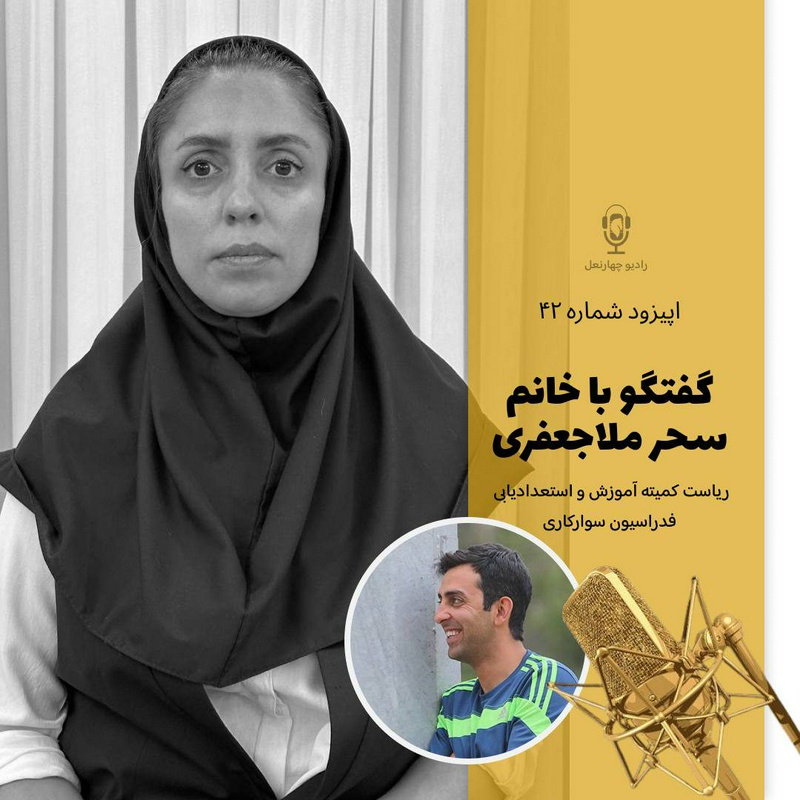
Sahar Molajafari, Head of the Education Committee of the Equestrian Federation
خلاصه
In the forty-second episode of Radio Chaharnal, Ms. Sahar Molla Jafari, the head of the Education Committee of the Federation of Equestrian, has examined the educational system of the federation and the needs assessment of provinces for holding coaching courses. She has pointed out the problems of granting coaching certificates without sufficient expertise and emphasizes that certificates should be issued based on the actual market needs and with the aim of improving the quality of education. Additionally, the importance of retraining courses for coaches and the need to enhance their knowledge level has been discussed. Ms. Molla Jafari stresses the necessity of designing educational clinics and conducting entrance exams to ensure the competence of coaches. Regulatory issues in clubs and the lack of attention to civil liability insurance have also been mentioned, along with suggestions for improving safety conditions and increasing family awareness. Finally, the need for holding specialized courses and initial training in equestrian and registering certificates in the relevant systems has been emphasized.
نکات کلیدی
- روند طراحی کلاسها بر اساس نیازسنجی استانها و درخواستهای مربیگری است.
- مدرک مربیگری برای دریافت مجوز باشگاههای سوارکاری الزامی است.
- دوره بازآموزی برای مربیان فعال ضروری است.
- مربیان باید در دورههای بازآموزی شرکت کنند و آزمون بدهند تا از آمادگی خود مطمئن شوند.
- تاییدیه سلامت روان برای صدور کارت مربیگری الزامی است.
سرفصلها
- ورود به فدراسیون سوارکاری — بررسی زمان و شرایط ورود سرکار خانم مهندس ملا جعفری به فدراسیون سوارکاری.
- طراحی کلاسهای آموزشی — نحوه طراحی و برنامهریزی کلاسهای آموزشی بر اساس نیازهای استانی.
- اهمیت مدرک مربیگری — دلایل اهمیت داشتن مدرک مربیگری و تاثیر آن بر اشتغال در باشگاهها.
- دورههای بازآموزی مربیان — ضرورت شرکت در دورههای بازآموزی و آزمونهای مربوطه برای مربیان.
- گزارش رفتار نامناسب مربیان — روشهای گزارشدهی رفتار نامناسب مربیان به فدراسیون و پیگیری آن.
پرسشهای متداول
از کی وارد فدراسیون سوارکاری شدید؟
سال ۹۸ بود که با ریاست آقای دکتر خلیلی از وزارت ورزش به فدراسیون سوارکاری آمدم.
چگونه کلاسهای آموزشی طراحی میشوند؟
هیئتهای استانی بر حسب متقاضی که دارند به ما اعلام نیاز میکنند و کمیتههای تخصصی بررسی میکنند.
چرا مردم به دنبال مدرک مربیگری هستند؟
زیرا فکر میکنند با مدرک مربیگری میتوانند در باشگاه مشغول به کار شوند و درآمد کسب کنند.
چگونه میتوان به دوره مربیگری وارد شد؟
افراد ابتدا باید آزمون ورودی را با موفقیت پشت سر بگذارند و قبل از آن در کلینیکهای آموزشی شرکت کنند.
چه الزامی برای شرکت در دورههای بازآموزی مربیان وجود دارد؟
مربیان باید در کلینیکهای بازآموزی شرکت کنند و آزمون بدهند تا از آمادگی خود برای شاگردگیری مطمئن شوند.
چگونه میتوان رفتار نامناسب مربیان را گزارش کرد؟
افراد میتوانند درخواست خود را به فدراسیونهای مربوطه بدهند و موضوع در کمیته انضباطی مطرح میشود.
آیا دورههای آموزشی برای مدیران باشگاهها وجود دارد؟
بله، یک دوره آموزشی برای مدیران باشگاههای سوارکاری برگزار شده و مجوز باشگاهها به گذراندن این دوره منوط شده است.
متن کامل گفتگو
Greetings and respect to all you good listeners of the radio. I am very happy to be with you dear ones for another episode.
I am grateful for your love and support. I am here with the forty-second episode of Radio Charnel, which is my conversation with Ms. Sahar Mola Jafari, the head of the Education Committee of the Equestrian Federation. In this episode, you will learn about the federation's education system and plan your educational program accordingly. You will also hear about the principles of clubs, club systems, and the rules related to club and coach regulations. I hope that
you listen to the end of this episode because I believe that these discussions are essential and necessary for all those active in the field of horseback riding. Again, I thank all of you dear ones and appreciate your kindness and favor towards me and Radio Charnel. I invite you to listen to the forty-second episode, a conversation with the head of the Education Committee of the Equestrian Federation, Ms. Mola Jafari.
In the name of the one who gave existence its name, the sky its movement, and the earth its calm. Greetings to all you Radio Charnel audience. I am your guest with another exciting episode. Today, I am with Ms.
Mola Jafari, the head of the Education Committee of the Equestrian Federation, and I have the honor to be close to her, and she has agreed to be a guest on Radio Charnel and answer the audience's questions as well as the Radio Charnel program. Ma'am, thank you very much for giving me this time. It is truly an honor, and if you want to say hello, please go ahead and greet your program's good audience. I am at your service, and I will certainly answer any questions within my expertise. Be healthy. As far as I know, you
have a master's degree in sports management, and I wanted to see when you joined the Equestrian Federation and took on the responsibility as the head of the Education Committee? It was in 2019 that with the presidency of Dr. Khalili, I came from the Ministry of Sports and started working in the Equestrian Federation. I was in the position of head of the Education Committee of the Equestrian Federation until 2022. Then, due to the high volume of federation work, I preferred to take a break from the fed
and with the arrival of Mr. Kazemian, I returned to the federation and am now working again in the education section. Ms. Mola Jafari, I wanted to see what the overall process of designing classes under the Education Committee is like? On what basis do you design a class? Market needs, coaching needs, whatever the course is, whether it's coaching, I don't know, course designer, police station, whatever course you have, on what basis do you design the class? Look, first of all, the provincial boards, which are the executive arms of the federation in the provinces of the country,
announce their needs to us based on the applicants they have. When they announce their needs to us, we send it to the specialized committees of each field. The committees review it, and if that province needs that educational course, we notify them. The specialized committees introduce the instructor, and we hold that class for that province. One point we have is that we Iranians are generally like this, we are always involved in a class and want a certificate. Yes, unfortunately, it is like this, and most people come to this class not to learn but to get that certificate and be able to make money from it.
And unfortunately, in the past three years, when the federation has been run by a caretaker, this has happened a lot, and when I entered, we faced a volume of certificates that neither the class was held professionally nor the province's applicant designed the class based on a complete needs assessment, and certificates were issued that might not really be useful to that person and can only take that certificate, frame it, and hang it on the wall. This point is there, this needs assessment discussion you mentioned, on what basis, for example, a province, let's say Hamadan,
on what basis do you hold a class for them? Based on the certificates issued, based on market needs, how? In horseback riding, it is more like this that people are applicants for coaching certificates because they think with a coaching certificate, it can only be a source of income that they can work in a club and earn income.
And most provinces request coaching certificates from us. They say, sir, for another reason, I must mention here is that the license for equestrian clubs is with a coaching certificate. The General Directorate of Sports of the provinces, one of the things it wants for the club license is that they introduce a person as a coach to the province's General Directorate who has this coaching certificate so they can give the club license. I allow, then because of this, people who want to invest themselves and get a club license prefer to come and get this coaching certificate themselves.
Unfortunately, without having a background in horseback riding, they enter these horseback riding classes and usually do not achieve the required score in the entrance exams and fail, but there are many who pass the exam, can get the coaching certificate, and go for coaching work, even get a club license with it. The needs assessment of the provinces, since the applicant is more based on coaching, they request more coaching course classes from us.
And considering how many clubs we have now, we sent a letter to the provinces that Mr. Kazemian signed, and the letter went today to tell us the number of clubs in each province, the number of active coaches in each province. A province may have, for example, 100 coaches with cards, but the number of active coaches currently working, who is an active coach? An active coach is someone who has passed the federation's retraining course. The retraining course is such that from the date of issuance of the coaching certificate, the individual can work with that certificate for three years, after which they are not allowed to work unless they have participated in the retraining course and passed it.
Now, what do they do? They take those who have taken the retraining course and, in our opinion, are considered active coaches of that province, they come and work in that club, and unfortunately, there are those who have not taken the retraining course and are working in clubs and create many problems that affect the club and the coach themselves. That is, the criterion is not that, sir, for example, the coach has only worked in the club or, for example, in the club where you have worked, I present it in the month, for example.
Ten to five to two students, works here for so many hours because there is no basis, you just say retraining. We say that an active coach is someone who really is like that. If they are active, they know they need that retraining course and must participate in the retraining clinic, take the test, and see if they are still fit to take students or not. This has also been approved by the Ministry of Sports for most disciplines, meaning I think all disciplines have this retraining.
I didn't go, but I know that what you are saying exists. Ms. Jafari, what has happened in recent years is that everyone, whether with a card or without a card, is working, is involved in this, or feels they should get this card. If, God forbid, something happens to someone, they have, for example, food innocence. Now, I have mentioned this wherever it has been, but overall I want to see if your basis as the head of the education committee is to raise the scientific level and knowledge of those who are coaches or if they just get a card so that if someone falls, they also have a coaching card. You pointed out a good point. In 2019, when I entered the federation, clinics did not exist before the coaching entrance exam.
We tightened a period called the entrance exam where people would take the entrance exam. If they passed the entrance exam, they would enter the coaching course and take the final exam and receive the coaching certificate. But many failed the entrance exam because the entrance exam is a practical test. In fact, when they saw that people did not have enough information and knowledge, the coaching committee and the education committee concluded that we should teach them before taking the entrance exam and then ask them for something. We designed five clinics, each eight hours long, held over five days.
After people receive training, they enter the entrance exam, and the good thing that has happened is that they gain good theoretical, specialized, and practical knowledge and then enter the entrance exam. If they pass, they enter the coaching course. We set this filter so that people can gain sufficient knowledge and information about equestrianism. If the basis was just to issue a certificate for them, this course would not have been designed, and they would have failed the entrance exam.
And they would not enter the coaching course. Or those who passed would come during the coaching period, and we could easily issue the coaching card. But this training process is also beneficial for the individuals themselves. If they have not been trained somewhere or although those who enter the coaching course, the clinics must have a letter of introduction from the board stating that the person has five years of equestrian experience. In many places, this has not been observed. I think now in Gilan at least, right now as I am talking to you on the third of Shahrivar, without a letter of introduction, no one has been admitted to this training course in Gilan province. I don't mean that it hasn't been observed.
Without that letter, no, that five-year one is very lenient in many places.
In many places, this may happen. One cannot say everything completely. No, this is not possible at all. It may happen, but it may come to participate in these five clinics and fail the entrance exam. Then, because they do not have the necessary ability, the coaching committee only takes the entrance exam, and when the coaching committee sees that the person does not have the qualifications to enter the coaching course, they give them the opportunity to come back six months later and retake the exam. But if they fail the entrance exam again after six months, they must go through the clinics from the beginning. Oh, that means twice.
In these few years, at least in the past four or five years that you have been present, have you ever thought that now that you have just come, these clinics should be updated, meaning their model should be changed? When we approved an educational bylaw in 2019, we held a meeting with 13 federation committees. At that time, each specialized committee presented its educational bylaw in consultation with the education committee and the specialized committee.
We sent this to the Ministry of Sports, and it was approved. Now we are doing the same thing again. All committees have been informed that this bylaw must be revised, updated, and re-approved by the Ministry of Sports so that we can hold our educational courses in an updated manner. This will definitely happen soon. Have you ever thought in these years to change the education model to, for example, the FBI system, where at the beginning of the year, it sets in its calendar, for example, level one, because the number of internationals is higher?
It gives it to them and limits it a lot, meaning how should I say, you only teach and be responsible for taking exams and issuing certificates. They go out, whether to a training center or a club, wherever they are, they go out to get updated with a specific training reference, and then you are only responsible for taking the exam. Well, you see, it used to be like this. Unfortunately, many people would get a certificate this way. Yes, I remember they did not have the necessary ability to get a certificate.
Now that you say we should limit it, in our country, most of our educational courses are in demand for coaching courses. I can tell you that 90% of the provinces that apply for educational courses apply for coaching courses. Unfortunately, because I think applicants think that with this course and getting a certificate, they can get a club license, which they can, and make money. Most importantly, we don't know how we didn't make this money. Until you said that someone who now gets a certificate, whatever degree it is, three years later, they must participate in a retraining course.
Does this retraining have any screening system that, by chance, the person who got the certificate and came out of that class now comes to retraining, anyway, this should be updated? After all, four of its things should have changed. As a coach, what system do you have? Do you have it or not, sir?
From this retraining, another filter should be added so that not everyone comes out again, meaning the same sample knowledge goes out. Exactly, the coaching committee has considered this, and they take another test for them. I want to see if they have the ability to take students as a coach of a club or not. They must come and grade them. The examiner committee writes for me that these individuals have passed or these individuals have failed. Those who have failed cannot work in clubs again. They must come back and pass the retraining course and pass under what title do you announce to the club that now this.
Unfortunately, since equestrian clubs are under the supervision of provincial general departments, they are actually their executors, and when they send an inspector, they must follow up on whether this person has a coaching card or not. I don't recall any from the department... Yes, unfortunately, because they don't have enough personnel. Let me give you an example from just last week, unfortunately for one of the coaches.
An individual was injured at one of the clubs, and the coach was blamed, even though the coach had a retraining card and a coaching card, but in any case, the coach was at fault and is now involved in court, compensation, and all these legal stories and documentation. For this very reason, individuals must be proficient in this regulation themselves so that they don't work without retraining.
And they must definitely complete the retraining course. Let me separate this part about the coaches' committee. Again, the coaches' committee has divided those who undergo retraining into three groups. Some may get group A, B, and C. Those who get group A can only work for one year, B for two years, and C for three years. Meaning they are allowed to work for the years they are permitted. Otherwise, if they fail the retraining course, they are not allowed to work until they pass the training. One point is that...
The federation does not accept it because the administration of clubs must be done by the provincial sports departments. Meaning the federation now, for example, if I work at a certain club, I have taken retraining one, I couldn't, why this under a letter, I don't know fax or anything, Sir, his certificate is, for example, suspended for a year, he cannot coach. Because you see, I can confidently say because they are within the clubs and I look, there are many places, for example, someone has a level two certificate, is recognized, but well, his training system is dangerous for people's lives, in my opinion.
But well, no one follows up on this. Meaning you have no inspection that now, for example, in these 25 years that I have been working, I have never seen anyone come in and say, Sir, I am an inspector, for example, from the sports department, Sir, is his certificate correct. Because the reality is that clubs don't care at all until something like this happens, and they wake up. Sir, what was it? They sealed the club for retraining. Meaning last week this club was sealed, and many clubs, let me tell you, don't even have anything called civil liability insurance. I don't know, they don't force many of the coach kids either. I haven't insured anyone other than myself until now.
The psychological and physical damage, the cost discussion is really no joke. Meaning God forbid that now one hand breaks, at least 100 million must be paid. I want to say why you don't take responsibility for this as the custodian of this sport. It is the law of the Ministry of Sports. Sports complexes, in general, from you, from the pool, we want tennis courts, whatever it is, are under the supervision of the provincial sports and youth departments.
Now the federation is not like it has no authority at all. Usually, clubs that feel responsible or have a problem, for example, just today one of the clubs called, checked its coaches by letter to see if this coach has a coaching certificate, has undergone retraining or not. Well, after all this, then, for example, some other things that I must say in your podcast is that anyone who enters an equestrian club, please...
They can easily get sports medical insurance from the sports medical federation's website, so if, God forbid, an accident happens, this sports medical insurance can help them financially and is very important for them. Meaning anyone who enters an equestrian club, even a mother who is taking her child there to the equestrian club, it is better to get sports medical insurance, which has a very low price but provides great help to them. It should not be more than 30-40 thousand tomans. No, I think it's still nothing for a year. Exactly.
Jafari, the problem I have seen closely in recent years is that, for example, you as a mother register your child's hand, the club manager, the registration officer, whoever it is, you work with Mr. So-and-so or Mrs. So-and-so, but you as someone who has entered this space have no information at hand. Meaning, for example, you can't say who your coach is based on experience, based on years of work, based on coaching certificate. Principally, what happens in equestrian clubs, whether those who claim to be the best or those who are ordinary and have no claims, use the cheapest resources for public classes and...
In my opinion, many people who have entered this sport due to their bad luck have gone with a low-level or less-aware coach, now have a certificate and have fallen in any way, have not progressed, the horse and equipment are very terrible, the knowledge is very terrible, the literature is very bad, and we don't want that person in our sport. Until now, under this title that Sir, send a letter to the club or oblige them that Sir, now someone comes into the club, the coach list must put the documents on the wall, I don't know whatever you think.
Why hasn't there been anything until now? Meaning I haven't seen it at least. You're right. Now Mr. Kazemian is working on the site, which, God willing, will be up soon. The most important part he has considered and emphasized a lot on this part is this.
That when a family enters the club, wants to register their child, the most important part is that when they search the club's name on the site, they see which coaches are active in that club. Do these coaches have a disciplinary committee, have they had ethical issues that, for example, I have gone to the disciplinary committee, or have they undergone retraining or not, do they have a certificate or not, they can see all of them clearly on the site and then register their child.
One of the things we did in 2019 and 2020, which is still good for children, is that we designed posters and sent them to the clubs. In case these problems, for example, if the coach gets too close to you, the coach touches you too much, these things should not happen during your coaching, during your training, and both the parents and the child should be aware. When they see those posters, they were in cartoon form, in shape, drawn, Mrs. Sehatzadeh sent them to the clubs to put on the club boards. Families entering the club are fully aware of all the rules they need to know about their personal rights...
In the year 1400, this happened. I haven't seen women working in clubs. This happened when there were children, in places where there were many children. Regarding children, I should tell you that the Pony Committee, those who come to coach children, when they get a level three coaching certificate, they must attend children's training courses to become a pony coach. These courses are different again. That is, someone who...
A person who obtains a level 3 coaching certificate cannot work in paradressage, pony, or jumping. Yes, everyone must undergo specialized training in their respective fields. It's the same in paradressage. For example, Ms. Montazem has special courses for individuals with less physical ability. After these individuals receive their coaching cards, they must participate in these courses to gain the ability to coach people with disabilities. Never in these past years...
The federation itself has not thought about this because I have personally seen it a lot, in this field the story is that when you get a coaching card and as a coach, for example, I use myself as an example because I am a person without restraint and the power given to me and the title of master that is given to me, it allows me as a coach to do anything, from belittling individuals and using inappropriate words and unnecessary shouting.
We don't have an entry psychology test for this story, because many people come to complain. When a person enters the coaching course and wants the coaching card, it means they have come to the end, and for issuing the coaching card we have a clause that they must bring a mental health approval from a doctor. Yes, this is there. In coaching cards, they are asked for this letter for non-addiction and criminal record.
All efforts, I mean, I think since Mr. Kazemi came, he is doing his best to get this site up and running as soon as possible so people can be free from the problems of the previous site. The phone in your room has been ringing a lot lately, and it's really like that. When we set up a training course, most of the course applicants have problems registering and unfortunately, they contact the federation.
Ms. Malajafarian, the conversation I had with Masoud Makani, a casual chat, we were talking because he has now migrated, he mentioned something called Safe Sport which is a link between the USA and Canada. In this regard, it has set some behavioral and ethical restrictions for those who are coaches, so that even if you are sitting as a spectator next to an equestrian competition and feel that the coach is violating that person's privacy in any way, you can report it. We have such a system now. Yes, we have had it for years. Especially the Ministry of Sports is very seriously pursuing the issue. People who see inappropriate behavior towards them in sports complexes, now we are talking about equestrianism.
They can submit their request to the relevant federations. The federation raises it in the disciplinary committee, calls the person, and if they have any documents, they should present them. The person will definitely be disciplined by the committee. If they are completely sure that the person has made a mistake, their coaching card will be completely revoked. The system is from events that, in any case, happen due to carelessness, God forbid no one intends here, precautionary events happen in the equestrian club. Not at all in sports in general.
People don't know where to go, who to call, who to follow up with. Dr. Javadi is here to talk to, but in our coaching field, we have this story. You gave very good news, Ms. Malajafarian. An event that has happened in these past years, children have come and obtained level three and practically stopped learning and did not feel the need to obtain and upgrade this certificate. Because with a level three certificate, they did whatever they wanted, at least I have not seen such a thing in my field, for example, swimming which is not equestrianism, to be honest.
Have you considered the scope of authority for different certificates? That is, for example, how much can a level 3 coach work or what is their scope of authority or what can they do with it? Those who succeed in obtaining a level 3 coaching certificate, their scope of authority is that they can only work with beginner students. They cannot take people to the specialized section, for example, they cannot work with children or veterans or want to participate in jumping competitions.
Train a student who can participate in competitions. They can only provide basic initial equestrian training to interested individuals. This is the case, but it is not in the previous regulations. If it is updated, yes, it will definitely come. Now, for example, someone who has heard the radio wants to go and inquire about the coach, where should they get this, so to speak? The federation or their club.
Look, first of all, if it is on behalf of the club, the club sends a letter to the federation to see if these individuals have coaching or not. We have such a rule in club affairs that now, for example, a club manager calls to ask about this coach we have here when something happens to them, they do this. But it is exactly like this and unfortunately, these clubs must be in contact with their provincial board and request active coaches from the provincial board to be introduced to them and use them. Correct, and one more thing I must tell you, all equestrian coaches.
They must go to the Mobin system of the Ministry of Sports and upload their documents there. Then it is announced to the federation. The federation approves them if they are approved. This becomes the reference for inquiry for any other ministry. If, God forbid, a problem arises for the coach, the first place they inquire from is the Mobin system of the Ministry of Sports. That is, now as a coach, I must go to that system and enter my details. Now what documents are there to enter.
In what situation is its use? If a problem arises for the coach, their student encounters an incident and it goes to court, they can inquire from there. Court inquiry from the Mobin system. From the Mobin system. From the Mobin system. This is the first time I am hearing such a thing now. Now I hope you upload your site sooner. You, wherever we refer, the Mobin system belongs to the Ministry of Sports for all sports federations. It is not only related to the equestrian federation, do you know what the story is? I had an interview with Mr. Ka last time, now sometimes I talked to them, I criticized them that...
We are really weak in the field of information dissemination. For example, if there is a coaching clinic, everyone rushes to it. Well, for instance, I hadn't heard about the Mobin system in these past few years until now. Just today, Mr. sent an announcement to Mr. Kazemi. Kazemi instructed that it must be placed on the website. This is so that no club should use a coach without checking if they have a card or not, whether they have attended the refresher course or not, and that all equestrian clubs must ensure that individuals who come to learn have sports insurance.
That is, it should compel the club to have the individual obtain sports insurance from the Sports Medicine Federation's website and pay the session cost, for example, one million tomans for horseback riding, but they do not have the 90,000 tomans for sports medical insurance. Clubs are obliged. Yes, definitely with the club. Another incident that has happened, which you are aware of, is that in the management section of equestrian clubs, most of the managers, at least those I know, have nothing to do with horses, as Babak Shakiba says.
Master Babak Shakiba, for example, the person doesn't know the front and back of a horse's sweat scraper, do you have any program for training these club managers? As the head of this committee, in 1400, we held a course for equestrian club managers and made the equestrian club license conditional on completing this training course. Was there an exam or not? Just an introductory session. No, it was a session with about 10 instructors on the way. A veterinarian came in the morning, his mother was a veterinarian.
We had used jumping experts, dressage experts, nutrition, farriery, all of these were held in a two-day course which was very useful, but unfortunately, after the federation underwent changes, this did not happen again until Mr. Kazemian is now pursuing this so that the course will probably be held again in the second half of the year and they want all the equestrian club managers in the country to participate in this course, with the renewal of their club licenses being conditional on completing these training courses.
Even individuals who are not riders and are not familiar with equestrianism should at least become acquainted with the basics of equestrianism. They might have managed in other fields and have that knowledge, but the story and process of equestrianism is something else from the management of the education section. For example, now in a few seconds, a club might come and say, sir, I have four trainings myself. Ms. Mola Jafari, what do you have as a committee head and federation education, how should we teach these four trainings?
We designed this ourselves with the help of Mr. Mirzaei, who created a standard equestrian club model, which is now being taught at the Equestrian Federation's training center regarding club management.
And they wanted to star and grade the clubs. Unfortunately, with these changes, it didn't happen, but we will follow up on it, God willing, so that we can achieve results and update the clubs at least with the standards we have considered. God willing, in these past few years, whatever.
I personally say that every educational announcement I saw in the Equestrian Federation was level 3. Don't you really want to upgrade, at least get a level 2, and have one or two level 1s for the sake of God? Is it in your program or not? Yes, it definitely is. We are going to hold level 2. As you know, those who apply for level 2 must have a level 3 certificate, which must have been obtained three years ago, and the provincial board must confirm that the person has been an active coach in these three years, meaning they have worked, gone to the market, and at least had one refresher course.
The next part is that they can attend 12 workshops, of which they must have completed 9 clinics specifically. For example, I'm telling you, there are only three 8-hour dressage clinics in these 12. Yes, they must complete these to succeed in entering the level 2 coaching course and finally take the final exam and receive the level 2 certificate.
In the new regulations, we intend for level 2 to become specialized. Specialized jumping, specialized for veterans, specialized pony, and in this way, when individuals receive level 2, they can coach in their specialized field, not teach endurance jumping, meaning someone who has a level 3 coaching certificate thinks they can teach everything, whereas they can only teach beginner riders the initial training, and someone who receives level 2 can work specifically. What about level 1? We haven't set it yet.
The course for which we have a certificate, I think, no, God willing, it will arrive. I think 10 people passed for level 2 that year, and they can now participate in level 1. The Ministry of Sports' law for all federations is that first level 3, then level 2, then FE level. Exactly this process that I told you, the reverse of them is one two yes one two no, for example, now if someone wants to get a national certificate.
Under the federation's introduction, it has been 3 to 2 for 3 years, now I explained to you, it has been three years and one refresher. Consider the gap between two to one as three years with two refreshers. Exactly, if someone who is really active wants to pursue a certificate and work, they can reach level 1 in six years. I am now 40 years old.
You didn't participate, that's exactly it. Information dissemination is really a disaster. I remember there was a lot of information dissemination, there were many applicants for these clinics. Anyone who managed to participate in at least 9 out of 12 clinics understood as a rider that such a clinic existed.
Now, a topic I want to ask you about, do you define an educational calendar or not? God willing, from the course you, because before you, I know what was going on, I don't want to flashback at all. Do you, as an expert in sports management, have a program that, for example, the federation will have an educational calendar next year? I promise that in October, the educational calendar for the second half of the year will definitely be posted on the website. You have very good news. God willing, may God help you, Ms. Jafari. An event that has happened in these past few years, and now I have spoken with a few heads of boards or sometimes they told me on the radio.
I told them to wait for the federation to wrap up a morsel for you to use. Can't they really request something more specialized on their own? Like, for instance, retraining, or now a specialized class, like a jumping clinic, veterinary doping, or anything else—why are all requests only about coaching? This is exactly one of the federation's major problems. Unfortunately, most provincial boards request coaching when they say needs assessment should be based on the province's needs, like horse nutrition or first aid, like doping.
The classes that are a fundamental part of equestrianism unfortunately have few applicants, and the provincial board is not inclined to hold these courses, and we are forced to organize these courses ourselves, as the committee, like the doping committee, tells us if you hold this course in this province, the damages will be less, or put nutrition in these provinces, it will be less. We design some courses ourselves and hold them, and unfortunately, there is no reception at all. One of the courses that is actually necessary to mention here is the farriery course, which I don't know why the provincial boards do not welcome these courses. Of course, they are not to blame because the demand for these courses is very, very low.
And mostly when the federation holds the courses, because they do not reach the required number, unfortunately, the course is canceled. One of the points that exist is, of course, our Iranian nature that we are obsessed with certificates. We want to hold an intermediate workshop, and we don't give a certificate. Certainly, I am not considered. Unfortunately, the mindset is that if we go here, we must ultimately have a certificate that we can use to earn money and do work. What is your suggestion?
Imagine your suggestion now, for instance, in a county or province, some people hear this to go there, make a request, write a letter, and do something. Right? See, most equestrian clubs themselves know what problems they are dealing with in their collection. They can transfer these problems to the provincial board, and based on those problems and the needs that the equestrian club has, the provincial board requests an educational course from us, and that educational course is reviewed, and certainly, a specialist instructor is considered for it, and the course is held for the province. Very good. Another point that exists and I witnessed it closely.
Recently, in a club, there was a 14 or 15-year-old boy. Now, which club I was in, I was riding there, and these talks. This boy's breath got caught in his back. Now, because of being a lifeguard and knowing CPR, I ran to him and first checked that he didn't have a fracture. I lifted his back, and his breath was freed. Many of the kids who coach, and because we don't entrust people's lives to them, meaning we really don't know first aid or life-saving. Does.
Such a topic not want to be placed among the clinics or during, for example, the main classes, because it is a very important part? Because when an equestrian falls, the first thing that happens to them, even if nothing has happened to them, is they go into shock. That shock blocks their breathing path and causes a terrible contraction in their body, and as someone who must be the first to reach them, I really don't know what to do. This course you are referring to, like first aid or psychology courses.
These are proposed in the theoretical section of the General Directorate of Sports and Youth of the province, and the kids who pass the coaching course, after passing the federation courses, must pass these theoretical lessons of the General Directorate of Sports and Youth.
I think there are about 12 topics they have to pass, and first aid and psychology are part of the exam, and the General Directorate of Sports and Youth of each province announces to the federation whether these individuals have passed or failed, and then the coaching certificate is issued. Because the reality is that in recent years, at least many of the problems, maybe these courses have not been practical, and maybe the fault lies with the exam. The exam, sir, has failed, he has no breath, what should he do with his breathing? See, now the General Directorate of Sports and Youth of Tehran province, let me tell you, psychology, for example, its exam is separate, first aid is separate.
There are 12 lessons, and each has an exam. The set of grades and grades are announced to the federation in detail. It's online. During the Corona period, it was online, but now classes are held in person, and the exam is also in person. Correct. As a final word, do you have anything to add that the listeners, meaning the audience of Radio Chahar Naal, should go and think about it? I just want to ask all those who have a coaching certificate to definitely go for retraining.
And definitely, as an active coach in the Mobin system, upload all their documents. Whether themselves or those who work as students with them, definitely get sports medical insurance from the medical federation so that, God forbid, when a problem arises, no one gets harmed, and they do not face legal issues. Do you have any other points? No, thank you, and I really thank you for the time you spent, and I want to thank your family because I know you worked hard. You're welcome, and a lot of good talks were had, and I hope the audience of Radio Chahar Naal.
Thinks more and I ask you to please strengthen this information system here because people are really busy, and many, for example, call me or, for example, Radio Clinic. I hope that, of course, with your presence, I certainly know because you know how to manage the system well and have done it before, it will get better. I wish you health and increasing success, and thank you again for giving me this time. Thank you, and all the good listeners of the radio. Be healthy. Goodbye.
I am infinitely grateful to all of you for being with me until the end of this episode. I hope that listening to these talks will create a better future for all of us and that we will proceed with more precision in.
Educational matters and club management. Thank you again. Until the next episode, I entrust all of you to the great God, and finally, take care of your horses.