2 Practical Exercises for Improving Hunter Rounds
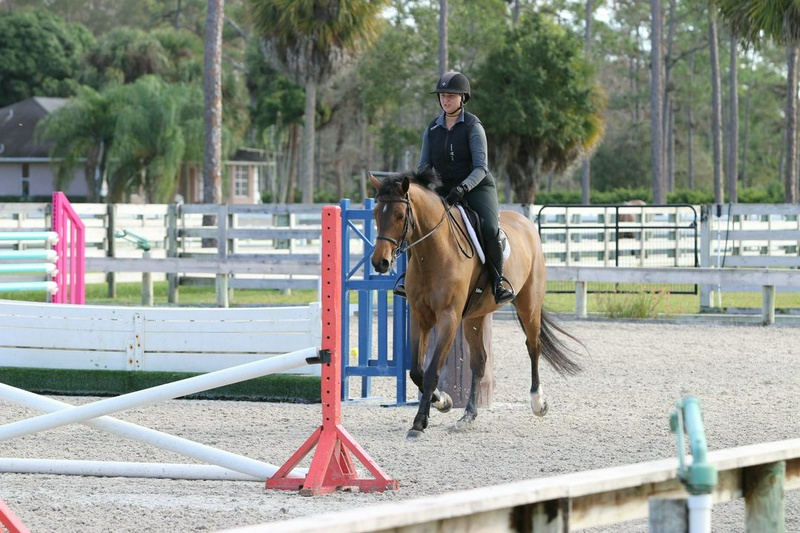
In this article, I introduce two of my favorite exercises that are very useful tools for both horses and riders.
The first exercise is a simple cavaletti on a circle that requires high precision.
The second exercise is a three-jump gymnastics that can be adjusted to suit the specific training challenges of your horse.
The circle exercise with cavaletti helps riders improve their skill in moving on the correct line, and the predictability of the gymnastics exercise allows the rider to focus on their body position and encourages the horse to improve its jumping form.
The circle exercise with cavaletti is a single-cavaletti exercise that is a suitable way to learn the correct balance of the horse using all aids and to become more precise in their application.
This helps keep the horse on the correct line; one of the most important things every rider must learn.
The result will be smoother and better rounds in the hunter style.
To set up this exercise, first pay attention to the diagram above.
Then start the work with a canter on the circle and passing over the cavaletti to the right.
The goal is to stay on the correct line by jumping from the center of the cavaletti.
To do this, you must use all your aids: legs, seat, and reins.
On the approach, create a more collected stride using your seat and simultaneously look through the turn to see your distance.
Use the inside leg towards the outside rein to help the horse bend while the outside leg supports it to prevent it from falling out.
When the horse is in the air and passing over the cavaletti, show it where you want it to go with an open and low inside rein, but be sure you still feel contact on both sides of the horse's mouth; using only one rein will cause the horse to move away from that rein's aid.
The horse should remain completely straight over the cavaletti and not veer left or right.
Every horse is different, and their level of responsiveness is not the same, so you may need to experiment a bit with how you use your aids to see what is more effective.
With practice, you will notice that reaching a deep distance with a collected stride helps the horse pick up the correct lead and have better balance.
If you take off from such a small jump with a long distance, you are likely to land on the wrong lead.
If this happens, bring the horse back to a trot, ask for the correct lead, and approach the cavaletti again with a collected stride.
Once you have successfully completed passing over the cavaletti on a large circle, start turning earlier to make the circle smaller while still passing over the center of the cavaletti.
This circle should not be smaller than seven or six strides.
When you have successfully completed this exercise to the right, give your horse a break and then repeat the same exercise to the left.
The more comfortable you become with this exercise, the more you will realize how you can use the line of movement to "help" with the distance and apply it in riding on the course.
If the distance is going to be too short and compressed, you can open the line of movement.
If the distance is going to be too long, you can bring the line of movement closer to the inside of the circle.
Gymnastic three-jump in a straight line
The important feature of this gymnastic exercise is that you can adjust it to suit your horse and use it to improve his individual needs.
It can be used as an exercise to recondition an older or more experienced horse that may be bored, or to correct a horse that is unbalanced or crooked.
Since this exercise is predictable, you can focus on your own posture while giving the horse the opportunity to use his body in the best way.
To perform this exercise, you need a qualified trainer or specialist — and I cannot emphasize this enough — to supervise you and tell you what effect your actions are really having.
This professional can help you decide as you progress through the exercise whether the horse's reaction and effort indicate it's time to make the jumps higher, the oxers wider, or make other minor adjustments.
This is why having a professional to assist in this work is absolutely vital.
To set up this exercise, refer to the diagram on the right.
Set up the exercise so you can approach it from both the left and right and change direction each time.
You need three jumps, which should be set very short at the start.
Note that the distances shown in the diagram are approximate; one of the main factors for success in this work is to adjust all these exercises so that your horse remains calm and comfortable when jumping.
When you provide a good and comfortable distance for the horse, you encourage him to jump in the best possible way.
Approach this gymnastic with an active trot.
You should enter over the first jump with a trot and exit over the next two jumps with a canter.
Entering the gymnastic at the correct distance is really important.
Everything should feel like it is in the right stride and easy for the horse.
If you find the correct distance to the cross-rail, the rest of the course usually works out very well.
You should want your horse to work patiently in this gymnastic; he should not rush.
Sit quietly in the saddle and give him time to complete his arc over the obstacle and then continue with the canter.
As you pass through this exercise, think about your own posture.
If you are unbalanced, this will show even more when passing through a combination.
Ensure your pelvis and shoulders are aligned and you keep weight and pressure evenly on both sides of the horse.
Your spine should also be aligned with your horse's spine.
If you can work on your posture and make it a natural habit, it will help your accuracy in all areas of riding.
Once you have successfully completed this gymnastic, you can make the following changes: increase the distance between the second and third obstacle by about 1 foot, raise the height of the first cross-rail, turn the second cross-rail into an oxer, and change the vertical obstacle to an oxer.
It's best to make only one change at a time.
Again, you should work with a trainer to determine the correct distances and heights for you and your horse and to identify what other changes, if necessary, should be made to get the most out of this exercise.
The final result of working on this gymnastics is a larger obstacle compared to the starting point, and Foklor presents a beautiful leap.
You will notice that we have adapted this exercise using guide rails on both sides of the obstacle and creating a corridor.
This reminds Foklor to stay straight and put more effort into his leap, while Rachel focuses on her posture.
Customizing the three-obstacle gymnastics You can customize this exercise based on your horse's needs.
Here are some ways to modify it: If you have trouble finding the right distance to the first cross-rail, use a stride pole placed 8 or 9 feet in front of the cross-rail.
If your horse veers to one side or the other after the last obstacle, stop him on a straight line afterward.
If your horse needs help staying straight, place ground rails about 8 to 10 feet wide at the entrance and landing of the second and third obstacles to act as a corridor.
When your horse becomes more comfortable with this setup, gradually bring the ground rails closer together until they are about 6 feet apart.
When you trot to the first cross-rail, land, and canter out over the second obstacle, this corridor encourages him to stay straight and balanced.
This helps him maintain focus and put more effort into his leap, and it's a good way for him to move straighter without much intervention from you.
About Louise Serio Louise Serio has twice won the professional Hunter Rider championship title at the United States Hunter Jumper Association's International Hunter Derby.
She was inducted into the National Show Hunter Hall of Fame in 2012.
Over the years, Serio has served on several committees to improve the sport and received the United States Hunter Jumper Association's Committee Excellence Award in 2012.
She is also a founder and designer of the WCHR program and the American Hunter-Jumper Foundation.
She resides at her Derbydown Stables in Kennett Square, Pennsylvania, and Wellington, Florida.
Her daughter, Kristina, is a trainer and professional rider, and her son, T.R., is a farrier.
Her granddaughter, Mary Jo, divides her time between the English and Western riding worlds.
This article first appeared in the Spring 2023 issue of Practical Horseman magazine.
This article is presented with the support of Sentinel.
Source: Practical Horseman – Training