Gymnastics brought the Thoroughbred horse "Even Better" to the Grand Prize.
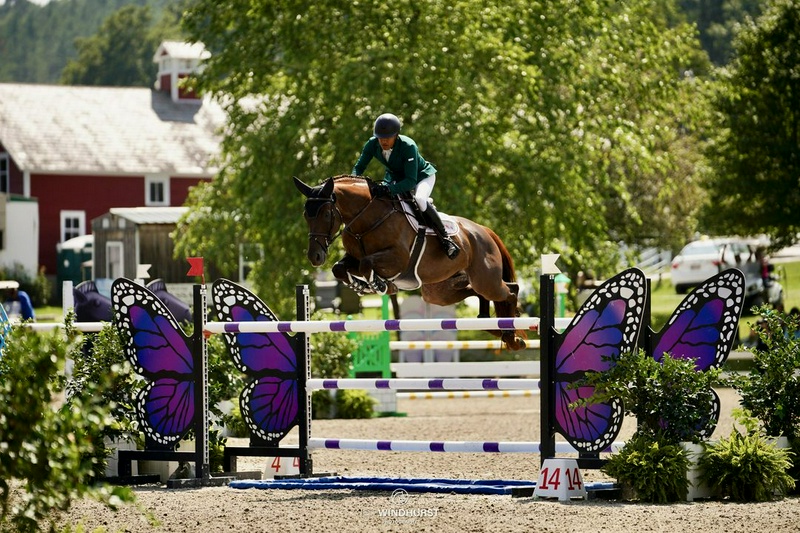
Four years ago, a small-bodied bay Thoroughbred horse, without a microchip and without a record in rated competitions, was sent from Florida to Connecticut to be worked on as a sales project.
Today, the same horse, known in the competition arena as Even Better and called "Neon" at home, is jumping in FEI Grand Prix courses.
The rider who brought him to this point, Michel Feitosa, attributes this transformation to one training tool above all others: gymnastics.
The underestimated horse, Neon, came into Michel's life through his wife, Amanda Picciotto Feitosa.
One of Amanda's friends owned this gelding, who was 10 years old at the time (Lemon Drop Kid × Offshore Breeze, by Thunder Gulch) and intended to sell him.
Neon, bred by Peter E. Blum Thoroughbreds LLC in Kentucky, was sold for $190,000 at the Keeneland September Yearling Sale in 2013, but never started in any race.
After professional retraining, he spent his early years in the hunter/jumper world, where junior and amateur riders rode him.
Michel says about the previous stable's view of this horse: "He was essentially a horse with a calm and easy temperament, but they really didn't believe there was anything special in him."
Amanda recalls the same impression.
She says, "My friend always loved him and thought he was an amazing horse. But his trainers, the professionals at their riding club, never really showed any particular interest in him."
Initially, Michel thought Neon would stop much lower than the level he competes at now, but still thought he could be an amazing partner for a junior or amateur rider.
He says, "For development and progress, he was a bit old. In my mind, he was supposed to be more of a horse that we would put a client on to jump a few small obstacles."
But this assessment changed when Michel started jumping with him.
He says, "The first time I went on a course with him, he gave me a really good feeling. I felt a lot of power, I felt his drive. When he jumped the first phase with me, it was completely different from when I was just jumping a few cavaletti with him. When I worked with him on the ground, he just seemed like a lazy horse; not very powerful, but sweet and lovely. But when I jumped a phase — even though it was a small jump — I really felt he could have something special in him."
Michel described this horse's initial temperament in the arena as inexperienced but honest.
He says, "He was always a very brave horse who wanted to do the right thing, but he really didn't know how to do it."
The introduction of gymnastics It didn't take long for Michel to recognize the gap between Neon's raw ability and his technique.
Michel says, "He seemed to have a big engine, a lot of power and capability, and always wanted to solve things relying on strength. Another thing was that he always shot forward. His take-off was very flat and forward, and he always landed much farther from the obstacle; he never thought about jumping up and round. It always seemed like he was saying, 'I'm going to the other side, whether I hit the pole or not.' He didn't read the obstacle to think, 'What should I do to jump this without fault?'"
Michel concluded that the solution was gymnastic work.
While most of her horses at Halcyon Show Stables, based in Litchfield, Connecticut and Wellington, Florida, might see a gymnastic exercise once a month, Neun would jump distances once or twice a week.
A recurring problem shaped much of the early work: what Neun did after landing.
Michelle says, "He was a horse I always worked with on several consecutive jumps because the problem I always had after the jump was that he would lower his head and pull me along without thinking about the next obstacle.
So it was always necessary to have another jump afterward to make him jump a little rounder.
" At the start, this meant short and simple grids.
The pair began with simple one-stride to one-stride or one-stride to two-stride lines, using placing poles between these obstacles to help Neun jump with a rounder arc, land closer to the obstacle, and regain his balance sooner.
Then, at the end of the exercise, another element awaited him.
Michelle says, "For him, we always put something else after the gymnastic work; a pole, a cavaletti; to make him balance himself a bit after landing and not just continue.
" Amanda Picciuto Fittosa says, "Michelle works very hard.
We take care of Neun ourselves, and she rides Neun every day, sets everything up herself, measures everything, dismounts, moves the obstacles, and rearranges them again.
" As Neun matured in these exercises, the length of the lines increased.
Michelle says, "Once he got used to it, his gymnastic exercises reached four, five, six consecutive jumps.
At one point, I could set up 10 small bounces for him.
Today I can put a triple combination in front of him, the same thing he might see in competitions, and because of all the work we've done with placing poles and cavalettis, he reads and understands it much better.
" Michelle tried to change the way Neun covered the distance between obstacles.
Because this gelding initially landed too far, the standard combination distances turned out to be short and unsuitable for him.
Michelle says, "My goal was to make him collect himself a bit over the obstacle and be more comfortable jumping the combination when the distance between jumps becomes shorter for him.
He has a good stride, his stride is natural, but he lands so far that the distance between jumps becomes short for him.
" Instead of confronting the problem directly, Michelle gradually approached it with exercises.
She says, "To prevent him from getting scared, what I did was set a normal distance that was comfortable for him.
He would feel good, and then I would gradually shorten it so he would get used to that shorter distance and feel comfortable with it.
" Michelle says she was very careful in the early stages not to push too hard or do it too soon.
She says, "The problem with gymnastic exercises is that you have to be careful not to make the horse use his body in a way he doesn't understand because it affects his mind.
Horses should always face a challenge they can handle, feel good about themselves, and feel like they've learned something.
"If a session wasn't going as planned, Michel would simply make the exercise easier.
He says, 'I would make the exercise as small and simple as possible.
I would remove two jumps and make it feel manageable.
For me, giving him confidence is more important than challenging him so much that he's afraid to do it the next day.
' Watching the work from the side of the arena gave Amanda a different perspective on Nion's learning process; a perspective different from what Michel experienced from the saddle.
She says, 'At first, you could see that Nion didn't fully understand how to do what was being asked of him.
He was very serious and eager and always tried.
But when he didn't understand, he almost became stressed.
You could see him thinking: "I don't understand this and I want to do it well, but I'm not sure if I'm doing it well or not."
' She adds, 'You expect an older horse to find its own way.
If you put a 2-year-old Warmblood bred for jumping into a free-jump corridor, you immediately see that the horse knows how to jump; completely automatic.
Nion didn't have that.
He had all the power, all the heart, and the desire to be a good horse, but he didn't have that natural jumping technique.
I think Michel somehow built that for him, and now he understands.
' Nion and Michel jumped their first Grand Prix together in June 2024, at the $30,000 Princeton Grand Prix in New Jersey, and that fall, the pair entered FEI competitions and made their debut at the Old Salem Farm CSI2* in New York in September 2024.
They now regularly jump in the 1.40 and 1.45-meter classes and aim to continue progressing to higher levels.
Michel's good student spent nearly eight years in Brazil starting work with young jumping horses, and he sees a pattern in Nion that aligns with his experiences preparing inexperienced horses for others.
Michel says, 'He is a good student.
My work in Brazil was preparing young jumping horses.
They always gave me the foals; I taught them how to start jumping, do their first jumps, and then I developed them.
Usually, when they reached about 1.30-meter jumps, their path would diverge.
' This experience shaped his view of the factors that predict a horse's potential.
He says, 'It was difficult to determine that just because a horse is talented, it will become a superstar.
What makes them the best is being a good student.
If you have a talented horse that doesn't listen to you and doesn't learn anything, it won't reach higher levels.
Sometimes a horse with less talent but really wants to do the right thing, listens to you, and learns how to do it correctly, can be more successful than a horse with more natural talent.
' Michel Fittosa describes Nion as a 'good student'; a trait that helped his rapid ascent through various levels.
The gymnastic exercises that brought 14-year-old Nion to his current position have now become part of Michel's toolkit for any young horse that enters his program.
He says, 'Overall, it was a big help because I did a lot of work with him.
When I have a horse that has a problem in some area, I tell myself: "Oh, Nion also had a problem with this.
I can create a gymnastics exercise similar to what I designed for Neon.
› Since I did a gymnastics exercise with him every week, I tried very different sets of these exercises.
This gave me more knowledge for other horses.
» When it comes to Neon's rapid ascent through the levels, Amanda attributes this progress to both all the gridwork exercises and the freedom that comes from full ownership.
She laughs and says, "Neon is ours, and we decided not to sell him, which is more of an emotional issue for me.
But we have been able to do whatever we want with him.
He has had the opportunity to perhaps participate in classes before he is completely ready to gain experience entering the arena.
If Michelle pulls out halfway, he still gains this experience.
At the same time, he hasn't shown much because we have to pay for it ourselves.
But not having to sell him really takes away the pressure of needing to go to the ring and get results.
» This patience in their partnership is completely visible and makes the results achieved more valuable and sweeter.
Amanda says, "Michelle works very hard.
We take care of Neon ourselves, and she rides Neon every day, sets everything up herself, measures everything, dismounts, moves the obstacles, and moves them again.
We've had Neon for four years, and he still gets better every day.
I don't think he has reached his full potential yet.
» Source: Practical Horseman – Training