How to ride flying changes better in dressage; with advice from Becky Moody
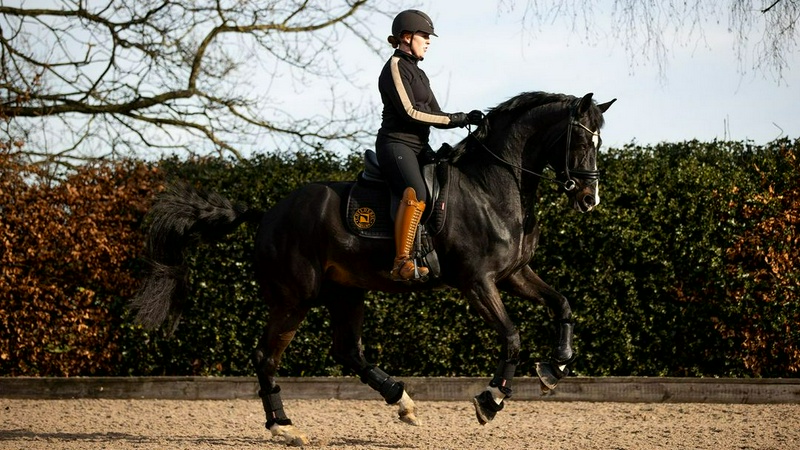
When the changes in your dressage tests are not going well, the natural reaction is often to practice more of them.
This logic seems right on the surface — practice what is not good — but very rarely is that exactly where the problem lies.
Becky Moody says: «It is very rarely the case that getting a flying change, or correcting a difficult change, is about doing more changes.
It is almost always about improving the canter.
» That is what often misleads riders.
The change itself looks like the problem — it is either late, the horse runs out through the front door, or it changes and immediately falls into trot — and that is why they go to work on it there.
But the change is only a symptom.
What is happening underneath it, namely the canter, is the real work.
«Every time, the quality of the canter comes first» The canter required for a change is not the same as the canter you might ride in other parts of riding.
This canter must be collected, but energetic, straight, balanced and — most importantly — adjustable.
Becky says: «That does not necessarily mean the problem is the rhythm of the canter.
Very often the issue is the straightness of the canter, or the balance of the canter.
And for me, the adjustability of the canter.
I think you need to have a horse that is collected, but still stays full of energy.
» A useful image is to look at a top-level showjumper approaching a big vertical.
The horse collects, but the energy does not disappear — it is compressed.
The hindquarters come underneath the body, the frame shortens and the canter looks more springy.
Becky says that same feeling, before a flying change, is what you need to have.
Not slow.
Not merely steady.
But ready and powerful.
The springboard step Here we come to Becky’s most useful idea, one you will not find in any textbook.
She says: «I like to have a springboard step.
» «The horse does not change immediately in the first part of the aid for the change.
You have a springboard step — like spring and then change, not just change.
» In simple terms: your aid has two parts.
A preparatory stride, in which you ask the horse to collect itself and jump, and then the change itself.
The whole sequence has a rhythm like this: «Ready?
Change.
» That is exactly the difference between a change that is flat and late, and a change that comes up cleanly from the body.
Riders who run into trouble usually apply the aid in one single movement — leg on, change, hope.
In that case, the horse has not had time to load the spring first.
This is where anticipation comes in.
From Becky’s point of view, a horse that is learning changes should think about what is coming next — not nervously, but expectantly.
She says: «You almost have to create a degree of anticipation.
The horse should be a little like: “Oh, what is coming now?
This is quite fun.
” Not that you are in a lovely, neat, balanced, steady canter crossing the diagonal and then you give the aid for the change and the horse says: “What?
Do not lose counter-canter one common trap, once the horse learns the change, is that it starts offering it without being asked.
The rider asks for counter-canter, and the horse, out of cooperation and overexcitement, changes lead.
Becky says: “I strongly believe that when you start teaching a horse a flying change, you should not lose the ability to ride counter-canter.
“You should be able to say: ‘Now we are counter-cantering.
And now we are going to do a flying change.
And now we are counter-cantering again.’
“Horses need to listen to what you are telling them.
“This discipline matters, because in a test, you are asked for both — sometimes only a few strides apart.
A horse that assumes every straight line means a flying change will throw one in at exactly the worst moment.
Build the change before asking for it Much earlier than the flying change itself, the foundations need to be in place.
Transitions from canter to walk and from walk to canter are the main pillars of the work — clean, on the aids, and without falling through the shoulder.
The horse should be able to come back to walk with genuine engagement of the outside hind leg, and depart into canter from a clear aid, onto the correct lead, without hesitation.
A good benchmark: can you ride around the outside of the arena and make 8 to 10 transitions from walk to canter, each time on the correct lead, in a straight line and maintaining balance?
If not, that is where the main work is.
The flying change comes from that basic work, not from simply repeating the changes.
A half-pirouette in walk is also useful here, because it asks the outside hind leg to step farther under the body, and straightens the horse before returning to canter — in fact, exactly the body shape you need before a flying change.
One exercise: figure-of-eight at the short end Once the foundations are in place, Becky’s favorite exercise is a small figure-of-eight at the short end of the arena.
“Imagine a line of poles set along the 10-meter line at the short end,” she says.
“Then you do your small figure-of-eight inside that 20x10 meter box.
” (Image credit: Future) You leave the corner as if you were going to ride a 10-meter circle at M, then you take a short diagonal line across the center line toward the short side, change direction and pick up the new circle on the other side.
The purpose of working in a small box is that it stops everything from running away from you.
Becky says: “One of the most common things when both the horse and rider are learning the flying change is that everything gets a little too forward and out of control.
” She said: “Working in a smaller space helps keep everything positively organized, without the rider having to get their hands too involved.
” It is all in the hand.
A rider whose changes fall apart is usually a rider who has finished the changes by pulling both reins.
Working in a more confined space gives you the discipline to ride the change with the leg and seat, because there is nowhere else to ride it with the hand.
A note on poles In training the flying change in dressage, poles are often used and these exercises are very effective, but Becky rarely uses them.
She said: “I’m not a fan of poles.
” She has only used them once; for a horse belonging to one of her clients that really could not understand what was being asked of it.
He said: “We did everything we could to help make the job easier for him.
This certainly helped him better understand what we wanted to do.
“Then, the changes from behind were being made late, but at least the change was being made and then we could work on it.
In the end, everything came back to the quality of the canter.
” And of course that is the very point that everything in this article comes back to again.
The poles or exercises will not fix any changes if the canter underneath is not right.
Build the canter.
Then the changes will come too.
Source: Horse & Hound