How to move the horse for a veterinary examination and when it is needed
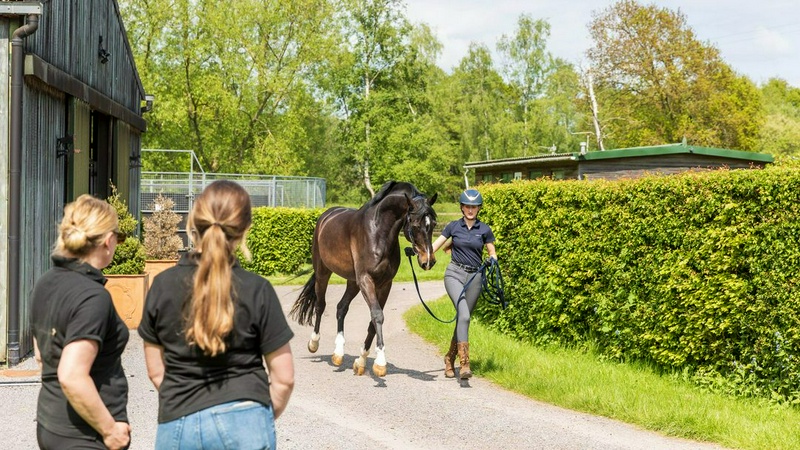
Having the right equipment, such as a safety helmet and sturdy boots, will help you move your horse with greater confidence.
A veterinarian may want to see your horse in motion for a variety of reasons, but what is the best way to do this?
A good movement allows the observer to see the horse moving in a straight, balanced line and to assess its gaits.
Veterinarians mainly use this movement to check the horse’s soundness.
Because the trot is a balanced gait and the legs move in diagonal pairs, it is easier to detect lameness or uneven loading of the legs in this gait than at walk or canter.
When are horses moved for veterinarians?
Veterinarians may want to see horses in motion as part of: a lameness examination, which may include additional tests such as flexion tests, lunging, and a ridden examination; a pre-purchase examination, in which the veterinarian is hired to assess the horse’s physical suitability for the buyer; an FEI competition in any discipline to check the horses’ readiness to compete.
In three-day events, there are two horse inspections: one before the dressage phase and another after the cross-country phase.
Horses must pass both in order to be allowed to compete box in an FEI event, the ground jury and veterinary delegate approve the horse after it has been moved or send it to the holding box for further examination.
The veterinarian in the holding box performs a more detailed examination, including palpation and assessment of the horse’s limbs, to help identify any injury, such as tendon injuries, that would prevent it from continuing to compete.
For example, a horse that has suffered a minor injury during cross-country or has lost a shoe may appear slightly unbalanced.
But after a veterinary assessment, it may be declared fit to complete a show jumping round.
Some horses are then shown in motion again, while others may withdraw from the competition in the holding box.
Veterinarians may perform a flexion test before observing your horse move.
Photo: Lucy Merrell Equipment needed to move a horse prepare to move your horse for the veterinarian with: a suitable bridle, cavesson, or halter sturdy, appropriate footwear such as yard boots How to move a horse for a veterinary examination Before thinking about how to move the horse, first choose a suitable surface.
This surface should be level and free of slipperiness, stones, or excessive softness.
Stand the horse square.
This allows the veterinarian to assess the horse’s posture from every angle.
Hold the bridle in your right hand, as if riding one-handed.
Move the horse straight ahead at a steady rhythm, and make sure there is enough slack in the bridle for the horse’s head to move freely and for the veterinarian to see any irregularities.
The horse should be energetic, but should not move too fast.
The veterinarian may signal when they want you to turn and move toward them, or if you are unsure, you can ask them to guide you.
A few steps before turning, ask the horse to change to a walk.
When turning, the horse should always move away from you so it does not step on you.
Bring the horse a little toward you and then ask it to move away.
This will allow you to turn back toward the vet in the same line.
Bring the horse directly toward the vet, but make sure you have enough control so that it does not run into them.
It is worth specifying whether the vet wants to see your horse walking first.
If so, use the steps above at a walk.
It is also a good idea to specify exactly how to move the horse for the vet.
Some vets want to see the change from trot to walk in front of them.
You should show this transition clearly.
If you have a young or inexperienced horse, practice moving the horse so that when you need to do it, you can present a straight, good movement to your vet without any trouble.
If you are preparing for a competition, it is worth you and your horse learning how to move correctly, because a horse that is not presented well may look unbalanced, even if it is not.
Malcolm Morley MRCVS believes that buyers who have been frustrated by a lack of answers may have missed the main purpose of the pre-purchase examination.
Archive image.
Credit: Peter Nixon Archive image.
Credit: BEX PATTENDEN A vet examining the front leg of a horse.
Credit: Lucy Merrell Source: Horse & Hound