How to complete a cross-country round without errors
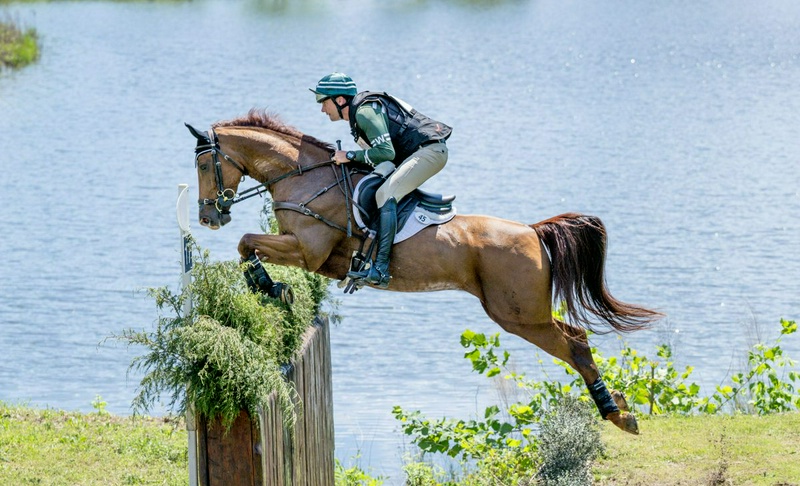
It doesn't matter whether you are competing at a beginner level or at the highest level of equestrian sport in a five-star event; the cross-country section consists of similar elements and questions.
In every course, you will see water jumps, ditches, and precision obstacles such as corners and skinnies, and in between them, there are Chaharnal obstacles; that is, more straightforward obstacles like benches, tables, and hedges.
Each cross-country course usually follows a similar pattern.
I consider obstacles 1, 2, and 3 to be Chaharnal obstacles, but they are also introductory obstacles.
You need to use these obstacles to establish your rhythm and ensure that you and your horse have enough confidence before facing the first real question of the course—a challenging obstacle or a combination of obstacles.
It is usually expected that obstacle 4 will be the first question of the course, followed by a few more Chaharnal obstacles so you can regroup and regain your rhythm before the next question.
Cross-country training sessions should build the horse's confidence and prepare it for competition.
"Checkpoint," the 10-year-old Hanoverian gelding owned by the Checkpoint group, demonstrates confidence in performing his duties.
How you familiarize your horse with these questions during training sessions directly affects your partnership with him.
The goal of each cross-country training session should be to build confidence and make that session completely sure and flawless.
To achieve this goal, you should progress your horse in a step-by-step process to strengthen its confidence and enable it to tackle these questions.
In this way, it exits the start box in competitions, jumps the introductory obstacles, and is ready to face the first real question of the course.
In this article, I will first explain how to increase your horse's confidence with two questions—a water jump and a ditch.
Then I will teach you how to reinforce this foundation by introducing precision obstacles.
I will also share my tips on the best way to prepare your horse for tackling these questions on the competition course.
You may not be able to get through all these questions in one training session, as each horse has its individual characteristics and progresses at its own pace.
If your horse understands these questions quickly and easily, you can move on to the next question, but you must pay close attention to him.
If it seems to be under physical or mental pressure, return to the same exercise on another day.
The important point about cross-country training versus competition is that training and competition are two completely different situations.
Once, one of my students asked me why she shouldn't immediately send her horse into the water during a training session; her reasoning was that she would have to do the same in competition.
In my opinion, these two situations are not comparable.
If you send your horse toward an obstacle it lacks confidence in during training, you may create a moment of hesitation or pause in it; something that is more damaging and will ultimately show itself in the competition.
You should never put your horse in a position where it doesn't understand what you want from it or doesn't trust your request.
If the horse starts to doubt you, rebuilding that trust will take time and a lot of work.
When you want to introduce a horse to a new obstacle like water or a ditch, always walk him alongside it, rather than directing him straight towards it.
Think about how your horse reacts when you approach him in the pasture.
If you go directly towards his head, he will likely take a step back and react with hesitation.
However, if you approach from his side, he will be more receptive.
Use the same logic when introducing cross-country obstacles.
Always ask him to walk alongside the obstacle and then gradually guide him towards it.
Then take him towards the landing as well so he can see the complete picture of the obstacle.
If you introduce the obstacle to him this way, he will soon realize that it is not that scary and will accept it with more readiness.
Water When you want to introduce a horse to water, instead of taking him directly to the water, walk him along it back and forth.
It is very important to keep the horse moving so he does not stop or back away.
Continuously walk him alongside the water back and forth and try to get him closer gradually; continue this until he does it without hesitation.
After that, try the same exercise at a trot.
Whether you are working with a 4-year-old horse experiencing his first cross-country or an experienced five-star horse out for a regular training session, always have him pass through the water first before asking him to jump in; even if he has done it before.
Your goal should always be to build the horse's confidence in relation to the question you are asking him to answer, and it is perfectly fine for him to step or trot through the water first.
This gives him the opportunity to understand the depth of the water and the quality of the ground beneath his feet.
If your horse is more experienced, you can expand this and eventually send him in a canter from a drop into the water or jump him from a rail into the water.
Crossing water in the competition It is your job to eliminate the element of surprise when encountering water.
I approached the water with a wide turn so that Hix De Lize, the 7-year-old gelding German Sport Horse owned by Corn and Margie Simpson, would have the opportunity to process this question.
Beginner novice: As long as you are competing at the beginner novice level, your horse should confidently walk, trot, and canter through the water.
At this level, you are required to cross water on course without any jumping element in the water; however, you may have an obstacle and then a few steps later, turn towards the water.
Your job is to help eliminate the element of surprise.
Instead of following the mowed path from the obstacle to the water, it may be wiser to jump the obstacle a little further from the water and then turn towards the water with a wider arc so that your horse has an extra moment to think, rather than facing this sequence: jump, turn, surprise—water!
Novice/Training: At the novice level, you will have a single obstacle like a roll-top and then 2 to 4 steps to the edge of the water.
At the training level, you may have an independent drop into the water or a roll-top with 3 steps to the drop.
Even if your horse has successfully jumped the roll-top many times, he may hesitate because he can see the water on the landing.
Think about keeping your turn open enough for the horse to process the upcoming question and thus prevent stopping in front of the rolltop.
Introduction: At this level, you may encounter an obstacle that reaches a drop into water with 1 stride, or an obstacle that leads to a combination with 1 stride to a drop into water with 3 strides.
Apply the same principle of the obstacle before water at the beginner/training level, but keep in mind that this combination is not as forgiving, so it is important to give your horse time to process the question.
Your goal is to be balanced and precise over the first obstacle to have the necessary momentum and give him the confidence to come down into the water.
If your counter is weak over the first obstacle, he will also land weakly, which decreases the likelihood of him coming down into the water and may lead to refusal.
In ideal training conditions, there are 2 or 3 ditches of varying sizes placed together.
Introduce your horse to the ditches in the same way you introduced him to the water.
Move him next to the ditches at a walk and turn him left and right so he has the opportunity to see them with both eyes and from both sides.
Each time you turn him, pay attention to how your horse reacts.
In fact, when he starts to accept the ditches more, he will show you when he is ready.
When you feel your horse is ready, take him over the smallest ditch at a walk or trot.
Try to maintain a soft connection with his mouth, keep your upper body behind his movement, and support him with your leg.
More than any other question, the ditches require the rider to stay behind the horse's movement.
This is crucial because your horse may exaggeratedly jump over it, especially if he is new to the ditches.
If you anticipate the jump and throw your body towards the obstacle, he may hesitate when taking off.
By staying behind the horse's movement, you will have better balance, and if he stops or jumps too much over the ditch, you will be in a position to regain control more easily.
Once your horse has jumped over the ditch once, ask him to cross it two or three more times in the same direction to calm down and jump over it confidently and quietly.
Then change direction and jump over the ditch from the other side.
When changing direction, be prepared for your horse to approach the ditch as if he is facing a completely different question.
Then work the ditch in both directions at a canter.
If this is the first time you are introducing your horse to the ditch, there is no need to go for larger ditches.
But if your horse is more experienced at jumping ditches, you can practice over a medium ditch to jump over it confidently in both directions.
After that, if it suits your level, you can progress to a larger ditch.
Overcoming the ditch on the course requires the rider to stay behind the horse's movement more than any other type of question.
This is very important because the horse may, especially if he is newly introduced to the ditch, jump over it exaggeratedly.
Novice beginner level: The ditch is placed alone.
Just like the water obstacle, if you can give your horse more opportunity to read the obstacle and organize himself with a wider turn, always do so.
This work is beneficial even if it costs you a little time on the way; because you can make up for that time elsewhere.
Novice/Training Level: At the novice level, expect an element to be placed before or after the ditch.
At the training level, an element will be both before and after the ditch.
Just as you did when your horse first encountered the ditch, support him with your body position and stay behind the movement.
If you get ahead of the movement, there is a high chance that you will create hesitation when separating for the jump, leading to a stop at the ditch or a stop at the element after the ditch.
Precision obstacles When your horse confidently jumps over water and the ditch, you can introduce precision questions like the corner obstacle or the narrow obstacle to him.
But before you test these questions in cross-country, first familiarize your horse with them in the arena to help boost his confidence.
Narrow obstacle layout: To create a small narrow obstacle, lay a simple barrel on its side and use rails on both sides as wings.
These wings act like a tunnel and clearly indicate what you want from your horse.
Corner layout: To create a small corner, lay a barrel on its side.
About 10 feet away from it, place two standards close together so that the cups face the barrel.
Place one end of a 12-foot rail on the barrel and the other end in the cup.
Repeat the same with the second rail and the second standard.
At the base of each vertical section, place a ground pole.
To create a wing and clarify your intention for the horse, place one end of another rail on the front of the barrel.
Place the other end at an angle of about 100 to 110 degrees towards the outside jump on the ground.
To start, jump both obstacles in a canter so your horse has more opportunity to understand what you want from him.
Keep the reins slightly looser than usual so that the horse's shoulders are evenly guided between the two sides of the obstacle.
Keep your upper body back and support the horse with your leg and rein contact.
This gives him the confidence to lift off from the exact line you want him to.
Once he understands the concept of this exercise in a canter, approach the obstacle in a counter.
Before jumping this obstacle in a cross-country training session, familiarize your horse with the corner obstacle in your home practice arena; just as I did here with Alcatraz, the Hanoverian gelding owned by Sarah Hughes.
Once your horse understands these questions and jumps them well in the arena, introduce him to the same obstacles in cross-country.
Especially if your horse is still new to this type of question, also use the side poles you used in the arena so that when he encounters them for the first time in an open field, he has more confidence and guidance.
Start in a canter and jump the obstacles exactly as you did in the arena.
When your horse jumps these types of obstacles confidently and consistently, remove the wings and jump them again.
Once you feel comfortable jumping precision obstacles alone, you can incorporate them into your cross-country training session.
I usually start by warming up the horse's body with the straightforward obstacles of Chaharnal, then I jump a corner and return to the simple obstacles of Chaharnal before moving on to the narrow obstacle.
It is important to include direct jumps between precision obstacles so that by jumping several precision obstacles in succession, you do not overstrain your horse.
Remember to always introduce your horse to cross-country questions in a step-by-step manner; give him the opportunity to process the obstacle, support him with your body position, and progress the training based on a progressive approach.
This approach will set you and your horse on the path to success in both training sessions and competitions.
Skill in navigating precision obstacles at the novice beginner level: At lower levels, precision obstacles are usually introduced in a gentler manner.
There may be obstacles that, in appearance or riding feel, resemble a real corner or narrow obstacle, but in practice, they are a bit more like a regular jump.
For example, the course may include a jump that is slightly narrower than a regular Chaharnal obstacle, so you need to prepare the horse a bit more for it, or a corner with a larger margin of error.
Practice: Precision-related questions at this level have a smaller margin of error compared to the novice beginner level, and you are more likely to encounter both corner and narrow obstacles on the course.
Make sure to prepare your horse well and create a strong, collected canter; you do not need a big, open stride.
The goal is to create a medium and consistent distance for the jump to ensure that your horse reads the obstacle question accurately and will jump between the flags.
Preliminary: Corner and narrow obstacles become technically even more difficult, as they are positioned in relation to other obstacles.
Therefore, it is even more important to create a strong and consistent stride so that your horse correctly understands the concept of the obstacle.
Train your eye at every level; you are likely to encounter an obstacle that has both a short and a tall section.
For example: a staircase bench (which has a short step and then two or three more steps above it), a ditch and a ditch wall, and a bush when approaching this type of obstacle, your gaze usually becomes distracted.
Practice focusing on the part of the jump that is closer to the take-off point to improve your accuracy.
For more of our reports on the Kentucky Defender 2025 three-day event, click here.
We thank the Kent Nutrition Group and Blue Seal for supporting our coverage of the Kentucky Defender 2025 three-day event, including events leading up to the competitions, interviews with riders, competition reports, horse introductions, photos, videos, and more.
This article was first published in the Spring 2025 issue of Practical Horseman.
About Ryan Wood Ryan Wood.
Ryan Wood, an Australian rider, has successfully competed throughout Australia and completed his first five-star competition in Adelaide at the age of 19.
He trained with Guy Wallace, an Australian eventer, Norbert van Laak, an Olympic dressage coach, as well as Ludger Beerbaum and Ernst Hofschroer, show jumping champions.
Wood moved to the United States in 2008 and worked for Philip Dutton before launching his independent venture named Woodstock Eventing; a facility that is now located at Linfield Farm, owned by him and his wife Lilian Herd Wood, in Coatesville, Pennsylvania.
Wood has become one of the prominent eventers in the United States, particularly known for his successful results in cross-country.
Sources and Attachments: Kent Nutrition Group Blue Seal Source: Practical Horseman – Training