Before trail riding: the best way to warm up and cool down horses
Q: Can you explain why warming up and cooling down are so important in cross-country and, for example, what warming up and cooling down your horses typically looks like in a major competition?
~ Lexy M.
, North Carolina A: Cross-country is undoubtedly the most physically demanding phase in eventing, so it is crucial to perform a proper warm-up for your horse before entering the high pressure of the competition.
A good warm-up gradually increases the horse's heart rate and breathing, enhances circulation, helps lubricate the joints, and makes its muscles more flexible for the task ahead.
Additionally, you should use the warm-up to gauge your horse's gears and prepare it for approaching obstacles at speed, as well as ensure that it is in sync with your commands for steering and speed control.
This is particularly important for its focus and adjustability on the course.
From the first obstacle onwards, you need to ensure it is ready to perform.
Cooling down is equally important.
Imagine you have just finished a marathon.
You probably don't immediately cross the finish line and sit straight on the couch to watch TV.
It's the same with horses.
When their breathing and heart rate are up and their adrenaline is high, you need to gradually bring them down so their muscles have the chance to recover and relax.
A complete cool-down for the horse is really important to give its muscles the best chance to recover, especially because you don't want them to be stiff and tight for show jumping the next day.
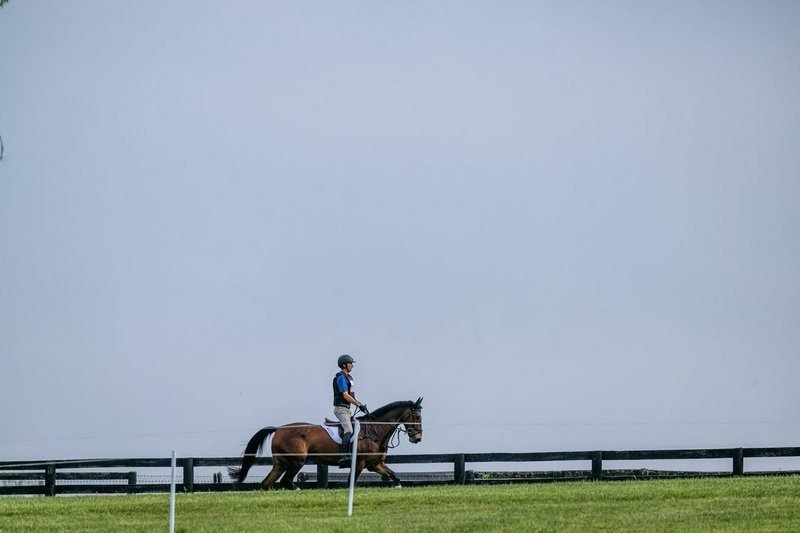
Warming up: Smart preparation I usually do about 10 to 15 minutes of light trotting, but some of my horses get really excited during the warm-up because they can see other horses galloping around the course and warming up.
In that case, I try to find a quiet space for groundwork.
If they get a bit fast and go into a canter during the trot, I just calmly let them settle into the canter if it makes them calmer; because you don't want them to be overly tense before heading out onto the course.
My goal in groundwork is to help the horses calm down and hopefully reduce some of their stress before starting to go over a few practice obstacles for warming up.
Then, in the canter, I shift the gears a bit to ensure I can reach a big, extended canter and then easily collect it again, because unlike other phases, in cross-country you really have to accelerate and switch between its different modes.
If you watch good cross-country rounds, you'll see that it's about going fast, but not with a mad gallop like racehorses on the track.
Such speed makes it very difficult to slow down and turn quickly.
It's more about maintaining that canter tempo and extending it to cover more ground while still having enough control to easily adjust the horse's strides.
I also use the warm-up on flat ground to ensure my horse maintains its balance and doesn't lean on me or fall onto the forehand.
In many ways, everything comes back to dressage work; even in cross-country and show jumping.
All of these are interconnected.
When I trot towards an obstacle at speed, I want the horses to be balanced in approaching the obstacle and to look where they are going.
I don't want them to move with their chin stuck to their chest and eyes fixed on the ground.
Therefore, I work with them on flat ground to ensure the horses are connected and truly respond to my aids.
For cross-country, it is very important to be able to easily shift gears so that you can increase speed on the course and reduce it whenever necessary.
©Amy K.
Dragoo Then, I do a few trot jumps over a small obstacle.
This is good for my body position because you never know when your horse will leave the ground in a trot, and at the same time, I think it also creates good readiness for the horses.
This exercise enhances their self-preservation sense and jumping intelligence because on the competition course, you never know when you might face an inappropriate distance and have a few trot steps inside or outside the ideal distance.
Then, I gradually increase the size of our warm-up obstacles.
In many competitions, beautiful cross-country obstacles for practice, as well as show jumping obstacles, are provided for riders.
I like to make sure my horses know which phase is coming up, so I usually only jump over cross-country obstacles.
If they make slight contact with an obstacle during the warm-up, their jump becomes sharper.
So when you speed towards the first large and square obstacle, you hope they have a clean and safe jump.
I also make sure to jump a few obstacles from an angle and from both directions.
Most courses have angled obstacles on both sides, so I think preparing for them is a wise move because horses need to lift their inside leg much quicker for these obstacles.
This is also a good exercise to ensure they jump safely and are attentive.
When Alliston speeds towards an obstacle, he wants his horses to be balanced in approaching the obstacle and to look where they are going; that's why he uses the warm-up to ensure they maintain their balance and prevent falling onto the forehand.
©Amy K.
Dragoo Near the end of the warm-up, I jump one or two obstacles at a gallop to find our stride and get the distances right at high speed.
This helps the horses get used to approaching at speed and then slowing down automatically whenever needed.
Usually, after warm-up jumps, the horses become a bit calmer, so here you can shift gears a bit more in the gallop.
Another important part of my warm-up routine, especially for a four or five-star competition with a very long and exhausting cross-country course, is that I always finish at least 10 minutes before I'm supposed to enter the competition round.
I ride about 40 minutes before the start time so we can do the warm-up and then give my horse a proper rest to catch his breath before starting.
I've seen this makes a big difference.
I find a cool spot for my horse to rest and for his heart rate and breathing rate to return to resting levels.
You should never start a long course with a horse whose breathing or heart rate is above normal because it will tire him out very quickly.
If he is overly excited from the start, completing the course becomes significantly more difficult for him.
An example of cooling down after cross-country Previously, when cross-country ended, you would immediately dismount and walk the horse to cool down.
However, a few years ago, I saw Michael Jung, Germany's top eventing rider, after finishing cross-country, gently trot his horse one or two laps and then work a few laps in light trot.
It has been shown that gradually reducing pressure is better for the horses' muscles than suddenly going from full gallop to walking.
I also took inspiration from Michael's program, which involves some galloping and light trotting after cross-country, unless my horse is truly exhausted.
In that case, we usually just do a little trotting and then dismount.
Trotting before walking also provides an opportunity to check the horse's health and soundness.
When transitioning from gallop to trot, I focus on whether the transitions seem smooth and easy or if the horse is putting some strain on its body in an irregular trot.
Kira Niyogi, HMR Roland's jaw handler, takes the gelding to the cooling box after cross-country by Alliston at Cosequin® Lexington CCI4-S 2026.
©Alana Harrison Alliston gives Roland a "good boy" pat in the vet box while the team is busy removing equipment and cooling him down.
©Alana Harrison After that, I usually dismount, loosen the girth, quickly remove the saddle, and continue walking while friends and grooms arrive with cold water.
Traditionally, we would pour cold water over the horses and then scrape it off, but the science of the best cooling methods is constantly evolving.
Now the idea is to pour as much cold water as possible over the large muscle groups and leave it there to lower the body temperature.
Then we want to remove the horse's boots to help cool the tendons, but I don't like to walk with him without boots if he has large studs under his hooves.
If he bolts for any reason, he might accidentally cut his leg.
Once he has calmed down and cooled off a bit, so I can safely remove the studs, we also take off the boots to cool the tendons.
To lower the horse's body temperature as quickly as possible, Alliston and his team pour cold water over the large muscle groups without scraping it off.
©Alana Harrison How long you cool your horse depends on your level, the temperature, and your horse's physical condition; but after a major five-star competition, especially in hot weather, we spend a lot of time cooling down.
In FEI competitions, cooling down is done in the vet box, so veterinarians are there to take the horses' body temperatures and check them to ensure they don't return to the stables too soon.
We like their body temperature to drop noticeably so the horse is comfortable before returning to the stables.
However, in many cases, when their body temperature drops, horses also calm down more easily in the stables and return to normal; because with all the hustle and bustle, from the start and finish of the cross-country rounds, they are usually still lively and excited in the cooling area.
I hope these tips help you, Lexy, to have a proper warm-up and cool-down plan for your next competition!
Ask Team Prac: Submit your training question. If your question is selected, it will be published in an upcoming digital issue of Practical Horseman and/or Dressage Today, as well as on our social media channels to help you and other riders who may be facing a similar challenge.
We are eager to be alongside you and your horse on your personal journey!
About James Alliston James Alliston, who grew up in England, has made a name for himself with numerous top international results, completing CCI5 competitions, and being part of several U.S. Nations Cup teams.
He experienced his first senior Nations Cup team appearance in 2022 at Boekelo CCIO4*-NC-L in the Netherlands with Nemesis.
In 2024, James and Karma helped the U.S. eventing team secure second place at CHIO Aachen in Germany, and they themselves were the top American combination in the competition, finishing ninth.
Source: Practical Horseman – Training