Accompanying the movement of the horse; the foundation of the rider's balance.
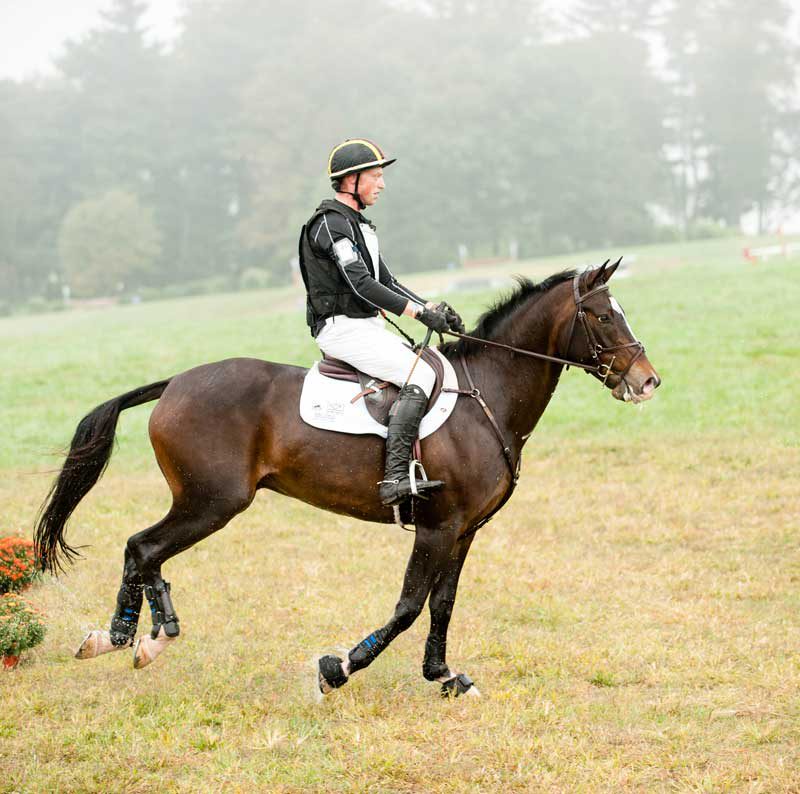
If your horse doesn't move, you don't need much skill to maintain a good position in the saddle.
You can take any unfamiliar person who has never ridden a horse before to the stable, sit them in the saddle, and adjust them until they reach a very good sitting position.
However, this perception disappears as soon as the horse takes a step.
Properly coordinating with the horse's movement requires years of practice.
This applies to every discipline.
Although the position of a dressage rider is different from that of a show jumping or cross-country rider, the fundamental principle is the same: to ride effectively, you must learn to follow your horse's movement.
It is easy to say that the only thing you need to do is follow the horse's movement; however, learning how to do that is very difficult.
In the various articles I have written about the three main positions in equestrian sports—dressage, show jumping, and cross-country—I have repeatedly emphasized that there is no such thing as a completely perfect position.
When the horse is in motion, your position must also continuously change and adapt to that movement in order to have an effect on it.
In this note, I want to talk about the necessary changes regarding an ideally theoretical position.
To begin with, it is better to define three states that your position in the saddle takes with the horse's movement: moving with the horse, lagging behind the movement, and getting ahead of the movement.
What I mean by moving with the horse is that even when the horse is in motion, you appear calm and still in the saddle; and by stillness, I do not mean being stiff and fixed, but rather that your movement and the horse's movement are exactly aligned.
One of the qualities we admire in high-level riders is their calmness and poise in the saddle.
They are masters of technique, but in motion, they are extremely economical.
Practice maintaining your position so much that you achieve this quality of calmness in the saddle in every discipline.
If your movements are not in rhythm and balance with the horse, achieving self-carriage is impossible.
Your movements, in practice, instead of helping to maintain the horse's balance, disrupt its balance.
What I mean by self-carriage is that the horse can maintain the same rhythm and speed you have asked for over a long period without needing further action from you.
This is very important because we always want self-carriage from our horses.
The concept of self-carriage is not limited to the dressage arena.
This quality also contributes to a good round in hunters and is essential for safe riding in cross-country.
If you go beyond English disciplines, you will see a very educational example of self-carriage in action when you look at a photo of a cutting horse working in one of the previous notes.
In fact, by practicing sitting slightly behind the movement and slightly ahead of the movement, your ability to sit calmly and in complete balance with your horse improves.
(Remind yourself that when you move from one end of the spectrum to the other, you have passed the point of complete balance.)
Like all our educational discussions, we start with dressage because this is the foundation of your connection with the horse.
The difference between getting ahead of the movement and lagging behind the movement in dressage should not be noticeable to an ordinary observer.
These are subtle changes in your upper body positioning, not the obvious—and sometimes even harsh—changes you see in jumping disciplines.
The simplest example of when you need to sit back from the movement is when you have a slow and sluggish horse.
This type of horse needs to be constantly monitored in its forward movement, and you should sit slightly behind its movement to maintain its motivation.
(It should be noted that the slower your horse is, the more sensitive your hands need to be.
It takes the slightest increase in contact as an excuse to slow down.
) To sit back from the movement in dressage, you need to shift slightly to the back of the saddle without losing the curve of your back.
The body position is completely vertical, but the emphasis should always be on the lower leg.
If your horse needs constant reminders from the lower leg, carry a dressage whip and use it behind the leg while applying the leg aids.
Before using the dressage whip, take your hand off the reins to ensure your aids do not interfere with each other unintentionally.
To engage your legs and back while keeping your hands soft, you need an independent seat.
In general, your horse will always respond to the aids you didn’t want it to hear.
If you can sit quietly and without tension in the saddle ahead of the movement, riding horses that tend to quicken their pace and lose rhythm is easier than riding sluggish horses.
You must remain prepared, balanced, and still, as spirited horses will take any extra movement from you as an excuse to go faster.
With such horses, keep the lower leg quiet and imagine you can slide a banknote under your seat bones.
This will make you sit slightly ahead of the movement.
Shortening the stirrups by one hole may be beneficial for you, as it helps you stay slightly ahead of the horse's movement.
If you have a horse that speeds up, make sure you do not hit it.
As I recommended here, sit and familiarize it with the internal leg aid and the external rein.
Staying with the movement over obstacles now shifts the discussion from dressage to jumping; a part that requires the same subtle adjustments in body position to bring the horse to self-carriage over the obstacle, which I explained earlier in dressage.
If your horse hesitates when taking off or pauses at the jumping point, you should use the whip right at the moment of takeoff and encourage it with your voice.
When the horse lifts off the ground, you should feel the need to follow with your upper body to stay in sync with its body arc over the obstacle.
This will keep the horse in front of your legs.
Using the whip and vocal encouragement at the jumping point usually resolves this issue.
However, if the horse's reluctance is stronger, you may also need to provide stronger encouragement.
If your horse noticeably falls behind your legs as it approaches the obstacle, the first step is to close your legs in the narrow area of the horse and use the whip just behind your leg.
I do not teach using the whip on the horse's shoulder.
Applying the whip in this way, without simultaneously pulling the horse's mouth with your hand, is difficult; and this means your aids conflict with each other.
If the legs and whip do not solve the problem, open the angle of your pelvis and bring your shoulders back to position them directly above the pelvis.
This work helps the horse to stay ahead of you and protects you if it makes an uncoordinated effort over the obstacle.
However, the world is not always ideal, and you may have to resort to more drastic measures to get over the obstacle.
Bend your back and tuck your seat bones under your body.
Normally, you should have a gentle curve in the lower back, but this is no longer the time for classical riding.
Bending from the waist, as seen in the photo of eventing rider Doug Payne, artificially raises your thigh and places your center of gravity even further back from the horse.
When doing this, be sure not to pull the reins back; because this is exactly the excuse the horse looks for to brake, and in that case, all your efforts will be wasted.
Arching your back and bending from the waist causes you to lag behind the horse's movement, which is a positive point in this position; however, this is only a temporary solution, as it makes your body stiff and inflexible.
Body stiffness may be useful in the short term, but it is not a long-term solution for good riding.
The reasons that may cause your horse to show reluctance to jump encompass a range of factors; from inadvertently pulling the reins back while turning or in the air over the previous obstacle, to the loss of confidence of your horse (or even yourself; as the horse senses your attitude), lack of training, exposing the horse to conditions beyond its capability, or hidden pain that has not been diagnosed in the horse's body.
Of course, you can use short-term solutions and push through for now, but be sure to investigate the root cause and train your horse in a way that prevents this problem from occurring, rather than constantly resorting to temporary fixes.
Now let's consider the opposite situation: a horse coming at the obstacle with speed.
Just as some horses tend to go faster in dressage training, some also accelerate when jumping instead of slowing down.
Your reaction to the obstacles should be similar to the advice I gave for groundwork; that is, you should sit with the movement, not against it.
When your horse rushes to the obstacle, change the lower leg to a neutral and calm position; that is, the leg should be soft but not loose, and slightly close the angle of your hip.
Regardless of how high your horse raises its head and neck, maintain a straight line from your elbow to the horse's mouth.
Gather both hands without pulling back, ensure your shoulders are ahead of your hips, and keep your leg in that neutral position.
Riders often lean back on a horse that is rushing and pull the reins; an action that only worsens the bad situation.
When you pull back against your horse, it usually takes its body out of the correct position, drops its back, and leans on your hands.
When the horse reaches this form, no bit in the world will solve your problem.
You rarely see hunter horses accelerate on the way to the obstacle, as hunter riders have realized that by sitting in front of the movement, not behind it, they keep the horse calm as it approaches the obstacle.
The ultimate result of our training, in whatever discipline it may be, is to be able to sit exactly with the movement of our horse at all moments.
These changes in body positioning that I explained may seem exaggerated at first, but the better your horse understands what you want to teach him, the more subtle these changes in your body position should become.
These differences are very practical and you should master them, but they are a means, not the ultimate goal.
Your desired goal should be a horse that maintains its balance and self-carriage without needing your assistance.
Source: Practical Horseman – Training