The steady rhythm is the key to better jumping with a horse.
Whenever I am at a horse riding competition and see several hundred riders, whether as a judge or a coach, I often think that among all of them, only a few make it look easy and smooth.
Only a few!
What is the problem with many of the other riders?
What difficulties are they struggling with?
Why are their rounds not uniform in terms of rhythm and jumps?
"Lack of control" is a phrase I often write on my judging sheet for adult and young rider classes, but why?
In my opinion, the reason is that these riders are too preoccupied with finding or creating the right distance.
As a result, they misjudge and make the horse nervous.
Sudden and late decisions can make any horse anxious and heavy-mouthed.
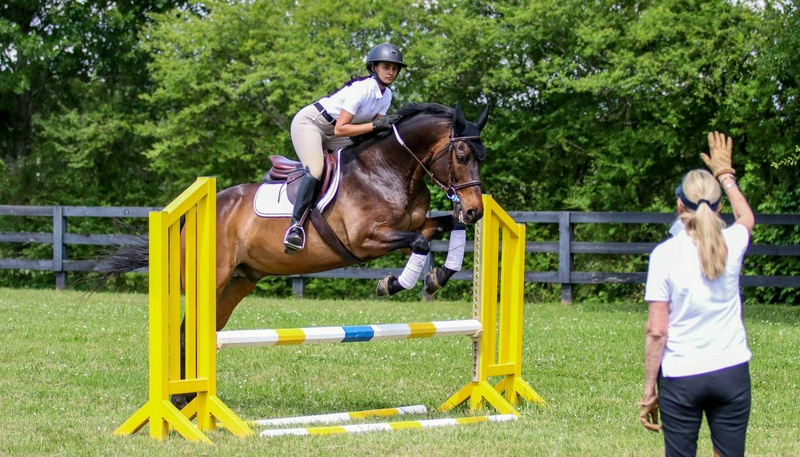
Holly stops about four strides after landing from the jump and tells Bahavia Madadi to focus her gaze on her hand from a few strides before the jump.
This helps the rider, who is anxious about seeing the right distance, not to interfere; her focus is on the hand, not on changing the rhythm.
© Julia Murphy When a rider interferes too much, the horse almost always becomes stronger and more unmanageable in the section after the jump.
If the rider misjudges the distance and arrives at the first jump of the line with a short and compact stride, and then interferes too much to get the correct number of strides down the same line, the result will be a horse that becomes strong and hard to control down the line.
The problem is that most riders are too focused on the distance.
Some coaches try to help the anxious — and often desperate — rider with seemingly clever methods and complex terms, and when the horse is three strides away from the take-off point, they start counting loudly.
One coach counts: "One, two, three," and another counts in reverse: "Three, two, one."
I think to myself, what happens if the coach starts counting too early?
Is the next stride called "negative one"?
All of this puts complete focus on guessing the take-off moment; something like the feeling of being thrown!
Another problem arises when unaware riders are convinced that by telling the horse the jump timing, they are helping it; while in reality, they themselves do not really know what the correct timing is.
Unless the rider is very skilled and experienced; otherwise, this can completely confuse the horse.
Riders may send conflicting messages, and the result can be total chaos.
In some cases, it would have been better if the riders had closed their eyes!
Of course, I am not really suggesting that, but at least it would eliminate many of the wrong and misleading signals.
Note: When approaching the jump, focus on a steady rhythm.
If riders have enough experience, they can support from a suitable distance, but within the framework of this discussion, riders who sit calmly in the saddle and allow the horses to manage the distances themselves provide the most help to their horses.
Now, considering all of this, what can riders do?
They should change their priorities when cantering towards the jump and focus on a steady rhythm instead of finding the distance.
The most important principle is to start with a good forward rhythm.
Then they must maintain that same rhythm; that is, they should not let the canter change with an increase or decrease in speed.
The focus should be on this, not on the distance.
As long as the rider maintains their balance and keeps the rhythm, the distance will also be safe.
The horse will also be more comfortable, and the canter over the jump will continue with the same cadence.
As my ex-wife used to say: "Jumping with a horse is just flatwork with obstacles in the way."
To achieve this goal, I will explain four exercises.
Exercise 1: Trot and canter through the poles Layout: Set up a vertical jump with a pole on the ground, then remove the jump pole and the ground pole so that only two poles remain.
Position it so that you can canter at least four strides in a straight line, both before and after it.
(You can also arrange the vertical jump so that you can jump it on a large circle or in an eight pattern.)
A modified two-point position: Keep your heels just below your hips so that your feet and lower legs are directly under your body.
Bring your shoulders about 30 degrees ahead of the vertical line and bend from the hip joint so that your seat just slightly leaves the saddle.
© Julia Murphy Start sitting-trot rising and establish a forward and steady rhythm in a circle on one side of the arena.
Once this position feels comfortable, look between the two poles and pass through in a straight line from the center of them with a trot.
Throughout the approach, focus on maintaining the same trot rhythm, the same speed, and the same straightness.
All trot strides should be the same.
Doing this without the distraction of a real jump is easier, but the poles give you a sense of approaching the jump.
After your horse has trotted through them, change direction and repeat the exercise on the opposite side.
When your horse feels comfortable, take a nice, calm, and relaxed canter and go into a position that I call the modified two-point.
Make a circle at the canter, then look from the center of the poles and pass through them in a straight line while maintaining the same rhythm and speed of the canter.
Focus on maintaining your two-point position.
After your horse has cantered through them, turn around and repeat the exercise.
When this position feels comfortable, move on to the next exercise.
Exercise 1: Bahavia in her two-point position passes through the two poles at a canter, focusing on maintaining the rhythm, speed, and straightness of Risotto de la Roque.
© Julia Murphy Exercise 2: Canter over the ground pole Layout: Place a pole on the ground between the two poles from the previous exercise.
Maintain the same canter you had when passing through the poles and get into a two-point position.
Approach the ground pole and maintain the rhythm, speed, and straightness of the canter until you reach it.
Do not worry about the distance.
When riding towards the pole, look at it.
This is for depth perception.
If someone throws a ball at you, you can't catch it until you look at it.
If you don't look at the pole or jump, there is no way for your eyes to gauge how you are going to reach it.
When you look somewhere else, you can't see the distance.
When you feel your horse has it in sight, lift your gaze and focus on a point at the end of the arena, at eye level.
Stay completely calm and soft in your position and allow your horse to canter over the pole.
If the horse jumps over the pole or leaps from it, follow its movement but do not lean forward yourself.
Go back and repeat the exercise.
When you can maintain a steady rhythm while crossing over the pole, try the next exercise.
Exercise 2: Bahavia focuses on the two-point position, rhythm, speed, and path of movement when approaching the pole on the ground.
He is not worried about "seeing the distance."
Exercise 3: Countering over a small obstacle setup: create a small vertical obstacle between two standards and place a pole on the ground on each side of it.
Note: If you maintain your balance, your horse can adjust its stride.
Establish a good rhythm in the counter, go into the two-point position, and approach the obstacle; throughout this process, think about maintaining that same rhythm and keeping your position.
Do not worry about the distance.
If you stay balanced, your horse can adjust its stride.
Look at the obstacle until you are sure your horse has it in sight, then raise your gaze and look at something at the end of the arena, at eye level.
Let your horse jump towards you.
You have already positioned yourself correctly for the jump, so when the horse leaves the ground, there is no need to change your position.
Leaning forward causes you to get ahead of the horse's movement and increases the likelihood that the horse will not jump the obstacle well.
Go back and repeat the exercise.
Exercise 3: Holly creates a small obstacle and emphasizes that Bahavia should focus on the rhythm of the counter when approaching the obstacle, not the distance.
If Bahavia maintains his position and balance, Rizoto can adjust its stride.
Exercise 4: Counter and look away from the obstacle even after practicing the above exercises, some riders become anxious when jumping and make unnecessary changes in their approach to the obstacle.
They either push the horse forward or collect too much, resulting in not reaching the right and comfortable point to take off from the ground in front of the obstacle.
At that moment, their focus is no longer on rhythm and balance until reaching the obstacle.
When I encounter a rider who acts this way, I ask them to perform the following exercise: Setup: Ask your coach or one of your friends to stand at the landing side of the vertical jump from exercise 3, four strides away.
When you are a few strides away from the obstacle, they raise their hand.
Take a balanced and calm counter and approach the vertical obstacle as you did in exercise 3.
Maintain the same rhythm and speed and focus on the straightness of your line of movement and your two-point position.
Do not make any changes to the horse's stride.
A few strides before the jump, ask your coach or friend to raise their hand.
While maintaining the same rhythm, speed, and line of movement, look at their hand.
Keep your gaze on the coach's or friend's hand as you pass by them.
When you feel comfortable at this stage, ask your coach or friend to gradually move to the side of the obstacle.
At this point, the obstacle is almost out of your line of sight.
Maintain your position and let the horse jump the small obstacle by itself.
Exercise 4: After Bahavia jumps the vertical while looking at Holly's hand a few strides away from the landing spot, Holly gradually moves to the side of the obstacle.
When you work on this exercise, your less intervention helps the horse.
When you look at your trainer or friend, you can only focus on the rhythm, not on the distance.
The best part of this exercise is that if you follow these instructions, the jumps will come out smooth and effortless.
If there is any change in distance, it is very minor and opens your view, as you gradually realize that just by staying still and maintaining a steady rhythm, the result improves significantly.
This method always works; it’s almost like magic!
When you experience the advantage of not making big changes, the results become quite tangible, and it will be easier for you to sit quietly and intervene less.
Maintain the rhythm and ride like a star!
Note: It is easier to sit quietly and intervene less when approaching an obstacle.
About Holly Hugo-Vidal Holly Hugo-Vidal, who works at Arbor Hill Farm of Scott and Nancy Boughey in Canton, Georgia, has a very intensive program with her junior and adult riders alongside holding clinics and judging.
She, along with her former husband, Victor Hugo-Vidal, managed the successful show jumping club Cedar Lodge Farm in Stamford, Connecticut, and learned from her ability to help anyone motivated to achieve their goals.
Her next coach, show jumper Rodney Jenkins, taught her how to read horses and instill a desire to please in them.
She is the author of the book Build Confidence Over Jumps!
Source: Practical Horseman – Training