Dressage solution for a straight and precise centerline
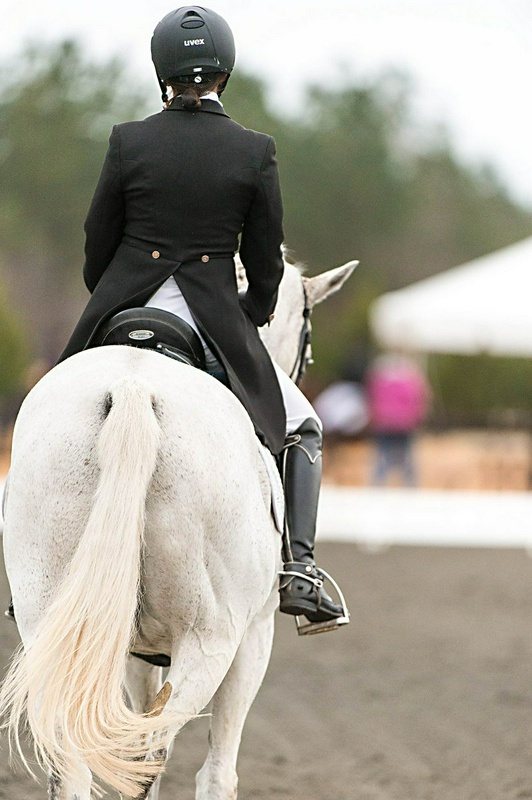
Question: My horse and I compete at the First Level and our scores on the centerline fluctuate a lot.
My gelding tends to drift off the line when turning onto it, and sometimes he anticipates the halt; therefore, the judge's first and last impressions of our test are not what I would like them to be.
How can I achieve straight and precise centerlines that not only score well but also showcase my horse's movements and our coordination?
And what is the best way to practice centerlines at home?
~ Debbie N.
, Colorado Answer: Debbie, rest assured you are not alone.
Many dressage riders at all levels face similar issues on the centerline.
The reality is that simply repeating going straight does not necessarily make us better at straightness.
Instead, we go straighter when we teach the horse to bend correctly and respond properly to the aids.
You need to ensure your horse is well-trained to know what the correct response is to the amount of pressure you apply with your leg.
Additionally, your receiving aids must also be present and ready to collect the forward energy of the horse.
To help with all of this, I recommend practicing a lot of leg yield exercises, zigzags of leg yield, and turns on the haunches.
Incorporating shoulder-in on the centerline can also be beneficial.
My old coach and mentor Charles de Kunffy constantly asked me to do shoulder-in on the centerline, even with 5-year-old horses that were difficult to steer around the arena; because the essence of the matter is to get the horse between the aids.
Charles taught me to get to the root of the problem and understand why my horse is not straight; and often, the simple reason is that the strength and training of his hind legs are not equal.
That is why the horse may drift off the line or quicken the rhythm.
Also, keep in mind that anything you feel in the reins is a direct reflection of what is happening or not happening in the horse's hind legs.
You need to work on strengthening his hind legs and ensure that they connect equally to both sides of the bit.
Preventing drifting off the line, the first two points I focus on to prepare for going on the centerline are to ensure that I am distributing my weight evenly over both seat bones and that my horse is correctly connected from the hind legs to the bit.
To maintain straightness, imagine you are riding your horse in a defined corridor; something like a safe space where you must strive to stay in the center.
Your thigh bones act as the ceiling, and your lower legs are the walls.
Then, focus on keeping the horse within this space with a stable seat and legs.
To correct drifting, I suggest working your horse away from the wall.
One of the main reasons horses drift on the centerline is that we allow the wall to do part of the job that we should be doing ourselves.
Many times while riding along the wall, horses respond to the inside leg, but because the wall prevents their hindquarters from swinging out, it becomes easier to overlook that your horse should also respond to your outside leg.
Then, when you enter the open space of the centerline after having relied on the wall to do half of your job, what happens?
Your horse starts to drift.
Therefore, this is a clear sign that you are not effectively utilizing your external aids and have relied a bit too much on the wall.
If you incorporate more of the center line in your home exercises, you will be forced to use both legs more evenly, which will help you better recognize the moment your horse starts to drift.
It is also important to consider whether one of your legs is stronger than the other, as your horse may drift towards your weaker side.
If you tend to pull one rein more than the other, or if your horse is stiffer and less flexible on one side, this can also lead to drifting.
To prepare for entering the center line, Gigi Tait, a member of Team Prak, ensures that she distributes her weight evenly over both of her seat bones and that her horse has continuity from its hind legs to the bit.
In this picture, Tait is riding Connemara Kinmount Gunsmoke Gideon at the 2016 Winter Equestrian Festival in Wellington, Florida.
Try to be more aware of your aids and ensure there is a balance between your active aids — that is, legs, seat, and hands — and your receiving aids; those same signals you use to direct your horse's forward energy.
If your horse starts to fall in or out when you turn onto the center line, focus on finding that ideal balance between your aids.
For example, to test my active aids, I make sure my horse is responsive to my inside leg.
If I apply that leg a bit and one of his ears turns towards me, I know he is listening.
When you add the inside leg, you should want your horse to be soft in the chest and side and engage its hind legs more.
It is equally important to ensure you are receiving your horse's energy in the outside thigh, outside elbow, and outside ring finger.
This allows you to capture and contain his energy so that he does not over-respond to the inside aid and leak out.
Practicing the turn on the forehand can help your horse become more responsive to the inside leg while ensuring you can organize him and receive that energy in your outside aids.
Preventing your horse from anticipating on the center line to eliminate his tendency to guess, I am a strong advocate for practicing a lot of transitions on the center line.
When I was working with Gyula Dalos in Budapest, we went down the center line a thousand times — and practiced transitions all across the center line.
Before I practiced with Gyula, I think I kept the center line for specific situations, namely my tests, and that method did not work well at all.
At home, practice more on the center line and quarter line, incorporating transitions of trot-walk-trot-halt into these lines.
This teaches your horse to be more focused on your aids and less reliant on the test itself; you want him to anticipate your signals, not a pattern he has practiced a thousand times.
The zig-zag leg yield is an excellent exercise to get your horse to be obedient, stay on the aids, and not anticipate the halt and salute before reaching X on the center line.
To prevent your horse from anticipating the halt on the center line, include several transitions of trot-walk-trot-halt in your center line practice at home.
This work teaches him to rely more on your aids and less on the test itself.
In the image, you see Will Coleman and Diabolo on the centerline in the dressage CCI5*-L at the 2026 Kentucky Defender three-day event.
All these exercises ultimately help you showcase the quality of your work on the centerline; transitioning between working trot, extended trot, working trot, extended trot, working trot, halt, and back to trot.
The more complete your horse's training becomes, the better you can enter that more expressive trot with greater motivation; something that helps maintain body alignment and allows for a larger and smoother step without losing balance.
Ultimately, by helping your horse become stronger in the hindquarters and more responsive to aids, you will improve the quality of his steps.
Then you can ride with more motivation, suspension, and fluidity, and maintain your line with greater confidence.
Do you have a question for the Practical team?
What is Practical Horseman+?
To learn more about all the benefits you will have as a member of Practical Horseman+, click here.
To learn more about JJ Tate and the Tate Academy team, see here.
Source: Practical Horseman – Training