The lesson of that course is for improving jumping with horses over flatwork.
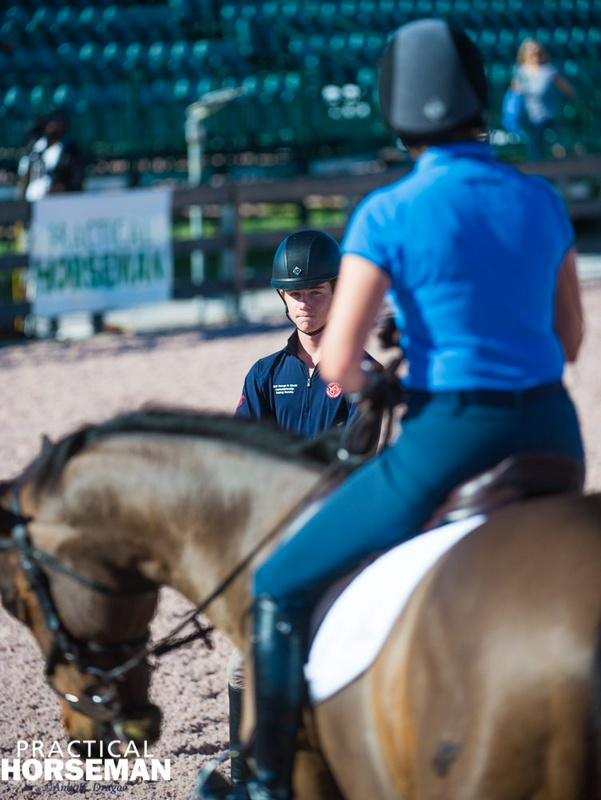
That course designer, a five-time Olympic rider, on the first day of the 2017 US Equestrian Horse Mastership training session, George H.
Morris focused on the connection and feel of the rider with the horse through USHJA.
He repeatedly emphasized that mindfulness plays a key role, both during the riding demonstration and while guiding the 12 riders present at the clinic.
He said, "When I ride, I feel the whole horse; every single part of the horse."
Riders were reminded that their legs, seat, and back are not separate from their body and that instead of working against the horse, they should work more with the horse to build confidence in the horse.
He said, "Self-awareness and having the correct body position means being soft and flexible, but not stiff and frozen.
I had a coach who always said my hands are in my seat; my hands are behind me."
12 riders from across the country were selected to attend this annual clinic.
This day was dedicated to working on flatwork in the international arena of the Adequan Global Dressage Festival in Wellington, Florida.
He promised the riders that focusing on flatwork and dressage would help their jumping.
He said, "Connection for jumping with the horse is extremely important.
If you are crooked, your horse will jump crooked too.
You can really solve all jumping problems through dressage work."
After a short demonstration in which he impressed the audience with his remarkable skill in controlling the bucking and rearing of his 8-year-old horse, Caspers Lasino, the riders were divided into two groups, and he carefully assessed their body positions.
He demonstrated the importance of a short rein and later tied all the riders' reins together so they would have to work with more flexibility and give-and-take in their rein work.
Once again, they were reminded that their legs, seat, and back are not separate from their whole body and that to create confidence, they should work more with the horse instead of against it.
He warned, "Self-awareness and body position mean being soft and elastic, not stiff and frozen.
A stiff rider makes a stiff horse."
They lengthened and shortened the trot and transitioned from a light trot to a sitting trot and back again.
They made countless transitions.
Then, in a two-point position, they maintained their balance to see if their horses accepted the seat and reins lightly.
He also asked the riders to guide their horses into small circles to assess their responsiveness.
Riders were selected from across the country, and the participants in 2017 included Caroline Dance from Pennsylvania, Cooper Dean from Alabama, Coco Fath from Connecticut, Madison Gutzman from New York, Emma and Gracie Marlow from California, Brian Moggre from Texas, Maya Nayar from New York, T.J. O'Mara from New Jersey, Hailey Robinson from California, Taylor St. Jacques from Virginia, and Michael Williamson from California.
He asked one of the riders, Cooper Dean, to release his stirrups to sit deeper in the saddle; as he was having trouble getting his horse to move forward in the trot without breaking the rhythm of the stride or falling back.
His mantra throughout the day to the riders was, "Sit in the saddle."
He asked Cooper to focus on the rhythm by keeping his body back and his hands together.
When it came time to turn left, he told him to use more of his left leg in the tight spot and to focus more on releasing and re-taking.
The trainees practiced the shoulder-in movement to the left; where they were told to keep their hands level, but to bring their upper body and both hands slightly to the left.
He said, "Take a little and let go a little."
He added, "Push with your seat and receive with your hands. Keep the inside leg active."
Then he mounted the horse Cooper for a practical demonstration and when the horse responded positively, he let go.
He explained, "I feel his mouth. When he lowers and stretches his neck, I let go."
To demonstrate how to release and take with the hands and seat, he mounted the horse Cooper Dean.
Although it is usually not recommended to do such a thing, he asked them to occasionally look down to check the progress of their horses.
He said, "When the horse bends, I let go and reward. When he accepts the contact, I let go. I sit the trot to see if he accepts it or not. When he takes the subject, I maintain my seat and hand contact. When his neck goes down, I follow his movement. If he leans a bit on the bit and pulls, I also resist a little. Do not move your hands saw-like. My hands are very light. When he fidgets with his mouth, shake the reins a little to get his mind on his hind legs."
He said he rides with his whole body.
He said, "My whole body drives the whole horse. Pay attention to the horse every time. The whole body of McLean drives the horse. The whole body of Bezi drives the horse. You don't see them just pulling the horse's head to one side with their hands."
Then, "just for fun," he tied a knot on the reins of all the riders.
This knot made the riders have longer hands and allowed them to release and take more with the reins.
They weren't sure if this exercise was meant to be fun, but soon realized that this exercise was valuable, as their horses became softer and more responsive.
He asked them to work on the turn on the haunches to isolate the horses' hips and get the shoulders moving.
Maya Nayar's horse was backing away from this exercise and he told her that as soon as she felt the horse backing up, to deepen her seat and move the horse's hind legs forward with her seat.
He emphasized once again the importance of feeling to achieve responsiveness.
He said, "To be a great rider, you have to do all sorts of things. The sign of a great rider is a happy horse."
On January 6 and 7 for more from George H.
A review of the key points from the Morris Horse Mastership training session with coaching by Bezi Madden and Laura Kraut.
Source: Practical Horseman – Training