.
.
Things like that.
However, the story doesn't end there.
Spend some time with horses, and you'll come to believe that there is a kind of connection between horse and human that cannot be measured.
The worst of them sense our fears and exploit them to their advantage; the best of them understand our dreams and take us to places we've always wished to reach.
For example, Carawich was such a horse.
Not many people get the chance to ride in the Olympics.
During the period when you're involved in the training and selection process, you don't have any time to think about anything else.
If you're lucky, you're so busy riding in the Olympics that you don't even have time to think about it.
Only after the games end do you get the chance to reflect on your experiences, on that long, hard, and winding road that brought you there, and most of all, on how lucky you were to have a horse that was Olympic caliber.
And inevitably, you ask yourself whether you'll ever find such a horse again.
By the spring of 1977, I had ridden in the 1968 and 1972 Olympics, but those experiences were becoming distant memories.
It had been five years since I had been part of any team, and in fact, since 1972, I hadn't won any competition above the preliminary level.
I had competed with an endless string of horses that were almost good enough; but when your goal is to ride at the highest level, "almost" isn't enough.
I hadn't given up on my dreams yet, but I was gradually starting to think that maybe soon I would have to trade dreams for reality.
That spring, I was coaching at Badminton and standing in the yard of the Duke of Badminton's hunt stables, waiting for the first veterinary inspection to begin when Lars Sederholm came up to me, and we talked for a few moments.
Lars, a genius in working with horses, had an incredible impact on my riding, and I always welcomed any opportunity to catch up with him.
By that time, the horses had started walking around the outer perimeter of the yard, and we went over to the crowd control barrier to watch the proceedings.
Lars got distracted by someone else, and I stood alone by the barrier for a moment, continuing to watch these amazing creatures as they walked past me.
Suddenly, I noticed a large, handsome, dark bay horse with a bright muzzle walking towards me.
His strides were huge, smooth, and fluid, and he immediately caught my attention.
Just as he reached me, he stopped and turned his head towards me.
Suddenly, that strange and eerie feeling came over me as if he was looking directly into my eyes, separating and evaluating me.
I was transfixed, and the hairs on the back of my neck truly stood up.
I can't say how long he stood there staring directly at me, because for me, time had stopped, and I could no longer hear the crowd, see the people around me, or anything else but this horse, who was intently looking into my eyes.
The groom impatiently pulled the rope in his hand, but the horse stayed there for a moment and looked at me.
Then, as if saying "hmm" to itself, it turned its head forward and started walking with the same strong and athletic steps.
I grabbed Lars' arm, interrupted him, and asked, "Who is that?"
And pointed to the receding figure of the horse.
Lars replied, "Oh, that's Karavich.
An extraordinary horse, but you can never buy it."
I told Lars, "Okay," but in my mind, I thought: "What a strange experience I just went through."
I watched Karavich for the rest of that weekend, and it really was extraordinary, but when I returned to America, I put the whole affair out of my mind.
In those years, international rules required that for a horse to be eligible to compete in the World Championship or the Olympic Games, both the rider and the horse owner had to have the same nationality by January 1 of the competition year.
By then, it was early December 1977, and I was gradually realizing that I was not going to get a chance to ride in the 1978 World Championship.
All the good horses in America were already taken by others, and my search for a horse in other countries had also been fruitless.
I was 34 years old, ready, and at the peak of every ability I could show.
If I didn't ride in the 1978 World Championship, I would have to face a long and dark three-year period of training, with little hope of making it to the 1980 Olympic team.
This upset me, but it was the reality, and it was better to get used to it.
At that point in my life, I was buying and selling English and Irish horses.
I was looking for a horse for one of my clients when it suddenly occurred to me to contact Lars Sederholm and see if he had a horse for sale.
Lars said, "Hello, Jimmy.
What a strange coincidence.
I just got off the phone with the owner of Karavich.
His rider is pregnant, and they have decided to put Karavich up for sale."
I immediately said, "Then call them back and say it's sold, subject to a veterinary examination."
We chatted for a few minutes about other horses and then hung up.
I thought to myself, "Now what?"
I didn't have the money to buy Karavich, so I eventually raised the money by using my life insurance as collateral.
It was the best business decision I ever made in my life.
We finalized the deal in time for my name to be registered in the ownership documents before the new year began, and thus began my partnership with the best horse I ever rode in my life.
I still vividly remember that when I first sat on his back, I felt as if I had put on a glove.
I rode him for four years, and not once did it happen that I didn't feel like he was reading my mind.
If I saddled him for a bit of dressage practice, he would stand still like a statue.
But as soon as I put on the show jumping saddle, he would start prancing and bucking in the cross-ties; even before I mounted him, he understood the difference.
When he came to me, he had a terrible and demeaning stable name.
I care a lot about a horse's stable name, but at the same time, I am very superstitious, and they say changing it is bad luck.
I said to myself, "Well, friend, you've found a new life, and my equestrian life has certainly taken a better path, so I'll change your stable name and call you 'Pop.'
Your jump over the obstacle is truly explosive, and 'Pop' is the nickname cowboys give to the wisest and most experienced person in the group."
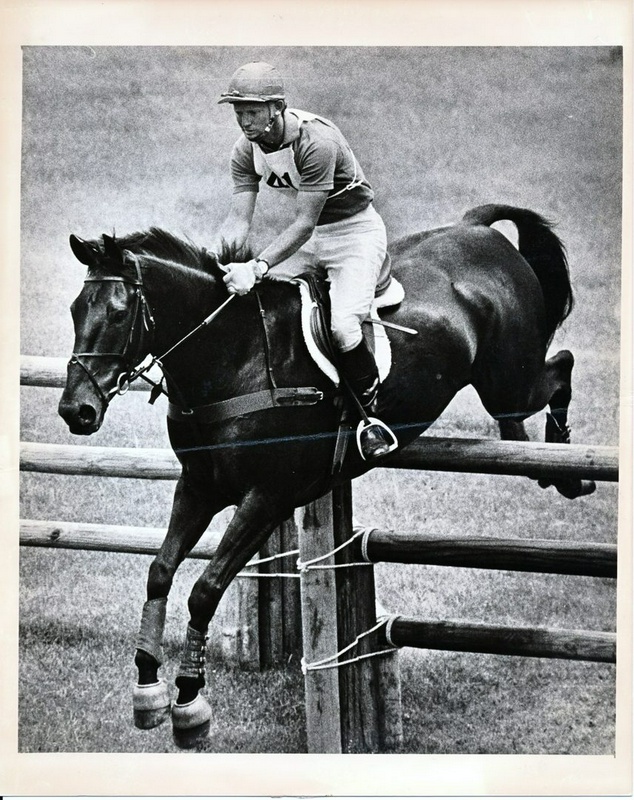
Pop gave me the greatest thrill of my riding career at the 1980 Olympic replacement in Fontainebleau, France.
In essence, he understood the importance of that position and practically galloped with me on a terrifying cross-country course.
This is not an approved strategy for the first rider of a team, but I really had no choice.
Pop had taken control of everything.
The only thing I can say in my defense is that I had enough sense to sit quietly and let the race run itself.
We finished with the fastest round of the day and an individual silver medal.
Is it strange that I loved him more than any other horse?
This photo, taken in the spring of 1984, is the last competition image Wofford had of Carawich, Pop.
Before I finish my words, let me tell you another story.
Usually, horse people don't let a horse rub its face against them.
They consider it rude and you must be careful that an animal weighing about 1,000 pounds more than you doesn't push you around.
After being with Pop for a while, I decided to set this rule aside just for him.
He appreciated it and greeted me every morning with the firmest and most enthusiastic face rub.
When he retired, I placed him along with Alex in the southern pasture of our farm in Upperville, Virginia.
Occasionally, I see horses that I instinctively love and know how to ride.
I saw Alex when he was 4 years old and fell in love with him at that moment, but it took 10 years for USET to allow me to ride him.
Of course, when that happened, we won the national championship, but that's another story.
Anyway, despite all the affection I had for Alex, he didn't rub his muzzle against me.
He knew the rules and respected the bond between me and Pop.
When I went to visit them in the southern pasture, both would come to greet me at the gate, and Pop would thoroughly and joyfully rub his face against me; at the cost of dirtying my shirt and sweater.
After I had to put Pop down, I couldn't go to the southern pasture for a day or two; I knew the pain would be too much for me.
But eventually, I had to go and see how Alex was doing alone.
When I called him, he came straight and firmly towards me and rubbed his face against my chest.
As he did this, I cried, and I think Alex did too.
Reprinted from the book "Take a Good Look Around," written by James C. Wofford, with permission from the University Press of America.
All rights reserved.
This article was first published in the February 2017 issue of Practical Horseman magazine.
Wofford passed away on February 2, 2023, at the age of 78, at his Fox Covert Farm in Upperville, Virginia.
Source: Practical Horseman – Training