Yoga exercises with Biz and Boyd for better riding
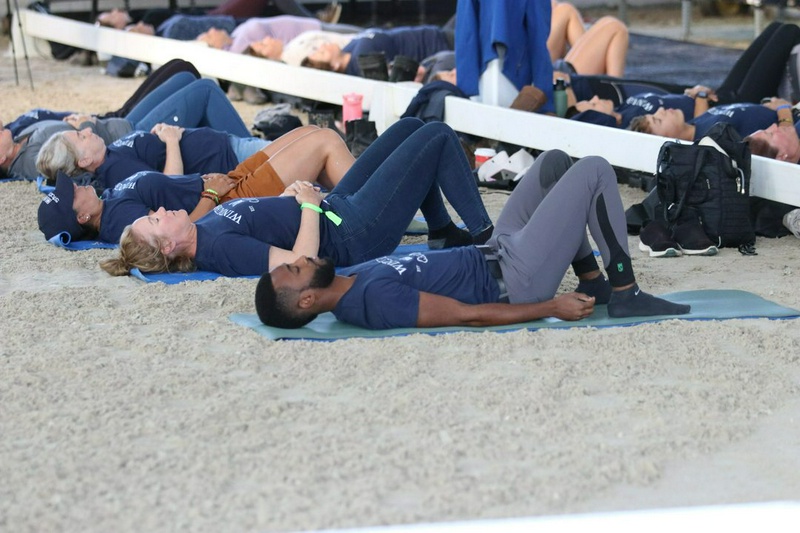
Early in the morning on the last day of "Camp Windura" 2026, Boyd and Silva Martin — the third annual and intense weekend dedicated to individual training and lessons for this couple — Practical Horseman had the opportunity to participate in the camp's yoga class led by Biz Magarity, Boyd's longtime coach.
In the first part of this two-part series, Magarity discussed the physical and mental benefits of yoga for riders and explained how this practice has transformed Boyd's performance in the saddle.
She also described the important role of yoga in the professional longevity of riders and explained how you can easily start this practice if you are new to it.
(To review the first part, click here.)
In the second part, we review a few movements that Magarity taught to participants in the Camp Windura yoga class — and this amateur yogi — while Boyd demonstrated them, and sometimes the Martin family dog, Sugar, came to help.
Everything starts with the breath. Even if you don't know much about yoga, you've probably heard that breathing is a key element of this practice.
Magarity said: "The amazing thing about the breath is that it directly affects our nervous system.
It can wake you up at the start of an early, sleepy day; it can help you fall asleep; and when you need to focus, it provides that for you."
To adjust our breathing pattern and calm our minds, Magarity asked us to start lying down; knees bent and feet on the ground, about mat-width apart.
She explained: "Think of the abdomen in two parts: the lower part and the upper part.
Place your left hand on the lower part of the abdomen, with the left thumb on the navel.
Place your right hand on the breastbone so that the right thumb is on the sternum."
She continued: "Now we do a two-stage inhale.
Imagine sending the breath to your left hand, hold it for a moment, then continue the same inhale until the air completely reaches your right hand in the upper part of the torso.
Pause again, as if you want to hold the breath right in front of your throat, and then exhale."
Magarity guided us through this breathing pattern a few times and then asked us to take a normal but deep inhale through the nose.
She said: "You should feel your abdomen rise slightly under your left hand, and as the entire chest fills with air, the ribs expand.
Hold the breath for a moment and exhale all the air from the lungs before the next inhale."
Breathing from the sides and body rotation Then, Magarity asked us to sit up and extend both legs in front of us.
She said: "Cross your right ankle over your left leg.
If your right hip rises, try to press it down towards the mat.
Interlock your fingers, bring your hands in front of your body, and gently pull to the left to feel a good stretch on the right side of your body.
As these muscles open, focus on breathing into the right side of your chest."
Next, bring the right knee towards the chest and cross it over the left leg so that the right foot is in a triangular position.
You can hold the right knee with your left hand while simultaneously reaching your right hand towards the ceiling to create a slight rotation to the right.
» Magarity continued: "Take a deep breath and as you exhale, while being mindful of the person next to you, fully extend your hand to the right.
» He asked us to repeat this movement a few times and then perform the stretch and breathing for the left side.
He said: "Just like horses, we always want to do everything on both sides in a balanced way.
» Table pose for cat and cow movement Then, Magarity asked us to get into the table pose; a position where you balance evenly on your hands and knees while keeping your back straight to prepare for one of the versions of the 'cat and cow' movement.
He said: "In the table pose, when you bend your elbows, you are tempted to let them go to the sides.
When this happens, the shoulders rotate forward and gather towards the ears.
Instead, rotate the hands from the shoulder area so that the elbows point towards the hips; this way, when you bend them, the muscles of the outer shoulder and back of the arm are activated.
The same principle applies to the downward-facing dog movement.
From the table pose, Magarity taught the participants of the Windura camp how to perform one of the versions of the 'cat and cow' movement.
©Encanto Sports After arching the back and lifting the chin for the 'cat', Magarity told the participants to exhale, round their back, and lift the pelvis for the 'cow' and enter the downward-facing dog pose.
©Encanto Sports He said: "For the 'cat', inhale to arch your back, lift your chin, and open your chest, and then for the 'cow', exhale to first round the back and then lift the pelvis and go into the downward-facing dog pose.
If your hamstrings are still a bit tight, keep the knees slightly bent.
Now bend the elbows again and keep them close to the sides.
This puts more pressure on the hands but creates more strength in the shoulders.
» He added: "Then, move your head slightly around to make sure your neck is not engaged and lower the knees back to the ground and return to the table pose.
We repeat this movement a few times and then finish the work in the child's pose by bringing the pelvis towards the heels.
» Magarity said if your wrist hurts in positions where you are on your hands, you can make a fist and balance on the knuckles.
The 'windshield wiper' movement to calm the body After a more intense training session, Magarity asked the participants to lie on their stomachs to prepare for the 'windshield wiper' movement; a movement that helps calm the nervous system.
The Martin family's dog, Sugar, also arrived to ensure everyone's form was correct.
©Encanto Sports Then, Magarity asked us to lie on our stomachs and face down while letting our face rest between our hands and keeping the body relaxed.
He said: "Bend your knees so that the soles of your feet face the ceiling and move your legs like a windshield wiper from one side to the other.
When you lie face down, all the nerve endings of the spine come forward and help calm the nervous system.
» He added: "This movement is a good one whenever you feel you need a break in the middle of the class.
» Plank and downward-facing dog movement set Then Magarity asked us to get into the high plank position.
He said: "Exhale and move the body back to reach the downward-facing dog position.
Take a breath and return to a high plank.
Exhale and go back to downward dog; inhale, bring your right leg up behind your body without hitting the person next to you, and then place your right foot forward completely to get into a hamstring stretch.
Inhale, raise your right hand for a twist, and we repeat this move three times.
During the plank and downward dog sequence, Boyd demonstrates lifting the right leg from the downward dog position with the help of Sugar.
©Alana Harrison asked the participants to perform the same exercise on the left side after completing this sequence on the right.
Here Boyd is demonstrating the left leg hamstring stretch while Sugar takes a short nap.
©Encanto Sports He continued: "Then we repeat the plank and downward dog flow and then bring your left leg forward to perform the same breath and twist move this time to the left."
Meditation Magerty said one of the great benefits of yoga is that it teaches you how to use your breath to calm yourself whenever you feel frustrated, anxious, or even overheated.
He said: "Some people do this very easily.
For others, when they remain still, their brain and nervous system seem to go out of control."
He added: "If you are one of those people who have trouble sitting still, this part of the session may be challenging for you."
Magerty asked us to sit facing the open space of the field and find a comfortable seated position while keeping our spine elongated.
He said: "This meditation session is going to be a little different because I want you to start it with your eyes open.
Find a focal point.
This point could be a shadow or a depression in the sand."
To conclude the yoga class, Magerty guided the Windora Camp participants through a meditation session.
He reminded them that one of the great benefits of yoga is that it teaches you how to calm yourself using your breath whenever you feel frustrated, anxious, or even overheated.
He said: "Take a few deep breaths and blink a lot to moisten your eyes.
Then open your eyes and stare at your focal point, trying not to blink.
When a thought comes to your mind, or your stomach growls and you wonder what breakfast is, tell your brain to ignore it, open your eyes wider, and stay focused on your focal point."
He added: "If you want, you can even give it a name."
"I named my focal point 'Wilson'; after Tom Hanks' volleyball friend in the 2000 film 'Cast Away.'"
While we were still staring at our focal points, Magerty asked us to notice how our field of vision begins to change.
He said: "Maybe the peripheral part of your vision becomes clearer, or maybe blurrier.
Sometimes you might see different colors or something might appear brighter."
"For me, the peripheral part of my vision became blurrier and Wilson clearer; I also saw more light with a rosy tint."
"Now close your eyes and lift the palms of your hands and gently press on your eyes while keeping your head in the same position you had with your eyes open.
You might feel under your hands that your eyes have warmed up and it seems like a little tear has gathered in them."
"Bring your hands down and keep your head in the same position, as if you are still looking at your focal point.
Even with your eyes closed, you probably see something like the negative of the same point you were staring at," Megarty said.
"Your mind still knows it's there.
"I definitely saw a negative of Wilson!
"Summary About two months before Boyd turns 47 this summer, I also turned 47.
Although I am certainly not an Olympic eventing rider, my personal yoga practice has been very beneficial for my riding, and I fully welcome Megarty's reference to Boyd's fitness program in the first part of this series: "The yoga routine, fitness, and overall health that Boyd has built for himself is entirely focused on how he can stay in this sport for another decade or more and perform at his highest level.
"As an adult amateur rider in the hunter/jumper discipline, I also want to stay in the saddle as long as I can.
We hope this series of yoga lessons from Windurra Camp has better explained the benefits that this practice sometimes seems a bit intangible for riders and encourages you to try it if yoga is not yet part of your off-riding training program.
You might be surprised by the numerous and amazing ways it can transform your physical and mental strength in the saddle.
Read the first part of this series titled "Yoga with Biz and Boyd: Why and How to Practice" here.
For more information about the annual Windurra camp owned by Boyd and Silva Martin, click here.
Source: Practical Horseman – Health