Jessica von Bredow-Werndl talks about the pressure of life at the top
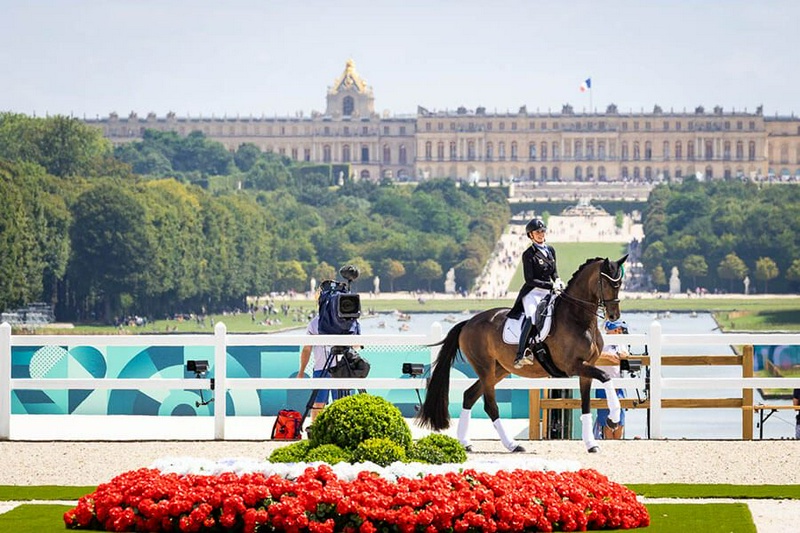
Rebecca Ashton says being number one in the world in dressage has dimensions beyond what meets the eye...
The Olympic Games are not easy.
The necessary work discipline, the anxious wait to find out if you have made it to the biggest sports stage in the world or not, long hours, the required mental strength, and focus.
And this is just about the journalists!
For the athlete, the Olympics are a real test of human spirit and physical ability...
And it has essentially always meant that.
And for equestrian sports, you have to consider two athletes; one of whom is completely dependent on the other.
So is reaching the highest championship podium really all smooth and effortless?
When you see some riders on social media, or watch them competing with big smiles at competitions, you might be justified in thinking that everything is really that easy.
Some seem to be born for this.
Some are made for it.
And then you say to yourself: I want such a sports life too; because really, what is not to love about it?
But what we usually don't see is the whole story; the pain and heartbreak that can be on par with reaching goals as grand as Everest.
One of these athletes is Jessica von Bredow-Werndl, the German dressage star and Olympic gold medalist.
Jessie is blonde, beautiful, and articulate, lives on a stunning estate, has the best horses in the world to ride, has a beautiful family, and is incredibly successful.
In the last two Olympics, she has won team gold and Olympic gold.
She is the perfect example of a "golden girl."
Her life seems flawless.
Don't believe it?
Just check her Instagram account.
That's why it was a valuable opportunity to sit down and have a conversation with this Olympic gold champion; what resulted was a candid and honest discussion about the pressure the Olympics impose even on the most prepared athletes and defending champions.
What's the first thing Jessie says about Paris?
She said: "It was incredibly exhausting.
The photos were amazing; on the last day and in the final, when I was able to see Paris, I really loved it, enjoyed it, and realized how much of the city was involved in the Olympics.
But during the games, when I was competing, I was just in my own bubble; going from the hotel to practice and back to the hotel again.
Now looking back, it's amazing that I was able to do it again.
But compared to Tokyo, it was much harder.
The pressure was unbelievable, also because I hadn't lost for three years.
Then I lost in Paris; Cathrine Laudrup-Dufour on Freestyle defeated Jessica and Dalera in the Special competition.
It was the first time, and suddenly I was no longer the one in the main contender position.
She said: "Those 23 hours between the team competition and the individual competition were incredibly exhausting mentally.
" How did she cope with this situation?
She said: "I have a lot of tools.
This was the hardest mental test of my life.
I don't think anything in sports can be harder than this.
She said: "I do a lot of things, I have rituals and habits to stay in this moment and now, because there is no fear in the now.
Fear is just a picture of the future.
However, reaching this point requires many strategies to not be overly afraid of potential consequences.
Breathing techniques, EFT, and many other things, so I could focus on what was happening at that moment.
I had to be kind to myself.
No matter how it ended, my value as a human being did not change.
» For Yessi and the Germans, reaching team gold was a relief, but at the same time, it increased the pressure on her to win an individual medal.
She said: "After I lost in the Special, they really didn't expect me to win the next day.
A new winner had come, and you could really feel it in the scores."
Yessi recalls that on the day of the individual test, "That day I really didn't want to be in Paris.
I wanted to be anywhere else.
I told my husband I wouldn't do this again.
Many times I ask myself why I do this?"
So why does she come back and continue this path again?
She said: "I don't know.
But I want it.
I'm not addicted to it.
I like to challenge myself, but in a completely healthy way.
I love what I do.
I like to see how I can keep and manage my horses motivated in a positive way, to see how I can reveal their full potential.
Because this ability is in my horses.
So when I return to Paris, from the outside it looked amazing, it really was amazing, but at that moment it was completely exhausting for me.
While winning in Tokyo was exciting and overwhelming, Paris was more of a relief.
It was very hard."
Although these two Olympics had a completely different feeling for this German star during the competitions, their impact on her was also very different after the competitions ended.
She explained: "However, to be honest, I was more exhausted after Tokyo.
After Paris, I managed myself with more awareness.
After Tokyo, I was completely drained.
Immediately after the championship, it was like I was euphoric, but the slump that came afterward was very intense.
For a few weeks, I couldn't feel joy, or sadness, or anything else, and it took about six months to find inspiration and motivation again.
She said: "Fortunately, in between, there was the European Championship, and I had to force myself to get back to my usual routine, but it was hard work.
This was my lifelong dream and childhood dream that came true, but then what?
Everyone talked about post-Olympic depression, but I'm not saying I was depressed; however, I could imagine what depression feels like because I felt so empty and useless.
"Also, immediately after the Olympics, I became pregnant and lost the baby right after the European Championship.
All of this added to the other issues, and everything was really hard for me.
Jessie says sometimes she still can't really believe she became an Olympic champion again.
She said: "I look at the medals and say to myself, did I really win them?
Because you think you should be a different person and feel different, but it's not like that.
It doesn't change the most important things in your life.
She said: "And if things don't go the way you want, it's still the same.
The most important things don't change.
This made me mentally strong.
Paris is over.
No one talks about it anymore.
Now everyone is talking about Los Angeles.
Me too!
"How did he come out of that tough situation after Tokyo?"
He said, "After Tokyo, I had no plan because I had never experienced such a feeling before.
It took time.
I remember it was February when I felt inspired and motivated again.
Of course, after Paris, I didn't have that feeling anymore.
It's really strange.
I didn't have a mental breakdown anymore.
I was ready for it.
I planned a few days off for myself and took care of myself.
Being aware of what might happen sometimes helps prevent it."
Jesse quickly emphasizes that everyone struggles with different issues, but now he can get through those difficult periods better than before.
He said, "I know when to be hard on myself and when to embrace myself.
That's what I learned between Tokyo and Paris.
That's what I needed for Paris.
I had to be kind to myself before the individual test.
This doesn't change my worth as a human being.
I can't offer anything more than my best effort."
So next time you see an athlete with a big smile and a shiny gold medal around their neck, know that they are also a real human with real problems.
But what makes them stay afloat instead of sinking?
They find solutions, make plans, and believe in themselves.
Source: The Horse Magazine