The calf comes into contact with parts such as the stirrup strap and the edge of the saddle during riding, and this constant contact can cause friction, redness, and skin discomfort.
On the other hand, choosing the right tall boots is not easy for all riders because the shape and size of people's calves vary.
This is where gaiters can come in as a practical solution.
What are riding gaiters?
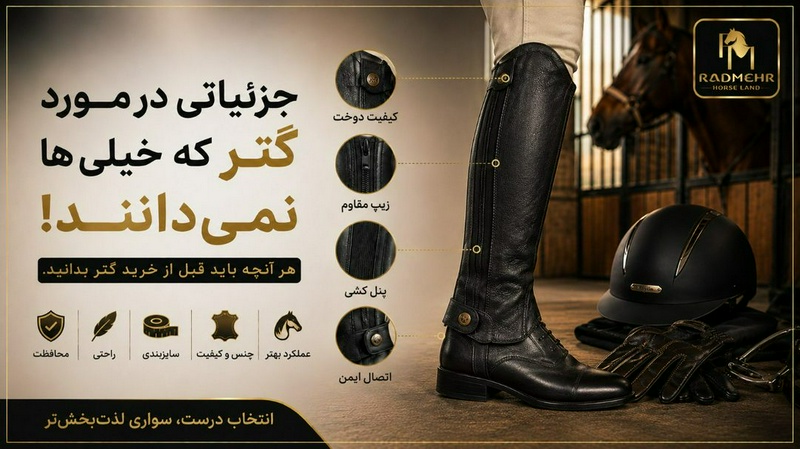
Riding gaiters or Riding Gaiters are protective leg coverings that usually cover from the ankle to below the knee.
Gaiters are typically used with short riding boots, and this combination creates an appearance and coverage similar to tall boots.
The three main features of gaiters are: Coverage range: from the ankle to below the knee Protective role: creating a layer between the calf and equipment Connection point: combining with short riding boots Therefore, gaiters should not be considered merely an accessory; their design aims to provide coverage, protection, and better coordination of the calf with riding equipment.
Why does a rider need gaiters?
A rider's calf may constantly come into contact with the stirrup strap and the edge of the saddle during riding.
Repeated contact can cause chafing and skin irritation.
Gaiters can help reduce these problems by creating a protective layer and provide more comfort for the rider during long rides.
The most important benefits are: Reducing friction and skin chafing Helping to prevent redness and calf discomfort Providing protective coverage against equipment contact Increasing comfort in long rides So the application of gaiters is not just aesthetic; their main purpose is to protect and create more comfortable conditions for the rider's calf.
Gaiters; a smart alternative to tall boots Tall boots or riding boots create an integrated and professional coverage, but fitting them on the calf is not always easy.
The boot may be suitable in foot length, but its calf shape may not align with the rider's leg.
In such situations, the combination of short boots + gaiters can be a more flexible option.
This combination: Creates an appearance close to tall boots; Usually costs less; Allows for separate selection of boots and gaiters; Can be practical for riders who have fitting issues with tall boots.
Important note: Gaiters are not an absolute replacement for tall boots; rather, they are a practical solution for achieving suitable calf coverage.
Materials and design of gaiters; what options are available?
Gaiters are made from various materials, and the choice of material should align with the type of use and the level of care required.
Natural leather Natural leather has high durability, a professional appearance, and good formability; however, it requires regular care.
Suede Suede is soft and flexible and is widely used in Half Chap models.
Synthetic leather and modern materials These options are usually more economical and have simpler maintenance in many models.
In addition to the material, pay attention to elastic panels, grip sections, and structural design of the calf.
These details can affect the stability of the gaiter and freedom of movement.
Detailed gaiter sizing guide Choosing the right size is one of the most important steps in buying gaiters.
For measurement, you need two main indicators: 1.
Calf circumference Measure the calf circumference at the widest part of the calf muscle.
2.
Measure the height of the leg from the sole, excluding the heel, to the crease line behind the knee.
The golden rule of measurement is that it should be done in conditions as close to real use as possible; that is, with the same socks, riding pants, and boots that you intend to use with the gaiter.
This ensures that the selected size is closer to real riding conditions.
What is the standard fit of a gaiter?
A suitable gaiter should be snug and fitted, but not cause uncomfortable pressure.
If it is too loose: it will move on the leg; it will have less stability; it may not provide the desired performance and appearance.
If it is too tight: it will cause pressure; it can lead to numbness; it reduces freedom of movement; it puts more pressure on parts like the zipper.
About new leather gaiters New leather gaiters may initially be somewhat tight and fitted.
This does not necessarily mean they are too small; because natural leather can better conform to the shape of the leg with use.
The correct fit means the gaiter stays fixed on the leg but does not restrict the natural movement of the ankle and knee.
Does a gaiter enhance riding skills?
No; a gaiter alone does not improve riding skills.
Real skill comes from training, practice, body control, and proper execution of techniques.
However, suitable equipment can create better physical conditions for the rider.
A gaiter, by helping to: reduce friction and skin discomfort; provide better coverage stability; increase comfort; provide more suitable physical conditions; can help the rider be less distracted by equipment discomforts and focus more on technique, balance, and connection with the horse.
Therefore, the impact of a gaiter on riding skills is not direct; rather, it happens through creating comfort and better conditions for practice.
Principles of gaiter maintenance and extending its lifespan Proper maintenance is as important as choosing the right gaiter.
1.
Cleaning Remove dirt, mud, and sweat from the gaiter after riding.
2.
Drying Dry the gaiter at room temperature and away from direct heat.
Direct heat can particularly damage leather.
3.
Care For leather gaiters, use care products suitable for the type of leather.
4.
Inspection Periodically check the zipper, its teeth, elastic or rubber panels, and sensitive parts of the gaiter.
A small defect, if identified in time, is usually much easier to fix than a serious breakdown.
Golden checklist for buying a gaiter Before buying a gaiter, check these items: 1.
Material quality The material of the gaiter should match the amount and type of your use.
2.
Leg fit It should neither be too loose nor too tight.
3.
Zipper quality The zipper should be smooth and its structure reliable.
4.
Construction quality and design The elastic panels, grip, and other details should perform adequately.
5.
Stability and freedom of movement The gaiter should stay fixed on the leg and not restrict natural foot movement.
6.
Compatibility with boots The gaiter should be suitable for use with short boots.
Important and supplementary criteria in buying a gaiter, first focus on the main criteria such as quality, fit, structure, and comfort.
Features like appearance, breathability, and ease of maintenance are also important, but they should not replace the main criteria.
Summary Riding gaiters are not just a simple leg cover; they are part of the rider's equipment set that can play a role in protecting the leg, reducing friction, increasing comfort, and providing better stability.
However, a more expensive gaiter does not mean it is better for everyone.
The best gaiter is one that matches the anatomy of your leg, riding boots, and your type of use.
If the size is correct, a proper fit is achieved, the material aligns with your needs, and the gaiter is properly maintained, this equipment can create a more comfortable and professional riding experience for you.
Ultimately, the goal of the gaiter is not to replace your skill; its purpose is to ensure that the equipment distracts you less so you can focus more on riding, technique, and connection with the horse.