Joe Stockdale's suggested jumping exercise for improving the horse's straightness and balance
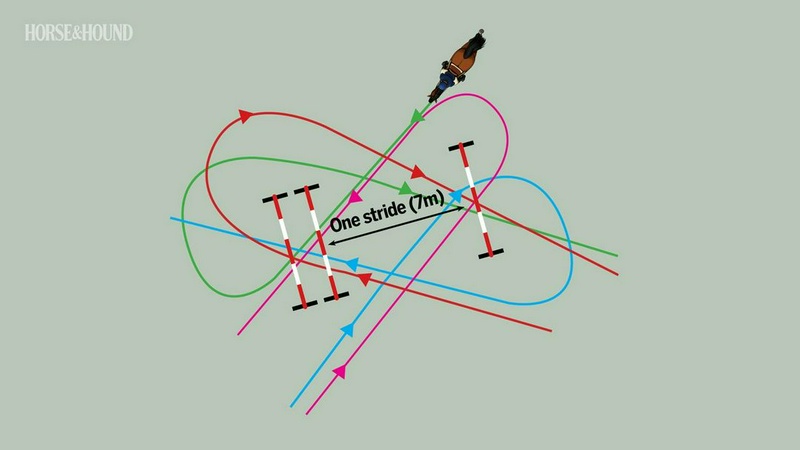
Joe Stockdale shared this simple jumping exercise with two obstacles with Horse & Hound.
He often uses this exercise as a warm-up because it helps establish a connection between the horse and rider, shows that all the "buttons" are working correctly, and ensures your horse listens to your aids and commands.
These two obstacles, although set up in a related distance line, are jumped as single obstacles and at an angle; this provides multiple options for lines, angles, and different patterns for the rider.
Focusing on approaching at an angle here is more challenging and demanding compared to the usual straight lines.
This requires your horse to be more engaged and connected, listening to your commands rather than jumping on autopilot and just cantering around the course without spirit.
Objectives of jumping obstacles at an angle: determining which lead the horse lands on, increasing responsiveness to aids. With just two obstacles, you can execute four different routes (Image credit: Future). For this exercise, you need three pairs of jump wings and poles to create a vertical and an oxer.
This exercise can be done in an arena or in an open field.
Set up a one-stride double with a vertical and a square oxer on the diagonal of the arena to have the most space around the obstacles.
Both obstacles can be jumped from both directions.
This jumping exercise is suitable for all levels, so set the obstacles at a height you feel comfortable with.
Joe demonstrated this exercise with his 1.60m jumping horse, Cacharel, over obstacles around 90cm to 1m and says, "I rarely jump over 1.10m at home."
How to execute this exercise: Warm up in walk, trot, and canter on both reins.
With lots of transitions between gaits, ensure your horse listens to the aids.
You might want to jump a warm-up obstacle first; for instance, a cross-pole, or whatever you usually do at the start of a jumping session.
In this exercise, both the vertical and the oxer should be approached at an angle and jumped as single obstacles, not as part of a double.
You can play with different lines.
Always approach the obstacle you want to jump as the second part of the double.
The reason is that you don't want the horse to pass by an obstacle it has already locked onto; this is more likely to happen if you separate the first obstacle and the second is in the horse's line of sight.
This means you should always approach at an angle.
As shown in the diagram, try circles, turns, and figure eights, and determine which lead the horse lands on.
Finally, jump the double straight and complete a couple of times to reset the horse and the exercise.
Tips and troubleshooting: 1.
Back to basics: For young or inexperienced horses, you can set the double distance to two strides to make it less demanding for them.
This makes the approach angle less steep and gives the horses more time to see the path ahead.
2.
Work on weaknesses: Every horse naturally has a preferred landing lead.
You can practice various exercises by approaching and landing on different leads.
Avoid leaning to one side, but look in the direction you want to go and slightly open the inside rein; this should affect the hand your horse lands on.
Want more ideas?
Our complete library of daily practice inspirations source: Horse & Hound