Eight simple exercises to improve balance and self-carriage of the horse in canter
Sometimes the simplest training exercises are the most productive.
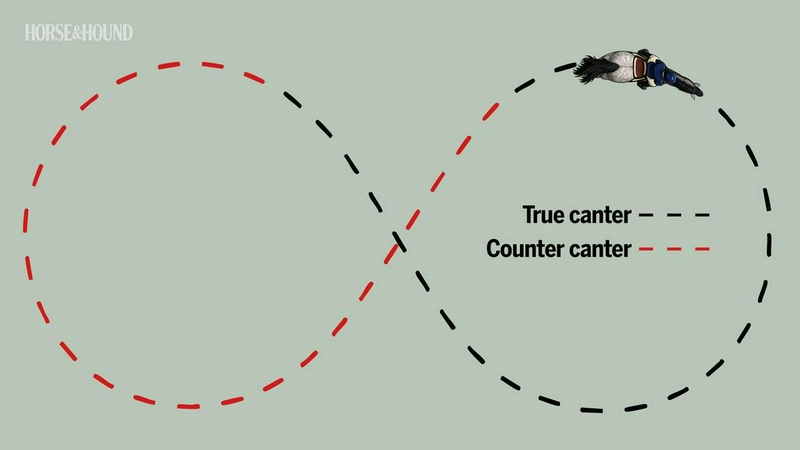
This simple yet challenging flatwork exercise practices counter canter on a figure-eight pattern to help improve the quality, elevation, and balance of the canter.
I once had a very lovely Irish eventing horse that jumped incredibly well but was built on the forehand.
I found that counter canter really helped him lift his shoulders and move with self-carriage.
We did this exercise before every dressage test, and our scores improved dramatically.
This exercise is suitable for horses whose canter is well-established.
These horses should already be able to lengthen and shorten their strides in the same rhythm, perform loops in counter canter, and maintain 15-meter circles in canter while keeping rhythm, balance, and impulsion.
If you are still in the earlier stages of training, try the teardrop exercise to introduce counter canter.
Goals of using counter canter to improve canter: Enhance balance, elevation, and self-carriage Improve suppleness and flexibility Exercise layout This exercise requires no specific setup.
You can do it in an arena or open space; anywhere that allows for two 20-meter circles.
How to perform this exercise Warm up the horse with walk, trot, and canter on both reins.
You may want to do a few loops in counter canter to prepare the horse for the exercise ahead.
Establish a balanced and active canter and move around the entire arena.
Collect the canter slightly to ensure the horse is listening to you and engaged in the work.
Start with the left rein and begin the figure-eight with a 20-meter half-circle to the left.
As you cross the diagonal, continue in counter canter on the left rein and enter the second 20-meter loop to the right.
Keep your weight centered and align your upper body with the new direction of movement.
Your left leg should remain on the girth to maintain bend and impulsion; the right leg should be slightly back to control the horse's hindquarters and maintain the left lead canter.
The horse's poll should flex softly to the outside of the circle while maintaining bend on the leading leg.
Complete the second loop of the figure-eight in counter canter, then return to the correct canter lead as you cross the diagonal again and complete the pattern.
Repeat the same on the other rein.
Tips and troubleshooting 1.
Quality, not quantity If your horse becomes disunited or changes leads while attempting to complete the loop, it indicates that the canter is unbalanced or lacks sufficient engagement and activity.
To start, practice just a few good steps of counter canter along the diagonal and into the corner, and increase it as the quality of movement improves and suppleness increases.
Only work on counter canter as much as your horse can maintain it with good quality.
2.
Back to basics If the 20-meter half-circle is too challenging, practice shallow loops in counter canter to develop suppleness and a better understanding of aids.
The key principle is that counter canter should improve the canter, not harm it; therefore, you may need to simplify the exercise to allow your horse to gain the strength and balance necessary to maintain a correct and consistent rhythm.
Want more ideas?
The complete library of daily training inspirations See our practice Source: Horse & Hound