Diamond exercise for improving the bend and alignment of the horse's movement
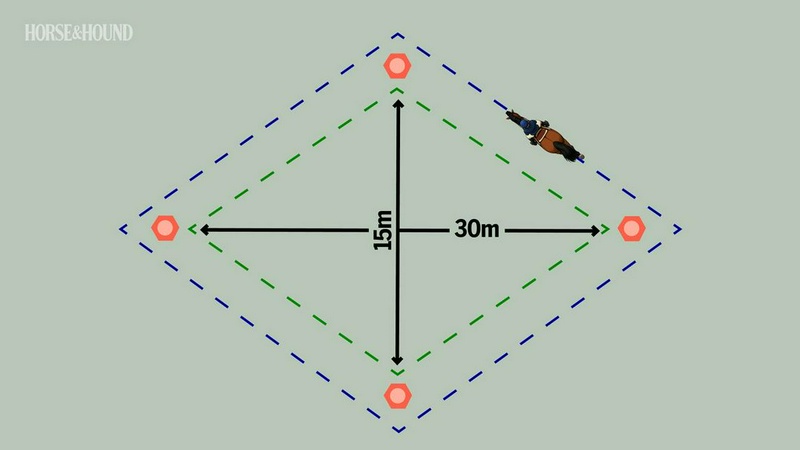
This "diamond" exercise is very suitable for training young or inexperienced horses; horses that deviate from the path when they should move in a straight line, or fall inside or outside when they should bend around the rider's leg. This flatwork exercise can be done in walk, trot, and canter, and as the pace increases, its difficulty gradually increases. Another way to increase the difficulty of the exercise is to make the diamond shape smaller; a task that requires quicker reactions to aids for bending and straightening again.
Objectives
- Straightness
- Bending
- Clear aids
- Focus
Exercise layout
- Four cones in a diamond shape, with enough space to ride around them. This exercise can be done in an arena or a manege. It is best to start with dimensions of about 20 meters by 30 meters, although more supple and experienced horses can do it in much smaller dimensions. (Image credit: Future)
How to perform the diamond exercise
Initially, perform the exercise in walk and on both reins. Imagine a diamond shape in your mind connecting each cone to the next and ride around this diamond outside the cones. Between the cones, focus on the horse's straightness; look ahead and keep your body balanced and straight; then give the necessary aids to bend around each cone and then go in a straight line towards the next cone. Two or three strides before each cone, give a half-halt to ensure the horse is listening to you and engaged in the work. Look around the cone in the direction you want to go. Your inside leg should be on the girth to encourage the horse to bend around it; the outside leg should be slightly behind the girth to control the outside hindquarters. Squeeze the inside rein slightly to create a soft bend while keeping the outside rein steady to prevent the horse's shoulder from falling out. Then try this exercise in trot, on both reins, and on the outside track.
Tips and troubleshooting
1. Increasing the level: To make this exercise more challenging, try riding a smaller diamond inside the cones (green line in the image above). The sharper turns inside the diamond require both more suppleness and higher precision, as you no longer have the physical reference point of the cone to bend around.
2. Crookedness: This exercise quickly shows whether your horse has a problem with straightness or bending. Most horses are stiffer on one rein than the other. First, establish clear and precise aids in walk.
3. Adjustability: The ability to adjust the diamond shape means that the top and bottom cones of the shape require sharper turns than the side cones. This means you need to adjust your aids more precisely and subtly instead of letting your horse anticipate the next movements.
Want more ideas? Check out our complete collection of daily training inspirations.
Source: Horse & Hound