A simple exercise of transferring steps to improve the horse's balance and responsiveness
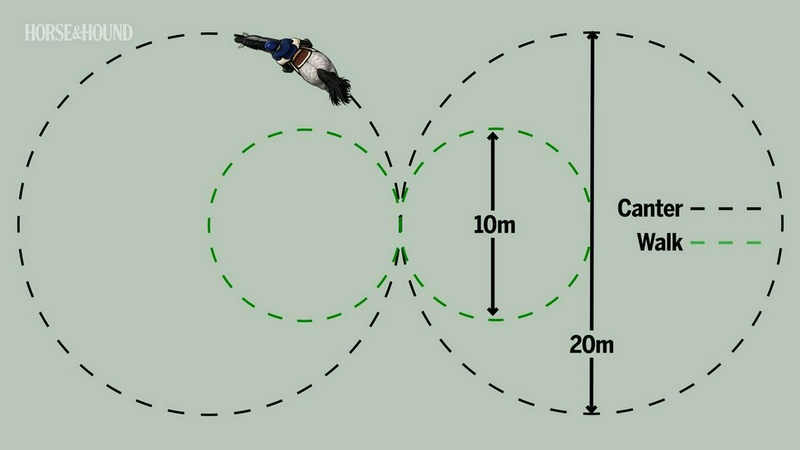
Turning on circles may seem aimless unless you define a specific goal and focus for it. The goal of this flatwork exercise is to connect simple 20-meter circles in canter and 10-meter circles in walk, along with transitions from canter to walk and walk to canter. Emphasizing precise upward and downward transitions is very beneficial in terms of accuracy; it helps the horse become more responsive, lift the forehand, and overall have better movement. Although the main focus is on precise transitions, you are also working on rhythm, balance, and bend; factors that must remain consistent when changing speed and continuing on any size of circle. This exercise also helps with better engagement of the hindquarters, suppleness, and collection, as in riding on a circle, the horse uses its hind legs more and bends its midsection around the rider's inside leg.
Goals:
- Improve transition from walk to canter
- Strengthen engagement of the hindquarters, suppleness, and collection
- Help lift the horse's shoulders
Exercise Setup:
This exercise does not require any specific setup. You can do it in an arena or a manege.
How to Execute This Exercise:
On a 20-meter circle at point C or A, go into canter. At point X, transition from canter to walk and, maintaining the same lead, make a 10-meter circle in walk. Once the circle is complete, at point X, transition from walk to canter and ride another 20-meter circle. Repeat this sequence five times. Change the lead and perform the same exercise again.
Tips and Troubleshooting:
1. Higher Level: If you have mastered the walk to canter transitions and vice versa, so that they occur precisely at X without deviation, loss of balance, or disruption of the horse's form, the next step is to perform a set of circles on the left lead, then change the lead at X and execute the set of circles on the other side in a figure-eight shape. Change the lead either with a few trot steps or with a flying change.
2. Late Transitions: Preparation is key. For the downward transition, prepare three to five steps before X; quietly rebalance the canter, keep your upper body straight and elongated, and instead of pulling the horse down with your hands, think about "softening and going to walk." For the walk to canter transition, ensure the horse's walk on the 10-meter circle is forward but not rushed. Give a clear aid to go into canter, rather than rushing through a few trot steps.
3. Horse Anticipating: It is somewhat beneficial for your horse to anticipate the next move, as it allows you to achieve a more precise transition with lighter aids. However, if the horse acts before you give the aids, change the exercise slightly. Continue along X without immediately changing direction to A or C; this way, he waits for your aid rather than guessing what the next step is.
4. Returning to Basics: If walk-canter-walk transitions are currently too advanced for your level, use trot instead of canter. This way, you will still work on transitions, bend, and accuracy.
Want more ideas? See our complete collection of daily inspiration for practice.
Source: Horse & Hound