Proper training with a simple bit; why an unsuitable bit ruins the work.
...
or why you might not actually need that trendy and seemingly "magical" bit to achieve your riding goals.
Let's talk about why your bit might actually be hindering your training process.
Dressage training is supposed to be the process of educating every horse to become a better mount.
In theory, the more a horse learns, the easier it becomes to communicate with him, and as a result, you can ask him to perform more complex tasks.
Although competitive dressage training often focuses more on preparing for the dressage test, the primary goal of competitive dressage—and its initial judging criteria—has not been this.
Initially, this discipline was designed to provide riders and trainers with a way to assess how well their training aligns with the theoretical and ideal model of the educational process.
However, it is very important to understand the meaning and reason behind some of the terms we use to describe dressage training and to know what to pay attention to when observing training and competition—whether you intend to compete or just want to better train your horse for whatever you do with him.
Ultimately, this is the main goal of my articles.
To educate and raise awareness among riders to improve their perspective and understanding of what dressage training should fundamentally be.
Although there will always be differences between practice and theory, good horse training is always recognizable to the trained eye.
That said, it is absolutely essential to remember and understand that limited knowledge leads to limited judgment.
* Bits are strange tools; they can make a fundamental difference between whether a horse moves well or poorly, but not always in the way you might think.
Essentially, a bit is a tool for communication, and generally, different types are not inherently "good" or "bad," but if used without knowledge and awareness, they can be completely ineffective or even cause severe discomfort for the horse.
For effective riding and training, it is important to use a bit that truly facilitates this; and many times this bit is not that flashy and specialized seemingly magical model that is advertised to turn your horse into a fully trained star overnight—because as you know, that is something that must be achieved through the training process.
In my opinion, many riders either learn to fear using a bit or, conversely, become overly reckless in its use.
At the same time, most riders do not know what effect each specific bit is supposed to have, and this often leads them to choose the most suitable bit.
The reality is that different bits have different effects, and when you want to choose a bit, you need to know your horse's natural reactions to riding with a bit and then select one that helps the horse understand what is expected of him.
Of course, this does not mean that anything you want to do in this area is permissible.
Some bits are used for specific applications because they allow the rider to create certain effects.
A bit is not the answer to your training problems, but a well-chosen bit can make solving those training problems possible.
(Read this last sentence again.)
In essence, you still need to know how to train a horse and dedicate time to it, but having the right bit allows you to do this effectively.
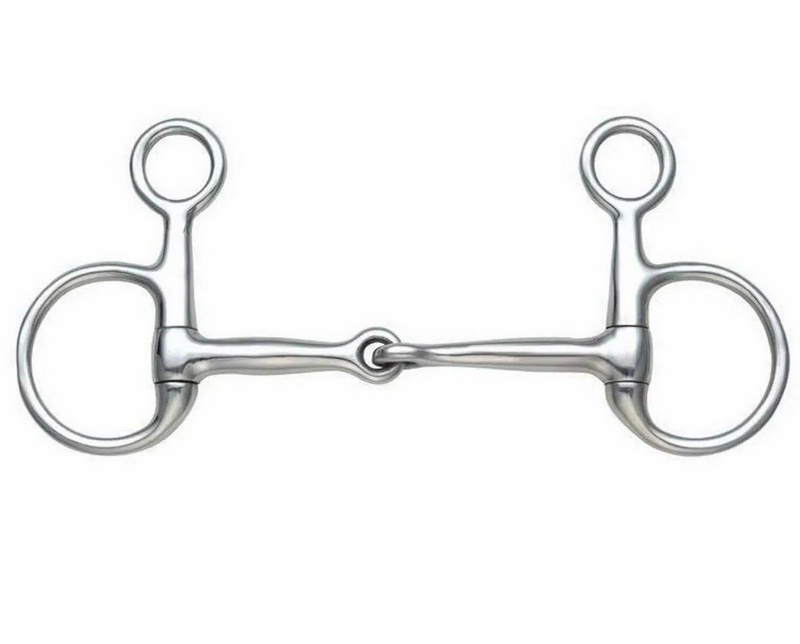
This bit is classified as a simple bit.
It has a fixed ring and is designed to create leverage on the horse's poll and jawbone.
Its use in competitions governed by the United States Equestrian Federation is permitted.
It is probably much sharper than most people think.
Many riders know that thin bits are sharper than thick bits, and straight bars, compared to jointed bits, can make the horse more compliant; that is, if used correctly, they can create more flexion in the poll and release the jaw, especially if they have a port and/or fixed cheeks, and perhaps a chain attached that passes under the chin; like a curb bit, Kimberwick, or Pelham.
However, their knowledge usually ends here...
And this is problematic.
This bit is not accepted in competitions governed by the United States Equestrian Federation.
However, outside of dressage training, it is a widely used bit.
Due to the port in the middle of the bit, the chain, and the fixed cheeks, this bit acts with a leverage effect and is not a simple bit.
Even in the hands of an expert, it does not help with softness and flexibility.
This does not mean that this bit is "bad"; it is just a tool for softening the horse and encouraging it to "chew the bit and go towards it."
"There is a reason that the United States Equestrian Federation has established a set of rules regarding the types of bits allowed in competitions.
Yes, this issue is based on the effort to prevent cruelty, and it should be so, but its goal is also to guide riders to understand what each bit is used for.
In other words, in dressage competitions at lower levels, we only see simple bits, and after the horse has mastered a certain level of collection, the simple bit can be used alongside the curb bit; that is, at higher levels.
This clearly tells us that the curb bit does not create collection, but can only be used when the horse has an understanding of collection (if you are using it for collection or as a means of control, you need to reconsider your approach).
Considering all this, a very large majority of horses that are ridden in dressage work with some type of simple bit, at least I hope so, and good or bad, there is such a vast variety of simple bits these days!
It seems there is a bit for every problem and every mouth shape, and a few extra models have been released to profit some bit manufacturing companies...
But let's not stray from the main point.
What you need to know about the snaffle bit is that this bit is used to transmit the rider's aids and is the only bit that can be used for softening and increasing flexibility; a subject that practically makes it the most essential and often the most suitable bit for many horses.
This bit is of the snaffle type and is permitted for use in USEF dressage competitions.
The straight and fixed branches of this bit make it "more neutral" and less effective in terms of creating useful contact.
There are specific reasons for using such a bit; there are good reasons, but this is not the best bit for practicing flexibility, encouraging the horse to take the bit, and placing the horse on the aids.
As mentioned above, the snaffle bit comes in many varieties, but I suggest that a basic loose ring snaffle, whether single-jointed or double-jointed, is the most practical bit for training in general.
In comparison, fixed ring snaffles are less useful for developing the characteristics mentioned due to their "fixed" nature, as they reduce the subtlety of the rider's aids and consequently dull the horse's mouth and make it less sensitive.
Do fixed snaffles have practical uses?
Yes.
But this application is temporary.
As training progresses, the horse must be educated enough to require and accept more subtle aids, as it gains a better understanding of its duties.
In other words, sometimes it is necessary for the horse to work with a bit other than one of the types of loose ring snaffles, but you must recognize the potential negative consequences that may inherently arise and have a plan to address those issues.
This is a typical loose ring snaffle.
This type of bit, despite the differences in its various models including the shown example, provides the greatest degree of subtlety in contact and the rider's aids, and in the hands of a knowledgeable rider, it helps with the horse's flexibility and willingness to take the bit.
The issue is not that this bit is "my favorite."
It is not a matter of taste or personal opinion.
It is simply the way this bit functions in the horse's mouth.
Sometimes the horse needs a different type of bit, and in the right hands, it may even thrive with the same bit.
But if we return to the main point, the bit must help the rider create flexibility and consequently bring the horse more onto the aids; and more importantly, it must facilitate effective communication; perhaps this is the most important point in all my discussion about the bit.
I have often seen riders using bits that are usually chosen to address a behavioral problem or to gain more control, but in practice, due to the discomfort that the bit itself creates, they force the horse to resist the bit or drop contact with it, without even realizing it themselves.
They think the bit is supposed to make the horse softer or lighter, while in the worst case, it acts exactly the opposite, and in the best case, it prevents the horse from seeking the bit.
In fact, the key point is that the horse must accept our hands through the bit, and reach for them; that is, take the bit or seek it out.
If the bit is too sharp or painful, the horse either stiffens against this discomfort and falls on the hands or pulls away, or tries to escape from it and goes behind the vertical.
A simple loose ring snaffle, if properly adjusted to fit the size and shape of the horse's mouth, positioned neither too high nor too low in the mouth, and used with hands that are neither too erratic nor too light, and do not constantly pull back, allows the horse to "seek" the rider's hands and when ridden forward, to move towards the bit.
This is what a simple bit enables.
This bit alone cannot create such contact.
This task must be performed by the rider, but even with very good riding, if the bit does not allow for it, the rider cannot establish communication.
So take a moment to pause and think about your horse's bit and the effect you want to create, and ask yourself if this bit allows you to communicate effectively or actually hinders it.
Sometimes it is just necessary to simplify everything and return to the basics.
Remember: limited knowledge leads to limited judgment.
Gwyenth and Flair in the Grand Prix competitions.
Gwyenth McPherson has over 35 years of experience in competing, training, and teaching dressage.
She began her training in the late 1970s when she was riding a 11-hand pony in her backyard.
Her first coach introduced her to Landon Gray, an Olympian from 1980 and 1988.
Landon was Gwyenth's mentor for a decade; during which she achieved her first national championship in 1984 and also won the team and individual gold medal in the young riders category in 1987.
In 1990, Gwyenth began training with Carol Lavell, the 1992 Olympian, who further developed her as a rider and FEI competitor.
Gwyenth won a team bronze medal at the North American Young Riders Championships in 1991 and a team silver medal in 1992, and during her time riding with Carol, she trained her stallion J-Door to perform all the Grand Prix movements.
In 2008, when Gwyenth was the senior trainer at Pineland Farms, she began training with Michael Poulin, the 1992 Olympian.
Michael had trained under Franz Rochowski, the senior rider at the Spanish Riding School from 1937 to 1955.
Michael shared much of Rochowski's knowledge and wisdom with Gwyenth and completed her training as a rider, coach, and Grand Prix competitor.
Gwyenth's educational and training business, Forward Thinking Dressage, is based in Williston, Florida.
Gwyenth also has a strong interest in sharing her knowledge about the sport and art of dressage while training riders and discussing topics related to the training process itself and the current competitive landscape.
Source: Horse Nation