Bize and Bouid talk about the role of yoga in riders' performance.
About seven years ago, after repeated injuries — including fractures of the pelvis, leg, arm, and wrist, as well as tears of the abductor muscles and undergoing multiple surgeries — Boyd Martin, a four-time Olympic rider, began a comprehensive transformation in his physical fitness to ensure he could compete at his highest level for as long as possible.
Martin said, "For many years, I felt invincible.
But eventually, I realized I was getting older and was no longer Superman.
That's why I really started to focus on becoming a more complete athlete in every way.
" He added, "I started physiotherapy, yoga, and ice baths and trained like a madman.
I had to make sure I was doing everything I could to perform the way I wanted and be my best.
" In addition to improvements in diet, sleep, and endurance, yoga has become one of the main pillars of Martin's health program, thanks to his longtime coach Biz Magarity.
Their collaboration began about a year before Martin's participation in the Tokyo 2021 Olympics, after his recovery from injuries to the pelvis, groin, and core muscles, which had caused stiffness and pain in areas most important for riding at the highest level.
We've all heard that yoga is beneficial for equestrian sports.
And according to Martin, this practice has had a decisive impact on his performance in the saddle.
But why exactly?
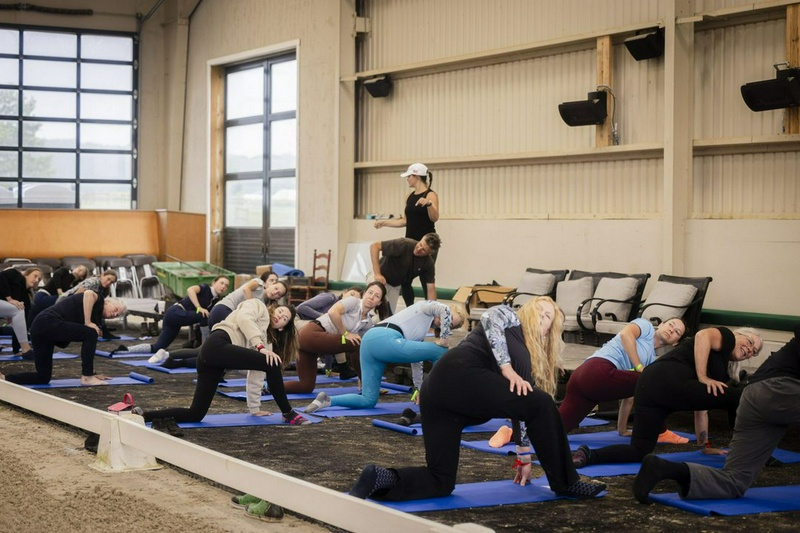
During the coverage of the Windurra 2026 camp of Boyd and Silva Martin, Practical Horseman magazine had the opportunity to hear directly from Magarity about the benefits of this practice for riders during the final day's yoga session.
Clinic participants — including Brett Parbery, a dressage coach, and Andrew Russell, Martin's physiotherapist, both key figures at the camp — attended this class.
Magarity explains here how yoga helps riders physically and mentally, what progress she has seen in Martin since he started this practice, and how someone new can start yoga.
In the second part of this series, we will review some of the movements Magarity demonstrated at the Windurra camp, along with their benefits.
Why yoga plays a key role in performance in the saddle Magarity, over her 15-year career as a yoga instructor, has gradually specialized in sports performance, stress reduction, pain management, rehabilitation, and injury prevention, and firmly believes that yoga is not just for incredibly flexible people but is a practice that can be tailored to the conditions of each rider.
In the early morning class, while pointing to Martin, she joked, "We all know how inflexible he is.
But this is something he has worked on over time.
" Magarity explains that whenever you engage in an activity that requires staying in a fixed position for a long time or repeating a movement, like riding, your body becomes more tense and stiff.
She said, "That's why it's important to have a movement practice like yoga that counteracts this tension to some extent.
Especially in riding, your hip joint is always in a flexed position, which causes stiffness.
" She notes that riders also typically hold tension in their shoulders.
He explained: "When you have the reins in your hands, your arms are always in front of your body, which causes the shoulders to come forward.
This can negatively affect your posture.
" However, stiffness in some areas of the body can often be misleading.
For example, he said if a muscle appears unusually stiff, this condition is often a sign of weakness in another area.
He added: "You need to pay attention to both tension and weakness.
You may stretch all day to help stiff muscles, but if you don't address a weak muscle that may be on the opposite side or related to that stiff muscle, that area will remain stiff.
" Magariti explains that whenever you engage in an activity that requires staying in a fixed position for a long time or repeating a movement, like riding, your body becomes more tense and stiff.
Yoga can help counteract this tension.
In this image, Martin is riding Cooley Nutcracker in the CCI5*-L competition at the Kentucky Defender Three-Day Event 2026.
Magariti has worked with a wide range of athletes and says he sees the same patterns in different sports.
He said: "The general idea is to identify how you hold your body in the saddle and what causes this tension, and then find a way to do the opposite.
" He explains that if you sit for hours every day at a desk or in a car, this position is directly contrary to the correct riding posture and relaxation needed in the saddle.
The deep muscles in the pelvic and back area need time to open up and relax so you can ride with maximum efficiency.
Magariti said that in addition to flexibility, yoga introduces you to postures and positions that increase your awareness of muscles and the skeletal system; it also strengthens the same core body position you use in riding, meaning it helps strengthen the muscles that keep your spine elongated.
The yoga path of Biz and Boyd Ava Chase, Martin's close friend and business partner, who is involved in the ownership of his Olympic horse in Paris 2024, the 16-year-old KWPN breed Fredericks B through the Annie Goodwin Syndicate, will never forget the first time he realized how committed this five-star eventing rider is to his yoga practice.
When he was holding a clinic at the Far View Farms equestrian center owned by Chase and his wife in San Marcos, California, Martin stayed at the couple's home to help host evening dinner parties with clinic participants.
Chase recalled with a laugh: "I would wake up at 5 a.m. to make coffee and see Boyd doing yoga on my lawn with Biz via Zoom.
That's exactly Boyd's style.
" Magariti pointed out that riders, compared to many other sports athletes, definitely have an advantage in terms of sports longevity, and for riders especially, yoga can be a key tool for extending their professional careers.
Martin, on the verge of the Paris Games and looking to his professional future, was fully focused on how yoga could help him ride at his highest capacity as he ages.
Magariti said: "Boyd has just turned 47 and is at the peak of his career.
Most top-level athletes in other sports have long since retired at this age.
There is no specific factor to say that yoga has helped his career.
A combination of mental and physical benefits alongside the fact that he can still do it.
In addition to the yoga we do together, his fitness and health program is entirely focused on how he can stay in this sport for about another decade.
» Martin and Margariti showcase their "Pony" movements during a yoga session at Windura Camp 2025.
To maintain flexibility and reduce pain and stiffness from hours of sitting in the saddle, Martin and Margariti hold a yoga session at least once a week, virtually or in person, depending on the busy travel schedule of this rider.
Before more important competitions, they usually have one or two additional sessions per week.
He also provided a shorter movement session specifically designed based on Martin's needs and weaknesses; a program he does every day.
Margariti said: "Boyd usually rides all morning and then sits down for lunch.
When he gets up again in the afternoon to ride, he has a lot of pain and stiffness in the hip area.
That's why I designed a short program that he does almost every day after lunch to help activate his hip muscles; muscles that become somewhat inactive when he sits.
This is actually a short body awareness and strengthening exercise that reactivates these muscles before the evening ride.
» Margariti said although Martin's previous injuries exacerbate his body's stiffness, it is also quite common for all riders that after three or four hours of continuous and similar activity, their body becomes tight and stiff as soon as they sit down.
He said: "In football matches, you see players sitting on stationary bikes on the sidelines to keep their muscles warm and prevent stiffness from inactivity.
It's the same for riders.
» Mind over matter: The mental benefits of yoga When Martin told his team that he was struggling with mental issues in the competitive environment before the Paris 2024 Olympics, Margariti immediately took action.
He said: "I told Boyd that we will continue working on his injuries, but at the same time, we will incorporate breathing exercises and mindfulness into the program to help him cope with pre-competition stress.
» He added: "This is especially important for high-level riders; to learn how to use their time before the competition to manage stress responses and put their body and mind in the right state.
» Margariti explained that when you are competing and under more pressure, this situation can further increase the level of tension; tension that affects you in a chain reaction and disrupts your mental ability to cope with stress.
Margariti says one of the most important things a rider can do is to regulate their emotions when external factors are likely to disrupt their focus so that this situation does not affect their horse.
Here, Martin maintains his composure after his dressage test with Commando 3 in the Kentucky Defender 2026 three-day event, when this gelding slightly spooked.
He said: "Through yoga, you can work on recognizing this tension and pull yourself out of it.
Our bodies are amazingly equipped with a set of tools that take us out of stressful situations.
When you practice deep breathing and other mindfulness exercises, you train yourself to remain calm even during tension or stress.
He added: "And this is exactly one of the main keys to helping riders perform better."
Although Megarty is not from the equestrian community himself, after watching riders train with Boyd, he has come to a common observation: when riders are anxious or stressed, this nervous energy transfers to their horses.
He said: "When you are in a situation that creates anxiety, you need to be able to regulate your nervous system, and yoga offers a wide range of tools for this."
One of the most important things you can do as a rider is to regulate your emotions when external factors start to disrupt your calm so that this situation does not affect your horse.
Find a yoga practice that works for you. Megarty suggests that riders who are complete beginners and want to start yoga should attend in-person classes with a qualified instructor to learn the basic principles well and receive individual training.
He said: "If you can find an instructor who is ready to help when you tell them you are a rider and experience stiffness or pain in the lower back, that's even better.
This builds a solid foundation for you at the start."
However, he said to maintain continuity, doing yoga through online videos or an app as a complementary practice is useful, and if you have a busy work schedule or travel a lot and still want to spend time in the saddle, it will often be a more convenient option.
But Megarty warned: "The point to consider is that when you practice yoga alone, you don't have the expert's eye watching over you.
And you shouldn't repeatedly perform a move incorrectly, as this can lead to poor posture or other negative habits."
He added: "For this reason, when you are just starting, I strongly suggest incorporating a combination of in-person classes and online videos into your program."
For riders who are new to yoga, Megarty suggests attending in-person classes with a qualified instructor to master the basic principles and receive individual training that can build a solid foundation for them.
Here, he demonstrates a pose during a yoga class at the Windura Camp 2026, while Martin tries to keep himself aligned in the background.
Although he does not recommend a fixed rule for how many times riders should practice yoga per week, Megarty strongly believes that everyone should find a program that works for them and stick to it as much as possible.
He said: "How often you practice yoga largely depends on the other exercises and stretches you do and what you hope to improve; flexibility?
Mobility?
Recovery?
In terms of the nervous system and the body's response to stress, doing yoga three or four times a week can be beneficial."
Once you have incorporated yoga into your training program, Megarty recommends maintaining consistency.
He noted: "When you train inconsistently, it becomes difficult to understand whether you are benefiting from it or not.
Consistency can make you aware of any hidden tension or underlying weakness.
" He added: "If suddenly after riding or doing an exercise you've been doing for a few weeks, you experience a lot of pain, this tells you that there might be a problem.
This is a very good tool for assessing your own condition.
" Although Magarity is a strong advocate of having a regular program, he recommends changing it when the program no longer works for you; and notes that this is especially true for women.
He said: "When we experience major hormonal changes as we age, this affects how our musculoskeletal system functions.
Therefore, stick to your program as long as it works.
Then, when it no longer works, reassess and make necessary changes if needed.
" He added: "You may find that you need to make changes every few years.
" For more information about the annual Windurra camp led by Boyd Martin and Silva Martin, click here.
Source: Practical Horseman – Health