Improve the balance and obedience of the horse with simple walk and rein-back exercises.
Transitions — as Becky Moody, the Olympic dressage rider, always emphasizes — are the most important part of daily training, no matter what rhythm you are working in.
This groundwork, in addition to transitions, also includes the rein-back to increase the level of difficulty.
This exercise improves the horse's balance, engages the hindquarters more to bear more weight, and simultaneously lifts the midsection.
The rein-back is also useful for assessing the horse's response to the rider's correct aids through seat, leg, and hand.
We might think that not much progress can be made at the walk, but this exercise is a great way to really improve the horse's way of going and also enhance your own riding skills.
Moreover, this exercise can be done both in the arena and while riding on a trail, and it is useful when the ground is hard or your horse is a bit older or not in full physical condition but still needs stimulating and purposeful work.
Goals Improve responsiveness Develop balance and alignment Strengthen rider coordination Exercise setup No specific setup is needed.
You can do this exercise in a field or in the arena.
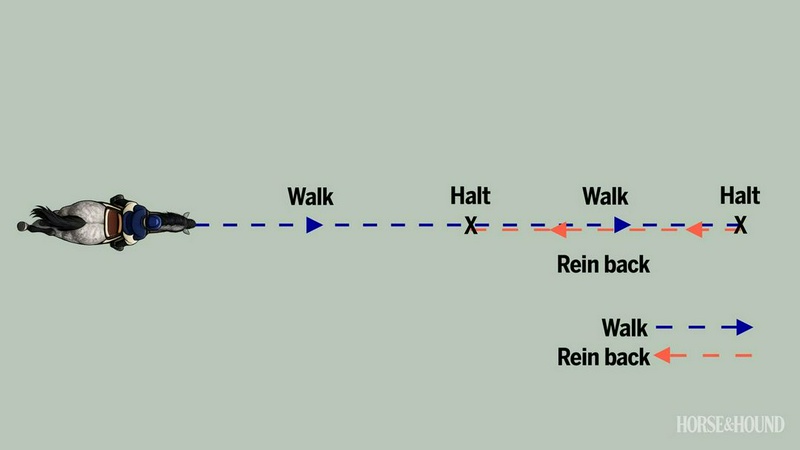
How to perform this exercise In a straight line, establish an active walk and focus on your position as a rider; that is, body posture, alignment, soft hands, and transferring weight to the heels.
Count about eight steps of walk, then halt for five seconds; meanwhile, use the reins and legs and keep the upper body stretched to bring the horse onto the bit.
When to start the preparation depends on your connection with your horse.
Check your halt; is it square and balanced?
Did your horse respond when you gave the aids?
Ask the horse to walk again for eight steps and halt once more.
Now take four steps of rein-back, or as much as is comfortable for you at the current stage of training; apply pressure with the inside thigh, keep the abdominal muscles tight, and gently half-halt, and as soon as the horse responds, soften the hand.
During execution, evaluate the rein-back.
Does the horse go back straight and move its legs in diagonal pairs?
Does it remain soft and consistent in its movement form, or does it resist?
Return directly to the walk and move on a large circle.
Tips and troubleshooting 1.
Increase the level If you are working in the arena, you can first do this exercise along the fence, or when riding on a trail alongside a hedge.
This helps keep the horse straight.
Next, try it on the centerline; where there is no fence to prevent the horse's haunches from swinging out or in.
Focus on maintaining a straight line, both in the walk, halt, and rein-back.
Once you can do this exercise comfortably, change the number of steps in the walk and rein-back.
Be strict with yourself to execute exactly the number of steps you have decided and avoid deviating from the path.
2.
Unwanted halt Preparation is crucial in this section.
If your horse is slow to respond to the halt, prepare earlier and give clearer aids.
If he stands crookedly, first check your own sitting position: Are you distributing your weight equally on both seat bones?
Are your hands level?
Instead of forcing the horse's head straight with the reins, visualize the horse's shoulders and hips aligning in a straight line.
To stay on a straight path, use the riding arena wall as a guide.
3.
Weak rein-back If your horse is new to rein-back, first try teaching rein-back from the ground.
While riding, start by asking for just one step and immediately release the pressure and encourage him.
Again, the simplest way to start this exercise is to do it alongside the riding arena using the wall as a natural barrier.
You can also place some poles on the ground to guide the horse through them.
Source: Horse & Hound