Evaluation of the form and performance of the horse in dressage
Isosceles triangles, levers, and points of support are not terms that are commonly heard in the aisles of a stable.
But according to Kristi Wysocki, a dressage and sport horse breeding judge, FEI rider, coach, and rehabilitation specialist, it should be so.
And of course, she is also an engineer; someone who worked for 15 years in oil fields before entering the world of horses professionally.
An image from the book "Typology of Sport Horses" by Christian Schacht, used with permission from Trafalgar Square Books (www.horseandriderbooks.com).
| Kim F. Miller It was Kristi's engineering background that led her to design the symposium "Assessing Form and Function in Sport Horses"; a program held at the annual California Dressage Society meeting on January 23 and 24 in Sacramento, California.
DressageClinic.com was the sponsor for this weekend.
This presentation aimed to clarify the relationship between a horse's physical form and its ability to perform the tasks required of it at all levels of dressage, pursuing several missions: • Helping riders assess their horses and understand how to leverage or compensate for their body type's strengths and weaknesses through proper training.
• Helping horse buyers to set aside emotions from the buying equation.
For example, not to be overly influenced by the horse's appearance or impressive pedigree.
And on the other hand, not to shy away from buying due to minor flaws that may be resolved through training or balanced by other strengths in the body.
Above all, Kristi sought to demonstrate that correct dressage, which means "training," can strengthen and soften any horse's body and create significant improvement in its way of moving.
Additionally, as long as the requested movements are appropriate for the horse's body type, it makes executing them easier for the horse.
On the first day of the clinic, using slides displayed of various horses, Kristi illustrated the connections between different points of the horse's body by drawing lines.
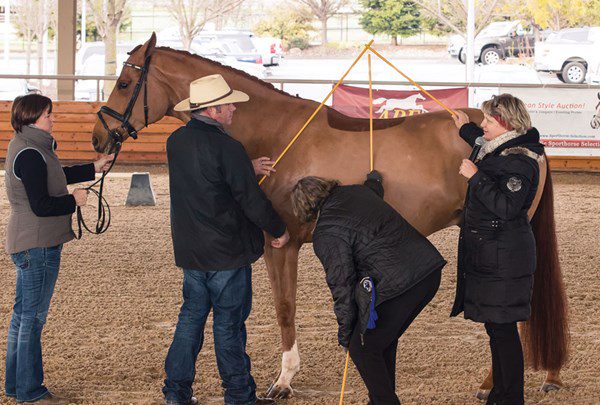
Participants were also asked to develop their eye for recognizing body types by placing threads on enlarged images of the horses.
The next day, these ideas came to life when applied to horses in motion, from various breeds and levels of training and physical development.
The second day began with a Friesian/Dutch cross and concluded with the Grand Prix stallion Janai Van, namely the Hanoverian Donarweiss GJGF.
In between, a Gypsy Vanner, a 20-year-old Welsh Cob German Riding Pony, a Haflinger, and a 17.3-hand Dutch warmblood showcased body type characteristics that demonstrated how broadly applicable these concepts are.
During the assessment of the strengths and weaknesses of body types, a series of training tips were shared with a precise and eager crowd gathered on a cool day at the Star One equestrian center of the Van family in the Sacramento area.
The good, the bad, and the ugly line assesses the overall balance of the horse's body.
According to the harmony line, the length of the distance between the poll and the muzzle should be approximately equal to the length of eight other dimensions of the horse's body shown in the image.
After referencing the whistling music from the Western film of the same name by Clint Eastwood, Kristi explained the "good, bad, and ugly" criteria in the horse's body type.
Good characteristics allow for a positive assessment of a horse's potential for equestrian sports.
However, these characteristics are not guarantees.
He said, "Horses with good body types do not always have good movements and vice versa.
" For example, Graf George, a holder of two Olympic bronze medals in dressage, may not have been completely flawless in terms of body type, but he overcame this issue with proper training and performed at the highest level.
Bad characteristics in body type include a range of defects that likely make it more difficult for the horse to perform as desired, but in many cases, these can be compensated for with proper training and reliance on other strengths of their body parts.
However, in the discussion of horse body type, not in terms of appearance but in terms of structure, "ugly" is something to be avoided.
These are characteristics that typically lead to movement health issues and/or safety problems.
Christy advised about "severe defects": "Just pass on it!
" He mentioned, among others, dropped heels, contracted or narrow heels, and soft or overly flexible pasterns, which, whether together or alone, increase the likelihood of suspensory ligament injuries.
Excessively straight hind legs, toes pointing inward or outward, small bones and joints, as well as small hooves can also be warning signs if seen severely.
Christy explained that there is often a body type-related reason that prevents a horse from performing a task.
He said, "Since I better understood horse biomechanics, I have become a much better rider, trainer, instructor, and judge; overall, I have become a much more knowledgeable person in working with horses.
" Since body type is largely determined by the horse's bones, a clear understanding of the horse's skeletal structure is very important.
Christy noted that it is not necessary to memorize all 200 bones of a horse's body, but one should know the main structures.
He said that over 30 years ago, when he first looked at a horse's skeleton, he had to ask what animal this skeleton belonged to.
The connection point of the neck bones, near the lower part of the shoulder blade, had surprised him.
He had imagined this point to be much higher and along the upper line of the body.
Christy shows how to examine the front legs so that a straight line from the body down, including the knee and cannon bone, can be seen; a line that is aligned and not deviating from the axis.
This is the best angle to check for fetlock joint twisting and also inward or outward toes.
Werdford has a slight deviation from the center, but his overall body type creates "high expectations" according to Christy.
Another structural aspect that even experienced individuals working with horses find surprising is the lack of bony connection between the shoulder and other parts of the skeletal system.
With a clear understanding of the main skeletal devices, the next step is to train the eye to recognize the placement of bones and their connections beneath the horse's coat.
This practical step involves parting the hair and gently touching with fingers to identify the location of the hip protrusion, shoulder protrusion, the end of the rib cage, and other body reference points.
This task is easier on a horse that has just been clipped and becomes more difficult with a thick winter coat.
In the case of a horse that is overly sensitive, it may not be possible to determine the location of these reference points through direct touch.
Since safety is a priority, in such situations it may be necessary to seek the experienced eye of a skilled individual to identify these points.
Once the location of the bones is determined, the next step is to draw straight lines between them to assess how the different parts of the horse's body can work together.
This skill can be developed by practicing on enlarged photos of horses and using thread.
In practice, if the horse cooperates, Kristi adjusts the straight rods on the horse's body to determine angles and proportions.
Start with an overall view to assess the structure of the hindquarters, drawing a triangle between the points of the hip, the point of the croup, and the hock joint.
The best type of this triangle for a dressage horse is one where the upper side is shorter than the other two sides.
| Kim F. Miller
In the side view, when the horse is standing square, the assessment should begin with the overall image.
The overall length of the horse's body should be greater than its height; height is measured from the highest point of the withers.
Also, the length of the legs, measured from behind the elbow to the ground, should be greater than or at least equal to the depth of the body; the depth of the body is measured from the withers to the belly and from the same point behind the elbow.
The distance between the point of the withers and the point of the croup should be 45 percent or less of the overall body length.
Short backs usually lead to less flexibility and greater difficulty in lateral movements.
Longer backs make it more difficult for the horse to engage its body from behind and also make it harder for the rider to control the hindquarters.
You should look for an upper neck line that smoothly arches upward from the withers and ideally creates a fan-like shape towards the poll.
The upper neck line should be about twice the length of the lower neck line.
If the length of the upper and lower neck lines are close together, especially if this condition is accompanied by a thick throat, it will be difficult for the horse to settle on the bit and maintain that position.
In the hind legs, the ideal angle of the hock joint is about 154 degrees; an angle that allows the necessary vertical lift to bring the hind legs up and under the body.
For success in the jumping arena with a horse, it is better for a jumping horse that all three sides of the triangle of the hindquarters are equal.
| Kim F. Miller
According to Kristi, the front limbs are the horse's "support columns" and should be positioned to bear the horse's body weight.
In the side view, these limbs should not angle forward or backward.
Desirable signs include a front shoulder that is angled forward and connected to a relatively long radius bone and a short cannon bone.
The front view also provides another image of these support columns.
In the front limbs, attention should be paid to a straight line from the body down that includes the knee and cannon bone, with the components aligned rather than deviating from the axis.
This is the best angle for assessing the twist of the fetlock joint, whether the hoof is turned inward or outward.
Attention should also be paid to the balanced growth of the chest muscles and the spacing between the two forelimbs, considering how well this position supports the horse's weight.
In the rear view, attention should be given to similar and straight lines along the limbs and hooves, balanced growth of the hindquarters, and a tail that is straight and hangs directly along the body line.
A crooked tail can be a sign of body crookedness.
It is also important to pay attention to a chest with a suitable curvature of the ribs to provide space for the placement and application of pressure from the lower leg, especially if your legs are long.
The "Harmony Line" tools of Kristi assess the overall balance of the horse's body and can consequently indicate its capacity as a sport horse and the likelihood of that "wow" factor under the saddle.
This topic was eye-opening for many.
According to the Harmony Line, the length of the distance between the poll and the muzzle should be approximately equal to the length of eight other measurements in the horse's body.
These measurements are: 1.
Shoulder point to the tip of the shoulder 2.
Shoulder point to the girth behind the elbow 3.
Tip of the pelvis to the croup 4.
Croup to the hock 5.
Hock to the ground 6.
Withers to the ground — front limbs 7.
Elbow to the fetlock 8.
The length of the horse's back; for this purpose, it is measured from the back end of the shoulder blade to the tip of the pelvis. Part of this overall assessment involves looking for signs of natural upward or downward movement in the horse's body.
Carrying the body in an upward manner, which is desirable in dressage, requires engagement and power from the hindquarters, and body type can make achieving this easier or more difficult.
The "center of balance" is one of several indicators that helps predict how easily the horse can achieve and maintain an upward movement.
Carol Koingdal's romantic neck could be more defined, and its connection at the chest is relatively low.
This feature, along with a thick throat, may indicate that bringing him onto the bit might be difficult.
The triangular shape of his hindquarters is relatively suitable for dressage.
More growth in the back and loins will make energy transfer easier.
His relatively steep croup is more suitable for generating power than a flat croup.
The center of balance is located at the intersection of two lines: one diagonal line that starts from the shoulder point and one diagonal line that passes through the hip point from the croup.
The further this intersection point is towards the back and closer to the rider's seat, the better.
Kristi pointed out that some equine biomechanics experts also consider the horse's center of gravity to be in this same area, but there is disagreement about its exact location.
She considers the center of gravity and the center of balance to be essentially the same concept, but uses the latter term to keep her system away from this debate.
Promising results in any of these measurements do not guarantee upward movement.
Instead, these results indicate that "the horse does its job more easily and maintains better movement health while doing so."
Kristi said, "When a horse makes something look easy, it usually really is easy for them."
Points of strength after working on transitions, circles, and lateral movement with lower leg pressure with rider Ariana Barzman-Grenan, this Haflinger mare moved with a continuous and complete connection; she carried her head and neck calmly and worked her back with appropriate height and oscillation; a feature that creates more elastic freedom in the steps.
| Kim F.
Miller Kristi, focusing on the horse's motor function, that is, the hindquarters, drew a triangle of lines connecting the point of the pelvis, the point of the croup, and the point of the knee.
In a dressage horse, the ideal state is for this shape to be an isosceles triangle, where the shorter side is the upper line between the point of the pelvis and the point of the croup.
In jumping horses, it is usually better for all three sides to be equal.
He said: "A dressage horse must have the ability to carry weight and increase stride length, and a jumping horse must be able to carry weight and jump.
In each of these two types of horses, a 'good triangle in the hindquarters' can compensate for many other weaknesses in conformation.
The appropriate angle of the pelvis and femur is also another sign that the horse can easily engage its hindquarters.
A croup slope between 15 to 18 degrees is ideal.
If it is too flat, carrying the body becomes difficult for the horse, and if it is too steep, the power of the hindquarters to transfer energy forward decreases and may put pressure on the lumbar-sacral joint.
The conformation in the movement of Parno Ori from Peproga, owned by Sara Bartolomeo, has a good hindquarters and a strong back, although it is a bit long.
Its thick neck, which is set slightly low, and its shorter front legs can make collection more difficult.
Its shoulder angle is slightly steep, but it has a good connection in the forearm.
| Kim F.
Miller's second day of this symposium was dedicated to training techniques that apply to the strengths and weaknesses of conformation.
The horses were very different, but Kristi's advice consistently focused on moving from apparent engagement to real engagement.
The first state arises from a locked upper line; a position where the neck is held up on its own without the help of the back muscles and hindquarters; something Kristi described as 'absolute elevation.'
"He prefers the neck to be seen in a lower position so that connection and energy flow in the body can form, and then the rider, relying on real and correct engagement of the hindquarters, creates an upward balance or what is called 'relative elevation.'
"Changes between gaits and lateral exercises were key to increasing the softness and relaxation needed to achieve proper energy flow in the body and honest and effective engagement.
Kristi asked each rider, depending on the horse's level, to perform a set of exercises; including leg-yielding on a straight line and on a circle, and for more advanced horses, short periods of shoulder-in.
Alongside several impressive warmbloods, there were also horses of unconventional dressage breeds that at first glance did not seem particularly striking in conformation, but their riders brought them to a quality in gaits and movements that drew both Kristi's admiration and that of the spectators.
He had personally selected these demonstration horses long before the symposium and during judging in California.
All of them are successful dressage horses, with very different conformation types, to show what a proper training can do for any horse.
A few examples of them include: Romantic, an 11-year-old Haflinger with which Ariana Barzman-Grennan won the reserve champion title in First Level at the Northern California Junior/Young Rider Championships in 2015.
Romantic presented a beautiful picture overall during the hand evaluation, but an assessment with Kristi's tools revealed that there are also challenges in terms of conformation.
Romantic's neck could have more definition and is relatively low-set to the chest.
This feature, along with a thick throat, may indicate that getting him on the bit is not an easy task.
Training methods that help him better develop the upper line of his body can help compensate for these issues.
His hindquarters are relatively suitable for dressage.
Strengthening the back and lumbar region will make energy transfer easier for this horse.
His croup, which is slightly sloped, is considered more suitable for generating power than a flat croup.
Romantic began his work in the arena under saddle with short steps; there was not enough suspension in his movements, and the top line of his body, like almost all show horses at the start of the program, was stiff and closed.
Ory under saddle and with rider Rachel Wade defied the predictions that could be made about him without paying attention to his body type.
The correct angles of the hindquarters, the proper connection of the shoulder to the arm, and the relatively well-developed lumbar area, along with his proper training and "extraordinary work ethic," have compensated for his limitations.
| Kim F.
Christy advised Ariana to "go big up and down, but not fast" and to imagine her body as a force that propels a basketball upward while in the canter.
In the canter, this bronze medal-winning rider of the USDF was also told to create "a leap in every stride"; "Jump!
Jump!
Jump!
" The changes of stride, circles, and lateral work quickly brought this golden horse to a state of low and calm head and raised and fluid back, resulting in beautiful strides.
Christy gave this horse an 8 for the canter and explained that the canter always improves after the counter canter, as the counter canter helps loosen the lumbar-sacral joint.
Romantic's canter after these exercises went from "barely a 6" to a 7.
Christy added that it is in the canter that horses should be more honest on the bit.
He said, "They can hide laziness in the trot."
Christy rhetorically asked the audience, "Does this Haflinger belong in dressage?"
He answered himself, "Absolutely!"
Pernod Ory from Peproga, a 10-year-old mare of the Gypsy Vanner breed, has been trained by professional rider Rachel Wade to make her first appearance at the Prix Saint-Georges level last year.
The owner of this horse is also Sara Bartolomeo, a veterinarian and amateur rider, who has also taken this mare to the competition arena.
"Ory" has a good croup, with an ideal isosceles triangle in the hindquarters and a powerful lumbar region.
Her back is slightly long, and the underline of her neck is excessively long compared to the top line of her body; a factor that indicates bringing her on the bit may be difficult.
Her shoulder angle is slightly steep, but with a good connection to the forearm, it indicates adequate reach in movement.
Ory under saddle defied the predictions that could be made without Christy's assessment tools.
She overcame her challenges with good training and an "extraordinary work ethic."
Good advancement in the walk, along with an elastic top line and sufficient activity in the hindquarters, was observed.
Rachel, the rider of this horse, was told to look at her seat as a "metronome"; a factor that determines the tempo of each stride.
She said, "The faster the seat, the faster the tempo; and don't let your horse convince you that the tempo is too fast or too slow; you decide with your seat."
Ory's heavy neck and relatively long croup made the canter her most difficult gait, and the collected strides were something that needed to be approached with more caution.
Christy advised, "To collect her, don't close the front door.
Make her sit, not shorten her neck."
Kristi warned that if collection is emphasized too early in the development of a horse or is taught incorrectly, it can be dangerous.
She said, "In that case, it won't be honest."
Ori showcased body carriage and beauty in the flying changes and training pirouettes.
This breed was originally developed for pulling heavy carts, which at first glance creates the impression that it is not suitable for dressage, but Ori proved otherwise.
In the end, Kristi said, "Ori and Rachel are the perfect example of harmony in dressage."
She added that the eager temperament of this mare reflects another one of her main messages: that in most cases, a horse's attitude is just as important as its physical form and gaits.
According to her, the right temperament is one that has the most compatibility with the rider.
This article was first published in the April 2016 issue of Practical Horseman.
Source: Practical Horseman – Training