Show jumping training with Boyd and “Bali”
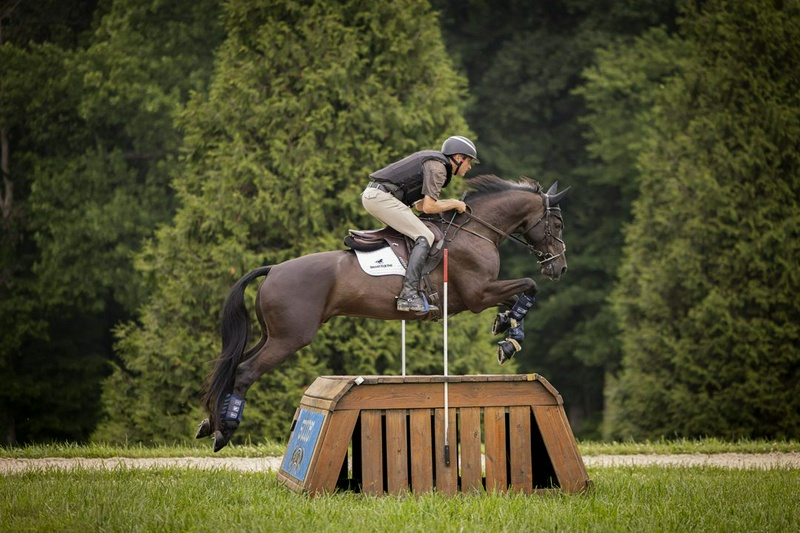
Just a few days after Practical Horseman's return from covering the Windurra camp related to Boyd and Silva Martin, Boyd and Cooley Nutcracker were selected to join the U.S. eventing team for the FEI Eventing World Championships held this August in Aachen, Germany.
During three days of intensive training, private lessons, and riding demonstrations, we not only had the opportunity to get to know Cooley Nutcracker and feed him carrots, but we also attended show jumping and cross-country sessions with this 12-year-old Irish Sport Horse stallion, who was previously ridden by Liz Halliday and accompanied her at the Olympic Games Paris 2024.
Boyd, a four-time Olympian, and Peter Wylde, Olympic gold medalist and prominent show jumping coach, both rode "Bali" — as he's called in the stable — for a group of about 70 riders and observers from various parts of the country who gathered for the third annual Windurra Camp at Boyd and Silva's 75-acre farm in Cochranville, Pennsylvania.
Wylde first met Bali when Halliday purchased him at the age of seven and said this stallion is one of the most beloved eventing horses of all time for training and riding.
He said, "He is very spirited, afraid of horses, has quirky behaviors, but is incredibly talented.
He is truly one of the most talented horses Boyd and I have ever worked with as a team.
" Next, we take a behind-the-scenes look at the Windurra Camp classes with Bali and review the key points Boyd and Wylde discussed about their strategy for Aachen.
We hope you can use some of these top tips from two Olympic champions to improve show jumping and cross-country with your horse.
Groundwork in Bali's Show Jumping In addition to being the show jumping coach at Windurra Camp, Wylde is also Boyd's show jumping coach and has worked on sharpening Bali's skills.
He said, "As far as we know, he seems to have been born this way.
Astier Nicolas, a French rider, rode him before Liz and said he was a nervous horse even at a very young age.
Sometimes this can reflect that he was a bit scared in childhood, or perhaps he was pushed too hard in his youth.
" Boyd emphasized the importance of understanding how your horse warms up best for show jumping and noted that this becomes even more important in competition.
After crossing the cross-country, you need to change his jumping mindset.
For warming up Bali, Boyd and Wylde have concluded that getting him very round and soft is absolutely essential.
Peter Wylde, the Olympic medalist show jumper who rode Bali in the Windurra Camp jumping lesson, prepares him to be round and soft before working on the obstacles.
©Amy K.
Dragoo Wylde, when working on the ground, adjusts his stirrups one or two holes higher than the jumping position to better wrap his legs around Bali's ribs.
©Amy K.
Dragoo Boyd said, "It's very important to take the time for this horse and do a bit of extra softening work.
If you watch Peter's groundwork, you'll notice he works a lot on lengthening and shortening the strides and really softens Bali."
Peter keeps his neck base flexible and elastic and also creates a lot of bend and arch in his body.
» Another important point that Wylde taught him when he first started working with Boyd was that in groundwork, the stirrups should be slightly longer than when used for jumping.
Boyd said: "This is especially useful for tall riders like me because it helps you wrap your legs more around your horse's ribs.
Peter and I usually adjust the stirrups one or two holes longer than the jumping position in groundwork.
But when the obstacles get bigger, shorter stirrups are needed so you can stay with your horse in the air.
» Using warm-up fences for warm-up fences, Boyd and Wylde usually ask Bali to jump an upright from both hands and then proceed to jump a small oxer from both hands.
Both believe Bali is a talented jumping horse, but after passing the obstacles, he usually stiffens and drops his back.
Wylde focused on slowing down and returning to a walk, or straightening and softening after the obstacles during warm-up fences, because it is in these sections that they usually lose control and rideability.
Boyd said: "When I first rode Bali, after the jumps, he would raise his head and go off like a racehorse, so this kind of head shaking and stiffening has been an important part of our jumping training.
Notice how on the landing side, when Bali wanted to rush out, Peter reacted to it but calmly.
» Boyd told the campers in the jumping lesson that Bali sometimes has trouble landing on his left lead after obstacles, but found that it is often better to ignore this issue.
Wylde guided him several times in a row with the same rider on the left lead exit, and Bali found his way himself.
©Amy K.
Dragoo Boyd explained to the camp participants that Wylde also used a slower and more consistent Chaharnal in the warm-up fences to encourage Bali to take off closer to the obstacle.
He said: "The initial jumps are more about restraining and slowing down to encourage him to jump higher.
If you can make him take off closer to the obstacle even in a slightly uncomfortable distance, he will have to raise his body more in the air to clear the obstacle.
» Another challenge for Bali in show jumping is to land on the left lead.
His body usually gets caught on the obstacles, and as a result, he prefers to land on the right lead.
Boyd initially focused on solving this problem, but over time took another approach.
He said: "The more you pretend not to see this issue at first, the more he starts to give us the left side.
When you see Peter going left over the vertical, he didn't change his ride at all.
He just consistently exited the obstacle with the same stride and left hand a few times, and by the second or third time, Bali understood the matter.
» Boyd emphasized that the vibrant atmosphere of the jumping ring at Windurra Farm helped Bali become less reactive to new sights and sounds in competitions with more imposing environments; Course Work: Putting It All Together Boyd said for more experienced horses like Bali, after jumping lessons, they do a significant amount of warm-up and hacking out, but they keep the jumping portion of their training sessions relatively short, about 20 minutes.
Wylde and Bali, during their show-jumping display, pass the second bending line with an oxer to vertical.
He explained: "Peter designed the course very carefully so that the gymnastic related to the bounce is placed in the middle of the course.
So, you navigate fences 1 and 2 on a bending line and then have to really collect and balance your horse for the gymnastic before you proceed to the next line.
Because horses tend to get faster and their tempo becomes more chaotic throughout a jumping course, Peter incorporates elements like bounce to maintain balance in the course.
" Boyd explained that the combination of bounce is a great exercise for Bali and all eventing horses because it teaches them to separate from the ground quickly.
He said: "Peter deliberately set the distances a bit shorter to encourage the horses to use their hindquarters more and jump off the ground with power.
" He added: "Shorter distances might be a bit uncomfortable for the horses at first, but it helps them learn to pick up their feet faster.
" The bounce combination in Wylde's show-jumping course at Windurra Camp 2026 made Bali act faster in separating from the ground.
©Incanto Sports Boyd explained to participants that Wylde intentionally designed the course with a gymnastical bounce in the middle to force riders to keep the horse collected and balanced between the bending lines.
©Amy K.
Dragoo Boyd says when Bali makes a mistake, it's important to walk calmly and repeat the exercise.
He said: "The worst thing you can do with a sensitive horse like Bali is to lose your temper.
That's why Peter stays so calm and relaxed, and even after he got a bit quick in the previous course and got somewhat flustered after the blue Stübben vertical and seeing the Philippine flag, he still works him on the ground.
I also like him to navigate the red and white bounce line without touching the obstacle.
" After the course was practiced a few more times, Boyd pointed out subtle improvements in Bali's jumping technique, especially when Wylde helped him to calm down and approach the obstacles with better balance and straightness.
After the jumping lesson, Wylde continued to work on the ground with this gelding.
He said: "Often after riders jump the last obstacle, they walk about 10 steps and consider the work done.
But here we see Peter still working him on the ground; something that helps Bali's self-carriage and allows him to stretch a bit in trot before fully cooling down.
" Wylde noted that since Bali is a horse that easily gets scared and sometimes reacts, the presence of Windurra Camp participants added to the training atmosphere, providing a beneficial experience.
©Amy K.
Dragoo Wylde said after this lesson that the presence of a larger group at Windurra Camp helps manage any potential training issues that may arise in competition from now on.
He said: "This horse is really energetic, but that's what makes him amazing.
From here, you can see how important patience is when working with a horse like him.
You don't want to tiptoe around problems, but you should never take an aggressive stance to solve them.
" He added: "Bali has had a quiet spring after Kentucky, so we just need to get him back into competition form a little more.
The more we work with him, he usually gets better.
And when he becomes calmer and his body moves more freely, he starts to deliver really spectacular jumps.
" The cross-country lesson with Boyd and Bali on the last morning of the stay at Windurra Camp, the camp participants headed to the large training field of the farm to watch the cross-country show of Boyd and Bali; where they were working around a table obstacle on a small hill and Wylde was explaining with his handheld speaker what was happening.
He said: "Just like the show jumping lesson, as long as we are just here and not waving our hands in the air, it's actually good for Bali to face us again.
When you go to Kentucky or other five-stars with an exciting atmosphere, he has to face a lot of things.
So it's good for him to face his fears at home too.
" The Windurra participants watched as Boyd and Bali warmed up for the cross-country show, and Wylde explained what they had done with this gelding.
©Incanto Sports Boyd, after doing some lead changes and softening Bali before starting the cross-country jumps, asked him to go for a gentle gallop.
©Alana Harrison Boyd, for warming up in cross-country, first did a few lead changes and then moved Bali a little faster to pass several obstacles with a good and smooth rhythm.
He then worked in a figure-eight pattern to pass several box obstacles with both the right lead and the left lead; something that was very similar to their warm-up exercises in show jumping.
Wylde explained: "For Boyd and Bali to reach the necessary time in big five-stars, we have to do everything with the least number of steps possible, of course safely and without making the work harder.
Top riding in cross-country should look effortless, but this also needs to be practiced in the horse to some extent.
Boyd remains calm and relaxed during the warm-up, and this shows later when he asks Bali to perform more difficult combinations.
When he becomes a little fast and nervous after an obstacle, Boyd collects him after landing to correct him and then continues the course smoothly and freely.
" Wylde, during yesterday's visit to the show-jumping course with Wylde, talked about the calculations needed when jumping from the course and said the same applies in cross country.
He said: "At higher levels, the importance of these calculations becomes even greater.
When the jumps are on flat ground, you almost take one step less than what is needed in a show jumping round.
" He added: "But when the ground changes and water and banks are added, these calculations can become more complex.
Wylde explained that for Boyd and Bali to make up time in the five-stars, they need to do everything in the fewest number of strides possible while staying safe, without making the course rough.
©Alana Harrison Wylde refers to a course at Luhmühlen CCI5 a few years ago that had a difficult combination; it included a hanging rail leading to a boat fence in the water, then turning to a chevron and then reaching another boat.
She laughed and said, "When we walked that combination, we all saw different numbers.
For the first obstacle, we saw six, seven, and eight; in the middle three, four, and five; and for the last two and three.
" She added, "But those distances are actually very similar to show jumping distances, because it means you can slow down and collect to jump them firmly and correctly.
" Boyd said one of the hardest parts of preparing for a five-star event is the lack of time; especially when he wants to prepare all three phases in the best way.
After reviewing Bali's show-jumping lesson with Peter a few days ago at camp, he noted that this gelding jumped well but was very energetic.
Boyd explained, "Like Peter said, he's had a break since Kentucky, so today in cross country I wanted to do something I call a mini school.
Often with these more experienced horses, you have to take the time and do a few reminders.
" After the cross-country work, Boyd told the campers that he wants to keep two points in mind from now on.
He said, "At the beginning of the course, when he's a bit fresh, if there's a turning question to the left, he gets a bit stuck.
" He added, "For example, if 4AB is a sharp turn to the left towards a narrow or corner, I know he gets excited, so we're working on it calmly and gradually.
" Boyd told the campers that after reviewing Bali's show-jumping lesson with Peter a few days ago at camp, he realized that this gelding jumped well but was very energetic.
To address this, he spent time during the cross-country lesson doing a few reminders.
©Incanto Sports To further help with this, Boyd practices jumping and preparing for left turns in the warm-ups of competitions.
He says Bali is one of the most honest horses and jumps every obstacle on the course, but from Kentucky, he also realized that he needs to focus this gelding on accuracy jumps on the course earlier.
"He said, "Even though in some parts he's still a bit off rhythm, I feel like he's really in good form.
And sometimes with these experienced horses, less is more; it's better to just do a little review and reminder and you don't need to jump every obstacle on the course.
That's the summary of Cooley Nutcracker.
But don't pat or clap for him!
Because that might be enough for him and ruin his day.
"" Boyd joked.
We look forward to seeing this pair as part of the Defender U.S. Eventing Squad in the FEI Eventing World Championships 2026, which will be held from August 13 to 16 in Aachen, Germany.
Boyd and Liz Halliday embrace after he and Cooley Nutcracker, his former horse and teammate at the 2024 Paris Olympics, competed in the dressage section of the CCI5-L at the 2026 Defender Kentucky Three-Day Event outside Rolex Stadium at the Kentucky Horse Park.
©Alana Harrison For more information: Read here to find out which other horse and rider combinations will compete in the U.S. Eventing Team at the World Championships Aachen.
Watch a video of our Windurra Camp coverage this year, where Boyd talks about his cross-country training with Bali; here.
For more information about the annual Windurra Camp by Boyd and Silva Martin, click here.
Source: Practical Horseman – Training