Proper training for jumping out of the corner of an obstacle
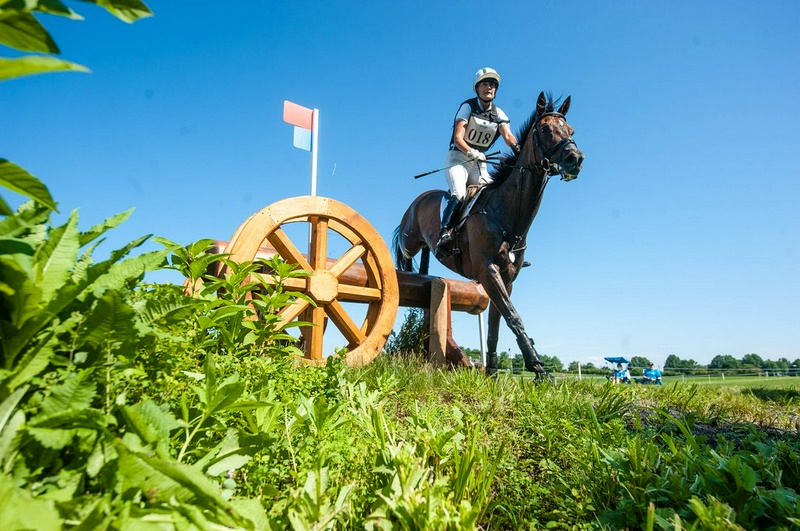
In this discipline, practice does not necessarily bring perfection; it is the correct practice that leads to perfection.
When learning to jump corner fences, the task should not be complicated.
In fact, it should not be complicated at all.
This skill should be learned gradually and consciously.
When a rider wants to teach their horse to jump a corner or any other accuracy question, two key points must be considered.
First, one should start slowly and in a controlled environment.
Second, it should be remembered that sufficient preparation creates respect for the question being posed.
The goal, above all, is to create a positive experience for riders and horses from the very beginning.
Corners are deliberately designed to offer an easy way out for the rider; that is, to veer around the obstacle instead of staying between the flags.
But when the horse or rider has practiced correctly, neither should be tempted to take that easy way out, even when faced with surprises.
Start slowly and in a controlled environment. There is a real difference between practicing corners in the ring and approaching them on the cross-country course, but the lessons learned in the ring are fully transferable to the field.
For this reason, I prefer to initially train young riders and horses in a more controlled environment.
In this space, one can gradually build an understanding of the question, determine what is required for the correct answer, and even reduce the likelihood of considering the easier route — that is, a runout, which is a common error.
Although a rider may not have to ride a real corner until the higher levels of eventing, I think many riders do not give this obstacle the respect it demands from the very beginning.
Even at the Training level, a rider should not approach a corner like a wide table or a brush fence obstacle.
I don't think any rider can approach a corner casually or at a charging speed.
This obstacle is designed to force the rider to ride with more discipline, and if they leave the easy way open for their horse, correcting it will be one of the most difficult issues.
Practicing in the ring using poles and standard obstacles and perhaps even barrels allows for changes in height and angle and helps the horse and rider gradually learn what it feels like to focus on a line and stay between the flags.
For this reason, I like to see a horse and rider thinking about jumping a corner from the very beginning, with the understanding that this obstacle is always more challenging and requires more thought at every level.
There is no reason to leave the easy way open in the cross-country environment when the horse or rider is just learning, while they can learn readiness and technical precision in the ring.
Then, once they understand the correct feeling, they can take it to the cross-country field.
Correct preparation creates respect. When the horse or rider learns to respect the corner for what it is, then they can jump it like any other obstacle.
This may seem contradictory, but let me explain.
The key still lies in preparation, but this time in a more tangible sense.
The rider should take as much time as needed to return from a Chaharnal or cross-country gallop and reach that forward, springy trot specific to show jumping that their horse needs to jump from the corner and answer this question with the necessary respect.
Only then can they ride it like a show jumping obstacle.
I like to see riders who establish their path about six strides before the corner and enter a balanced trot.
They should be in a light three-point seat in the saddle, and the horse should move uphill and balanced.
It doesn't have to happen exactly six strides back, but in my opinion, six strides is a longer distance than most riders think.
The point is that they should be ready earlier than they think.
Of course, this distance may shorten as the horse or rider reaches the next level or their relationship improves.
Just as we should take time entering the main arena, I want both horse and rider to take the time they need to feel comfortable answering the question.
Even when surprises occur, for example, the horse hesitates, gets scared, or slips, if there is a suitable distance from the corner, the rider will have the time and confidence needed to react, communicate effectively, stay on their line, and keep the horse confident, straight, and balanced.
A point about using poles or flags: there has been some debate for a while about whether the horse or rider should learn to "look for the flags" when passing corners or other challenges like narrows or chevrons.
From my perspective, it all comes back to ensuring that horse and rider have a good experience from the start and that neither ever feels the easy way is the only way forward.
We have previously talked about a gradual approach to reducing excessive pressure on the horse or rider, as well as the proper preparation path in approaching an obstacle at each level.
So is the use of poles or flags really necessary?
If it helps create a positive educational experience, my answer is: yes.
Chris Burton, the Australian Olympic rider, often uses something I like to call "training wheels" on either side of his cross-country obstacles.
These help guide the horse or rider towards the correct line of a challenge.
In fact, in practice, it rarely happens that he jumps narrows or a corner without poles on either side.
Top-level riders do the same, and I don't think anyone is necessarily training the horse or rider to hunt for flags or rely on poles as bumpers; rather, the goal is just to reduce the risk of a bad experience.
This action, until staying between the flags becomes routine and rewarding, removes the simpler escape route.
In fact, it is simply said: "Look, this is the path, no matter what shape the obstacle is."
The subject is preparation and taking the time to ensure proper understanding; then, the training wheels can be removed.
For anyone of any age, riding a bike for the first time can be difficult and sometimes scary.
Jumping from a corner or any precision-based question is almost the same.
The horse and rider need time to understand how to prepare, what it feels like, and that choosing not to do it is not nearly as appealing.
Gradually, as the training wheels come up and make less contact with the ground, riding without them becomes easier.
In my opinion, if the horse and rider learn how to jump from corners, or practice and prepare for any new obstacle in the same way, then they learn to ride it in a way that, just like riding a bicycle, they never forget.
Source: Practical Horseman – Training