How to Treat and Prevent Summer Sores in Horses
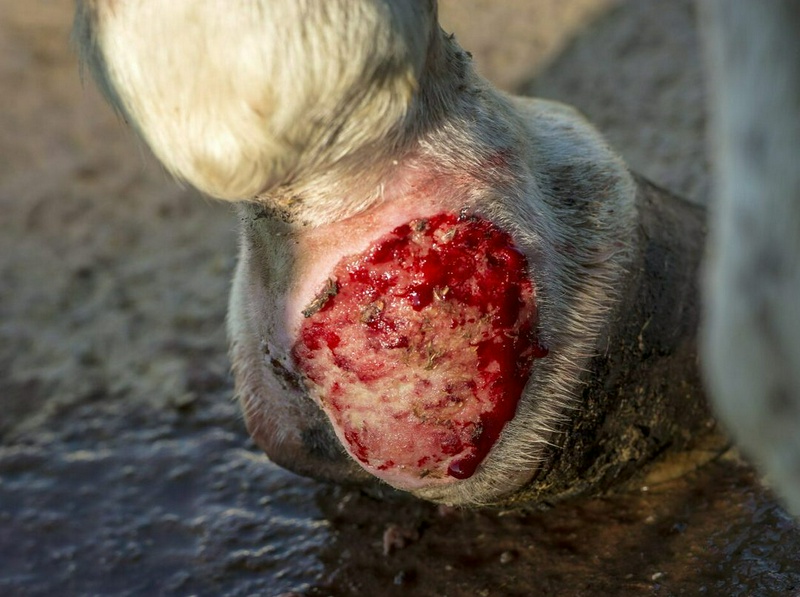
Everything started with a superficial scratch—really just a small scratch—on your horse’s pastern.
You cleaned it and thought nothing more of it.
But the wound did not heal and now, weeks later, it has turned into an infected, purulent sore.
Your horse keeps biting and rubbing it, so you know it is driving him crazy.
What happened?
If you have dealt with horses for less than 30 years, you can be forgiven for not recognizing the condition long known as summer sore.
Since the mid-1980s these sores have become very rare, “so rare that veterinarians who graduated after that time may never have seen one and may not be able to recognize it,” says Dr. D.
G.
Pugh, professor in the Department of Pathobiology at Auburn University College of Veterinary Medicine and director of the Alabama Department of Agriculture Veterinary Diagnostic Laboratory System.
He adds that summer sores are still not common.
But reports of cases have increased in recent years.
If your horse has a wound that will not heal, you should pay attention to this condition.
The good news is that summer sore heals with proper care.
Even better, these sores are preventable.
To know how, it helps to understand how they form.
Parasites on the wrong path Summer sore is the result of a deviation in the life cycle of certain stomach worms.
These worms (Habronema and Draschia species) are not the most dangerous internal parasites of horses—they live as adults in the horse’s stomach and rarely cause serious harm.
Dr. Pugh says, “But their larvae can be associated with problems.
” Although still rare, summer sores are increasing because of the warm weather that comes earlier and lasts longer than in past years.
©Paula da Silva/arnd.
nl The adult worms produce eggs that are passed in horse manure and hatch quickly.
The tiny larvae that emerge must return to the horse’s body to complete their life cycle, and they need help to do so.
Their accomplices are the larvae of house, face, and stable flies that live in manure.
As fly larvae feed, they ingest the worm larvae, and the worm larvae develop inside the fly larvae until the fly larvae become adult flies.
As adults, the flies are attracted to discharges around the horse’s mouth, eyes, nostrils, wounds, and other openings.
When they land to feed in these places, the larvae sense the moisture and emerge.
The lucky larvae find themselves near the mouth, are swallowed by the horse, and become adult worms in the stomach.
But trouble begins when the worm larvae are deposited in other areas—for example, in a wound or on the moist membranes around the eyes, sheath, or vulva.
The larvae hit a dead end in these places because they cannot reach the horse’s stomach; but they keep trying and migrate through the tissue at that spot.
As long as they have moisture, they can survive and cause local inflammation and severe itching.
The horse may bite or rub the area to relieve the itch, but that only makes the problem worse.
The result is a raw, swollen sore that has bloody fluid and red, lumpy granulation tissue, like the excess tissue that forms when the skin does not close over a wound.
White or yellow calcium-containing particles may disperse in the tissue.
When worm larvae are deposited in a horse wound or on its moist membranes, they cause local inflammation and severe itching.
©Paula da Silva/arnd.
nl These wounds, technically known as habronemiasis, were a familiar problem before the introduction of the anthelmintic drug ivermectin in North America in the early 1980s.
Ivermectin, moxidectin, and other related drugs were highly effective against stomach worms whose larvae cause these wounds, and the widespread, regular use of these drugs dramatically reduced their numbers.
But these worms were not eliminated entirely.
Pugh says: “Anthelmintic drugs kill these parasites, but not one hundred percent.
If adult worms are in the horse’s stomach, they can lay eggs.
If the larvae are in manure, some fly larvae can act as intermediate hosts for these stomach worms.
” It is unclear why more wounds are appearing now.
For some theories, see “The return of an old problem” below.
He adds that some horses appear to be more prone to summer sores.
These horses may be more sensitive to the parasite larvae—possibly if adult worms live in their stomach—or they may have a genetic predisposition.
Necessary measures A summer sore rarely heals on its own.
These sores usually appear in spring and summer, when flies are more active, and worsen as summer progresses.
Inflammation may lessen in winter and you may think healing is under way, but in spring the sore usually reappears.
Pugh recommends: The first step in dealing with this problem is to have your horse’s veterinarian examine the skin lesion and try to diagnose it.
Other conditions can also have similar signs.
Summer sores on the skin can resemble exuberant granulation tissue, various growths (sarcoid, squamous cell carcinoma, mast cell tumors) or pythiosis (“swamp cancer” caused by a fungus-like organism).
Flies that carry worm larvae are attracted to secretions around wounds, the mouth, eyes, nostrils, and other openings of the horse.
©Paula da Silva/arnd.
nl In the eye, a summer sore may resemble a growth, onchocerciasis (caused by the filarial worm Onchocerca), inflammation caused by a foreign body, or some bacterial or fungal infections.
Some of these problems may be more dangerous for the horse than a summer sore, so the sooner you consult a veterinarian, the better.
Diagnosis is based on clinical signs and laboratory analysis of a scraping or biopsy.
To get rid of the sore, follow a three-step plan: treat it.
The veterinarian may prescribe topical or systemic glucocorticoids, which are powerful anti-inflammatory drugs, or a topical combination of glucocorticoids and dimethyl sulfoxide (DMSO).
Reducing inflammation should slow the growth of granulation tissue in the summer sore, but this alone may not be enough to start healing.
Sometimes the excess tissue must be surgically “debulked”—trimmed away or frozen—to allow healing.
If a secondary infection has developed, the horse may need antibiotics.
Eliminating the parasites.
Systemic treatment of the horse with ivermectin or moxidectin should remove the adults from the stomach.
Sometimes these drugs are also applied directly to the wound, along with anti-inflammatory treatments, to strike at the larvae.
Fly control.
Every open wound is a fly attractant, and flies may irritate the wound and perhaps leave behind more worm larvae.
Fly-repellent ointments may keep them away, but whole-farm fly control is the best way to deal with these pests.
He said: “All fly control programs should focus on reducing the places where flies breed—manure, wet feed, wet organic material—and be part of a broad prevention strategy.
” As part of an effective fly control program, manure should be cleared from the yards at least twice a week.
©Amy K.
Dragoo Flies and parasites are problems for the whole herd—they pose a risk to every horse on the property, not just the horse that has developed summer sores.
To prevent these sores, you must control both problems.
Look for flies in the places where they live, breed, and feed.
Effective control can include these steps: cleaning.
Clean the stables once or twice a day and clear the yards at least twice a week to get rid of manure, spilled feed, trampled straw, and other materials that attract flies and provide feeding and breeding sites for them.
Manure management.
How you do this depends on your setup.
You can compost it.
If done correctly, composting generates enough heat to kill fly larvae as well as parasite eggs and larvae.
You can spread some of it as fertilizer in fields (but not in horse pastures, because this encourages the transmission of parasites).
You can store it in an area away from the stables and horse-holding areas or haul it to another location.
Except when it is spread in fields, keep it covered.
Using fly predators.
These tiny parasitic wasps lay eggs in manure piles.
The wasp larvae feed on and destroy fly pupae.
Suppliers usually send these predators several times during the season.
Using fly-control agents in feed.
These products contain insect growth regulators or larvicides that pass through the horse’s body undigested and remain in the manure, where they prevent the development of fly larvae.
These products also affect fly predators, so these methods should not be combined.
Protecting the horses.
Face and ear masks and topical repellents—sprays or ointments around the wounds—can help.
Horses can also be kept in the stable during times of day when flies are most active, especially if the stable has fans or fly screens.
Killing flies with traps, baits, and residual fly sprays in areas where they gather.
Sprinkling sodium bisulfate on stable floors can reduce the number of flies as well as ammonia in the stable.
Systemic treatment of the horse with ivermectin or moxidectin should remove the adult worms from its stomach.
Sometimes these drugs are also applied directly to summer sores to combat the stomach worm larvae.
©Paula da Silva/arnd.
nl fight parasites with a selective deworming program.
When a horse develops summer sores, it makes sense to treat his stablemates with ivermectin or moxidectin as a preventive measure.
They have been visited by the same flies that have visited the affected horse and may harbor adult stomach worms.
But when it comes to routine parasite control, the approach many horse owners have long followed—deworming every horse every eight weeks—should be set aside.
Pugh says: Such indiscriminate dosing encourages resistance, which develops when a few worms survive treatment and pass on the traits that helped them survive to the next generation.
He says: “This is also critical for other internal parasites, such as small strongyles [cyathostomes].
” At present, some of the dangerous parasites of horses have found ways to resist common dewormers, and this problem is spreading.
Widespread resistance has developed to two of the three main classes of these drugs, the benzimidazoles (such as fenbendazole) and pyrantel salts (pyrantel pamoate or pyrantel tartrate).
Ivermectin and moxidectin belong to the third class, the macrocyclic lactones.
So far, these drugs have remained effective against small strongyles, the most common and dangerous internal parasites of horses.
But researchers believe it is only a matter of time before worms resistant to all three classes of dewormers develop.
Fans and fly screens help protect horses in the stable at times when flies are most active.
©Stacey Nedrow-Wigmore/arnd.
nl to delay this day and protect your horse, work with your veterinarian to set up a selective parasite-control program tailored to your situation.
The recommended program will vary depending on where you live, the number of horses on the property, their age, the amount of pasture, how often you travel to shows, how often new horses come onto the property, and other factors.
Fecal egg counts help identify horses that are shedding more small strongyle eggs.
These horses may need more deworming than others, while less susceptible horses may only need to be checked and dewormed a few times a year.
The return of an old problem Experts are not sure why summer sores have become less rare in some areas.
Here are the main theories: resistance.
Repeated use of one dewormer allows parasites to develop resistance.
Have Habronema and Draschia become resistant to ivermectin and other drugs in the same class?
He said: “We do not know whether this has happened or not.
” Pugh said: “No one has documented this.
” New deworming programs.
Resistance to common dewormers has developed in other dangerous parasites.
To counter this trend, in 2013 the American Association of Equine Practitioners issued guidelines recommending a selective and individualized approach to deworming.
This new approach targets the parasites that pose the greatest threat to equine health (such as small strongyles) and generally involves longer intervals between deworming.
Have Habronema and Draschia used these longer distances and made a return?
Although it is possible, Pugh said: “We started seeing cases before the AAEP recommended the new protocols.
” Flies and parasites are herd problems—they pose a risk to every horse on the property, not just the lone horse that develops a summer sore.
To prevent these sores, you must control both problems.
Fly masks and ear covers and topical repellents can help.
© Amy K.
Dragoo air.
In recent years, warm weather has arrived earlier than usual in many parts of the country and has remained longer.
Warmer weather means a longer fly season, giving them more opportunity to reproduce and increase their population.
Management.
Weather may be a factor, but according to Pugh, over the past 40 years there have been changes in how horses are kept.
More horses are now kept in urban and suburban barns in a crowded manner, rather than being spread out.
Under these conditions, he says: “Poor manure management and insufficient fly control give the fly population a chance to increase.
If you have more flies, you will also have more summer sores.
” This article was originally published in the July 2015 issue of Practical Horseman magazine.
Source: Practical Horseman – Health