Five exercises from Marcia Kulak for using cavaletti
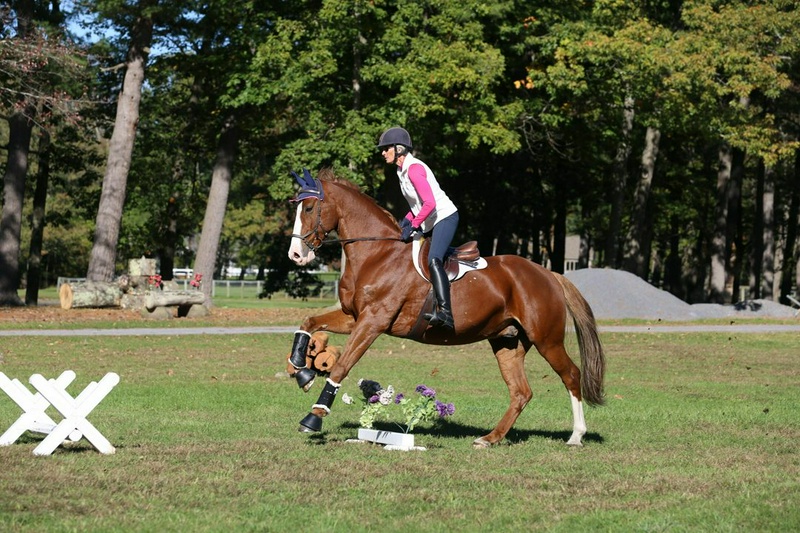
An experienced trainer in eventing, show jumping, and dressage, Marcia Kulak uses daily exercises with cavalletti to improve her horses’ strength, rhythm, balance, and precision.
Here, we explain some of her favorite exercises step by step.
Did you miss the first part of this article, in which Kulak talks about her training philosophy and the benefits of cavalletti exercises?
Read it here.
Always start with one or two poles about 4.5 feet apart and set in a straight line to make sure your horse can handle the exercise easily and maintains rhythm, line, and balance before, during, and after the exercise.
Start at the trot on a slightly inward line to make sure your horse goes through it easily.
If you or your horse are new to cavalletti, keep things simple and expand the exercises as confidence grows.
Make sure you clear the first pole without losing your position.
Use your peripheral vision, from the lower part of your eyes, to look at the poles without dropping your head.
Your brain will interpret the distance between you and your horse and the object you are approaching.
Looking at the poles or jump is very important, but it is also crucial to maintain your position and truly not look down or lower your head.
1.
Walk-trot-canter line This basic exercise teaches your horse to be responsive to your aids while developing rhythm in all three gaits.
Rhythm, line, and balance are your top priorities so your horse can focus on the footwork.
Set-up: Place three to four cavalletti in a straight line about 9 feet apart.
Use sturdy 10- or 12-foot poles secured with blocks at the ends for added stability.
Steps: Approach the line at the walk.
Allow your horse to go through calmly and in military rhythm.
Come back and go through at the trot, keeping your sitting position steady and your eyes up.
Repeat at the canter, focusing on a straight approach and a soft contact.
Incorporate transitions before and after the line—walk to trot, trot to canter, canter to walk—to sharpen responsiveness.
Tip: Keep your leg quiet and let the poles do their job.
Your horse will learn to lift and place its feet without your help.
2.
A circle of poles Working on a curve improves balance and precision while encouraging your horse to bend through the body.
This exercise helps develop and improve the quality of the trot.
Doing it on a curve increases engagement of the horse’s inside hind leg and reach of the outside foreleg.
This improves the engagement and suppleness of the trot.
Marcia Kulak demonstrating walking over poles on a circle.
©Amber Heintzberger Set-up: Place four to six poles evenly in a circle, like the numbers on a clock.
On the inside track, set the distances at about 4 feet, in the middle 5 feet, and on the outside 6 feet.
Steps: Begin at the trot on the middle line.
Keep your rhythm steady and ride a soft circle.
Move between the inside and outside lines.
A shorter distance requires more collected strides, while a longer distance requires more lengthening.
Once you are sure, canter the circle and maintain bend and balance.
Tip: Look where you are going.
If your eyes and shoulders follow the circle, your horse will too.
3.
Raised alternating poles
This exercise strengthens your horse’s hindquarters without increasing the height of the jump, and improves strength and coordination.
When introducing this exercise, always start with a low cavaletti as the first pole in both directions.
The rider’s responsibility in maintaining rhythm, line, and balance is crucial and allows the horse to focus on its hindquarters.
This exercise is challenging because of the slight difference in the height of the poles.
The goal here is to increase engagement and precision in the horse’s hindquarters.
It is important to maintain the rhythm and not let the horse rush through the exercise.
This exercise is about engagement, not movement.
Setup: Place four cavaletti in a line, with appropriate spacing for trot (4’6” – 4’9” distance).
Raise every other pole a few inches off the ground.
Steps: Trot the line and maintain a steady rhythm.
Focus on standing tall with quiet legs—do not try to help your horse over the raised poles.
Repeat several times, then give your horse a break on a long rein.
Tip: If your horse rushes, circle before or after the line to regain balance, then approach again calmly.
4.
The narrow poles challenge
This very advanced exercise develops precision, straightness, the horse’s understanding of narrow jumps, and rider focus—excellent preparation for narrow jumps in competition or tight hunter lines.
Narrow poles help horses and riders develop accuracy.
©Amber Heintzberger Setup: Use short poles, 4′ – 6′ long, in a straight or curved line, for trot or canter.
Start with one pole and add more as you progress.
Steps: Go over a narrow pole and keep your eyes focused on a point beyond it.
Progress to two or three in a row.
When your horse is comfortable, do the exercise in trot and stay straight and tall.
Tip: Horses don’t see directly in front of them—so ride with confidence to give them clarity.
5.
Pole and jump combination
This exercise adds variety by combining cavalletti and a small jump, and prepares your horse for obstacles.
This exercise helps horse and rider establish a calm, regular rhythm before and after the jump.
This method is very suitable for introducing new and slightly intimidating obstacles, such as Liverpool, an artificial ditch, a churon, or something as simple as a small log with a prepared stride.
Obstacles do not need to be high to help horses and riders develop skills.
©Amber Heintzberger Setup: Place two cavalletti before and two after a small obstacle, each about 9 to 9.5 feet apart.
Vary the filler in the middle obstacle: it can be a small wall, Liverpool, or crossrail.
Steps: Enter in trot and stay straight and balanced.
Let the poles set the stride.
Leave smoothly and focus your eyes on a mark beyond the exercise.
Keep changing the fillers regularly so that your horse remains alert and adaptable.
Tip: start small.
The goal is rhythm and confidence, not height.
About Marcia Kulak Marcia Kulak.
©Amber Heintzberger Marcia Kulak, with experience at the five-star level in eventing, and being shortlisted for two Olympic Games, and training with some of the sport’s leading names across several disciplines, including Jack Le Goff, Mark Phillips, Anne Kursinski, Sue Blinks, Ruth Hogan-Poulsen, Ali Brock and Beezie Madden, as well as natural horsemanship experts such as John Lyons and Louis Wood, brings a unique perspective to her riding and training.
She has also contributed to the sport through management and volunteer efforts, including serving on the USEF Eventing Selection Committee.
Today, she runs Kulak Equestrian near Saratoga, New York, and in Wellington, Florida, and works with a wide range of students.
Source: Practical Horseman – Training