Harry Boldt – A tribute to a legend
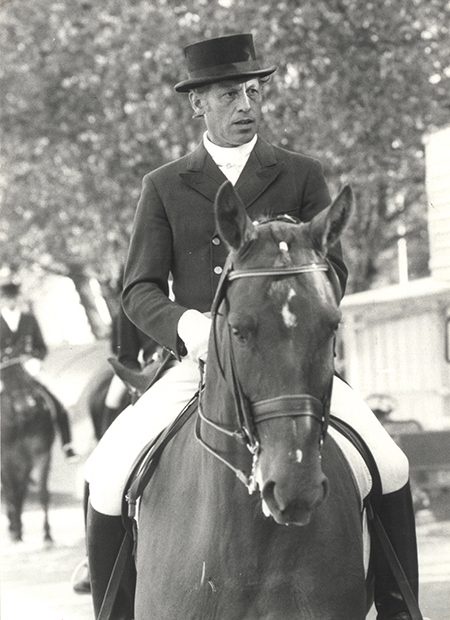
This article was published to mark the 90th birthday of Harry Boldt; in January this year he turned ninety-five — but his wise words still resonate.
.
.
Harry Boldt, the man who took Nicole Uphoff and Rembrandt to the top and led Germany to a collection of Olympic, European and world medals, turned ninety.
Harry was born for riding and training.
Harry Boldt’s father, Heinrich, had a racing stable in Essen, and Harry became a successful show jumper until, with the help of Käthe Franke, he turned his attention to dressage.
Harry and Remus at the 1964 Tokyo Olympic Games, he won team gold and individual silver with Remus.
He did the same at the 1976 Montreal Games, this time with Woycek.
Woycek from 1981 to 1996, he was the coach of the German dressage team.
Seoul gold for Harry and the team included Reiner Klimke, Nicole Uphoff, current German coach Monica Theodorescu and Ann-Kathrin Linsenhoff.
.
.
Harry’s life was always tied to horses: he said, “It’s a family matter.
My father was a riding instructor.
I grew up in riding schools and always saw horses.
But I was born before the war; there were no horses during the war and it was late for me, I was eighteen when I started riding.
After a year, I competed as a show jumper.
Two years later, I tried dressage a little and found that I enjoyed it more.
My father was a very good dressage instructor, which is why I became a dressage rider.
” Your first really good dressage horse?
He said, “It was Remus.
He was the horse I took to Tokyo in ’64.
The year before the Olympics I was on the German team with him at the European Championships.
In ’66 we went to the first World Championships, in ’68 I was with Remus as a reserve rider at the Mexico Games.
Then the horse got too old to compete and a few years went by with not-so-good horses.
” Woycek – the best He said, “In 1975, I was lucky to get Woycek.
He was my best horse.
He was nine years old and starting his first year in Grand Prix, but his owner needed money and was forced to sell, and that was my chance.
I found a sponsor who bought the horse and I had five very successful seasons with him.
The best of them was at the ’76 Olympics with individual silver and team gold.
” He added, “In the following years I was on the team at the World Championships and twice at the European Championships — and the European Championships were his last competition; he had an accident and after that his right hind leg was not very good.
Some weeks he was very good and then a little lame, so that was the end for Woycek — and that was the end of my riding career too.
” What made Woycek such a great horse?
He said, “First of all, his temperament.
He had the best temperament for a dressage horse.
When you asked him to work, he gave his best performance.
He was very calm; whether you were walking with him through the fields after a show jumping event, or the next week at a show jumping event or training.
He was better in the competition arena than at home.
He had very good walk, an excellent extended trot, and good canter.
He could do piaffe, passage, and pirouettes.
Those were no problem for this horse.
” Which riders have helped you?
He said: “Initially, my father taught me up to S-Prix St George and Intermediaire 1 level, and then I had three very successful years with a great German lady, Kathe Franke.
She was an extraordinary coach, especially for Grand Prix and with young horses.
Those three years were the best time for me to learn dressage.
That was when I had good horses.
Later, when I was on the team, I had the national coaches Bubi Gunther, Willi Schultheis and Albert Stecken.
Whenever you think you are a very good rider, there are always small problems, and these coaches can be very helpful.
” Kathe Franke riding Hanoverian Arnfried in Verden in 1932 He said: “Kathe Franke had years of experience as a competition rider at the highest level.
She was a refined and dignified rider, professional, but very dignified.
Later, as she got older, she was very successful with carriage horses.
There were no problems for her.
She was a show jumper in her youth and was known in every discipline.
” And now do you enjoy the challenge of training other riders?
He said: “In 1980, when my show riding career came to an end, the German FN asked me whether I was interested in coaching.
From 1981 I became coach of the German team.
” How does the national coach work with the private coaches of team members?
He said: “It is not a problem.
Most riders have their own coach, and I have a good relationship with the coaches.
When I go to see the riders, the coaches are always there.
Their coach gives the lesson and I watch.
If everything is right, I am happy.
We work according to FEI rules, they tell us what is correct – and we have all these individual riders who have to form a team and ride at one level.
” But in Nicole Uphoff’s case, were you also her personal coach?
He said: “Yes, since March 1988 I have been her personal coach.
She lived in Duisberg and then had more horses and the stable in Duisberg was small, so she moved to Warendorf, and from then on I became her personal coach.
” Was it difficult to work with a horse so young and with so much pressure at the Olympics?
He said: “For an ordinary twenty-one-year-old rider, perhaps it would be a problem.
But she is very strong and very calm.
The year before the Olympics, at the European Championships, we saw that Rembrandt could be a difficult horse, but in the days before the competition in Korea there were problems, yet every day it got better and better.
She is very strong and determined and has no nerves problems.
She knows her horse very well.
” He said: “Yes, it started with the Marzog period.
Marzog was very stylish and received very subtle aids from the rider.
It was a new method - before that we had horses like Granat and Woycek, which were heavy in weight, like hunters and very dynamic.
Now with Marzog, very stylish and like a Thoroughbred horse.
Then the following year Gaugin de Lully, which is almost the same.
...
Then last year Corlandus with Margit Otto-Crepin from France, this very excellent horse with a very stylish rider.
This is the period and now Rembrandt continues.
” He said: “I think the next ten years will be this period of elegance.
” Did the German federation sit down after Marzog’s winning streak began and deliberately change the style?
He said: “Yes, when you see the judges’ results and they give a horse like Marzog a better score than a horse of similar quality but not quite as stylish, we have to look for more stylish horses.
“Style in horses or in training?
He said: “The type of horse must be stylish.
With a stylish horse, more like a Thoroughbred, you do different training than with a horse like Ahlerich, which is very big and powerful.
The Thoroughbred type is softer.
“He said: “We had three very good horses on our team.
Rembrandt, then Courage with Ann-Kathrin Linsenhoff, a stylish Swedish horse.
Then we had Ganimedes - he is a mixture between Thoroughbred and Warmblood, sometimes a bit difficult for Monica Theodorescu, but he performed very well at the Worlds and is a very healthy horse, I think he will continue on the team with Rembrandt.
Courage is fifteen years old, maybe yes, maybe no.
“He said: “The horse carries itself very well, and this allows the rider to sit with very light reins.
We do not want hanging reins, but a little softness and lightness - that is what the judges like to see.
“And yet Rembrandt works very long and low?
He said: “Rembrandt can be very strong through his back.
If you saw Nicole Uphoff in the days before the competition in Seoul working with Rembrandt, his head was always down to loosen his back, with his head down to the ground - trot, medium canter and collected.
Rembrandt can canter in such a way that he only canters on the spot, even with his head down.
“He said: “That is why, when he is in the competition arena, he is always light in the hand and the transition from extended trot and canter to collected is no problem for him, because in the days before the competition she works with him only long and low.
Bringing this horse up is no problem - the only problem is bringing him down.
He always likes to come up a little, and that is why she always works him with his head down and his neck round so that his back works better - so that the horse’s outline becomes more closed.
This method is not suitable for every horse, but for this horse it is the right way.
“He said: “No, Nicole Uphoff is an experienced rider, she is young, but she has a lot of experience and can bring him down without using a draw rein or auxiliary rein.”
You prefer not to use an auxiliary rein?
He said: “For riders who do not have much experience and have trouble lowering and rounding their horses, why not use an auxiliary rein?
It is better to use a draw rein than to have the rider spend one or two hours riding, sweating both horse and rider, and always struggling and becoming frustrated.
For riders who do not have much experience, it can be helpful.
“He said: “I have ridden many horses in my life, some difficult horses, and you need double reins or auxiliary reins.
Double reins are not always the best way - they can cause problems with the tongue, so it is better to ride with an auxiliary rein.
But they are a little dangerous, you have to feel with the auxiliary rein when you need them and when the horse is no longer against the hand, you must give to him immediately - otherwise it is dangerous because the horse’s neck gets shorter and shorter.
“You like your riders to work their horses longer and lower…
He said: “That is the only right way.
Before the lesson starts, the horse must be loose in its muscles.
He stands in the stable for 23 hours and only walks a little; when you get on him and, without warming him up for 20 minutes to half an hour, start working long and low, that is not horse-friendly.
» Can he go very long and very low?
He said: «The horse should be a little closed.
Not so that his head is down and the hind legs are stretched backward.
It is important that the neck is round, not only long but round.
You must always shape the horse’s neck.
If you always ride the horse in a high position, the neck will not be beautiful; it will become stiff like wood.
First you must work your horse long and low, trot and Chaharnal, transitions.
When you feel that everything is good, when you can bend him left and right and he follows your hand, that is the moment when I start teaching collection and higher collection; then we can start the lesson.
» He said: «One of the lessons that has the most problems is the pirouette.
A rider who has never ridden a horse that does very good pirouettes cannot teach it to his horse.
In all countries you see riders who have brought their horses to the highest level, but you often do not see good pirouettes.
Most of the time, you see volts or a horse that is stiff and turns in three or four steps.
I often see riders not performing the pirouette correctly – yes, they are pirouettes, but they only get a score of four or five.
» He added: «Many riders think that when they sit very firmly and heavily in the saddle and lean back a little, that is the best method for the pirouette, but they are wrong.
You should sit a little more easily on your legs, not so heavily in the saddle.
It is wrong for the horse’s hind legs to come too far under its body, sometimes so that the hind legs are almost close to the front legs – that only leads to a blocked trot.
» He said: «It is better for the rider to bend the horse a little inward and make the neck rounder and bring it forward and not sit too heavily; in the pirouette the horse should trot in very small steps.
This is only possible when you sit very comfortably and the horse is Durchlassigkeit, half-halts, half-halts – it must still trot and cannot if the rider sits too heavily in the saddle.
» Do you often ask riders to do travers trot as preparation?
He explained: «Often the problem is when you start keeping the hindquarters to the inside.
A pirouette keeps the hindquarters to the inside.
You see riders using the inside rein too much and the hindquarters go out; that is the biggest problem.
The hindquarters must go in a circle smaller than the horse’s front legs – so the hindquarters must take smaller trot steps and the front legs must take bigger trot steps.
To keep the hindquarters in place, you train with a little travers trot.
Travers trot is only an aid for the less experienced rider to start the pirouette.
Start with travers trot on a volt to teach the horse to do a smaller trot with the hind legs.
» He said: «Most horses are too stiff to do a good pirouette; they must be ridden to become more flexible.
Very small trots can make the horse more supple and create a better three-beat trot; then, from this shortened trot, always transition to medium trot and extended trot. It is important not to always work on small circles.
» Source: The Horse Magazine