Three-Part Rule: How to Manage Your Horse’s Body in Motion
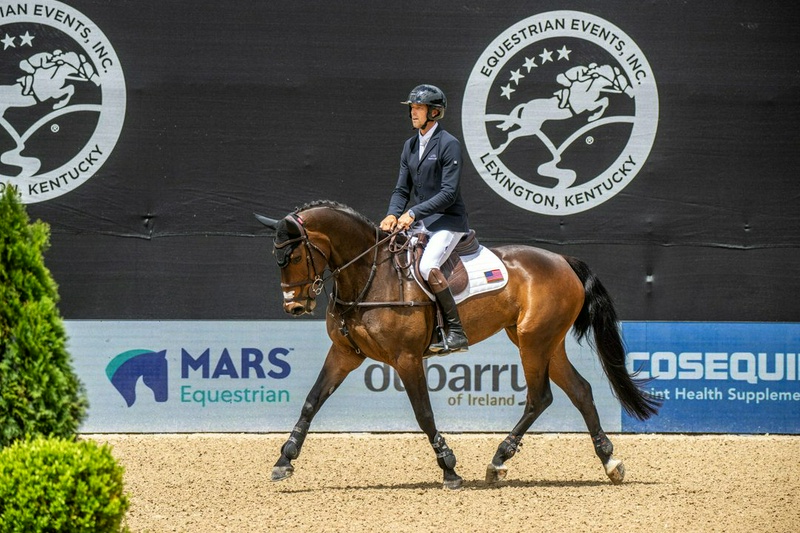
Coordinating all of your own moving parts and your horse’s can be a challenge.
But if you divide the horse’s body into three separate sections, it becomes easier to manage them.
Here, Stephany Fish Crossman, accredited LEVEL 3 Ride With Your Mind instructor, biomechanics expert, and dressage trainer, explains how you can positively influence your horse with your position.
Q&A Question: Can you explain how horses’ bodies are divided into three sections (front, middle, and hind) and how riders can correct the section that is out of line?
Michelle R.
, Florida Answer: This is a little outside the biomechanics of the rider, but it is a way that we begin to integrate the levers and pulleys of the rider with the levers and pulleys of the horse.
If you imagine dividing the horse into three sections, from the horse’s chest to just behind the elbow is the front section.
From just behind the elbow to where the knee meets the belly is the middle section.
We sit on the middle section.
And then from there back is the hind section.
Between each of these sections there is a seam where these two sections meet.
The hind section and the middle section are the hind seam, and the front section and the middle section are the front seam.
The horse’s center of gravity is located in the center of the front seam.
The better riders are positioned near the horse’s center of gravity, the better package they are for carrying the horse, and the less they negatively affect the horse’s balance and the more they are able to positively influence the horse’s balance.
By thinking about the horse’s different sections, the front section is usually the most challenging section.
The neck is attached to the front section, but is not actually part of the front section.
It’s like the rudder of a boat.
Most likely everyone has been in a rowboat.
That’s a boat without a rudder.
But if you’re lucky, you’ve also been in a sailboat that has a rudder to steer.
Either way, they’re both boats.
How you manage the connection between the front section and the middle section is directly related to the horse’s ability to pull the neck out over its body.
The balance they take from their neck matters.
There are numerous ways riders help maintain the connection of the horse’s various body sections through their seat.
The thighs play an important role in this.
Remember that I referred to the thighs as your seat’s seat belt.
Primarily, the thighs are there to keep you connected to the horse, but the more you remain connected and strengthen your muscles to maintain that connection without having to think too much, the thighs begin to take on different jobs.
Collection happens from the thighs up toward the torso, so the ability to use the thighs directionally is important.
This movement is not visible and is not something others see.
It is more of an isometric engagement of your muscles.
You can literally collect the horse’s body with your thighs because they are part of your seat.
This is a basic way to give an example of how the rider’s levers and pulleys can help maintain the connection and coordinated movement of the horse’s various body sections.
For more information: For more articles with Fish Crossman, click here.
About our expert: Stephany Fish Crossman Stephany Fish Crossman.
©Sunsoar Photography Stephany Fish Crossman, co-host of the Dressage Today podcast, began riding in the state of Maine as a child and has not dismounted from a horse since.
Except for a short period in the hospitality industry, Fish Crossman has worked with trainers at all levels, from pony clubs to several different Olympians.
He attended the International Academy of Equestrian Studies in Warendorf, Germany, and graduated with his National Trainer Certificate.
He also holds USDF bronze and silver medals and is one of only two Level 3 trainers in the world for Mary Wanless’ Ride With Your Mind biomechanics system.
He conducts training clinics across the country and runs a small training business called Serendipity Dressage in Okeechobee, Florida.
Source: Practical Horseman – Training