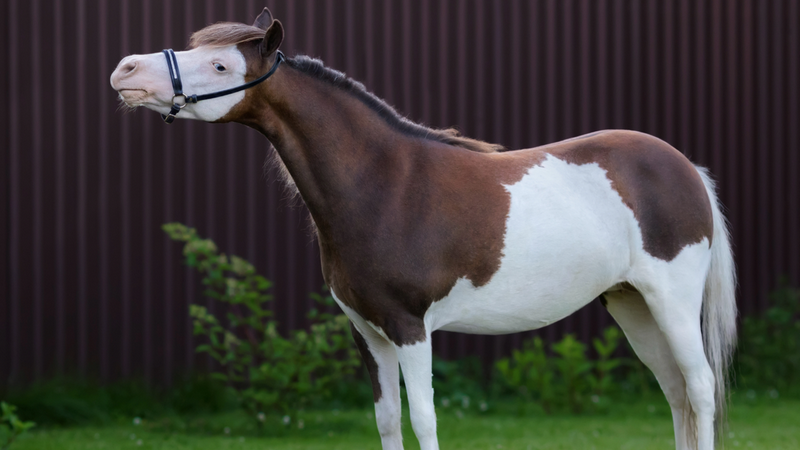
Credit: Getty Miniature horses are small but powerful, packing many features into a small body.
In fact, the smallest horse in the world is a breed of miniature horse.
But what is a miniature horse?
Aren’t we talking about ponies?
Is a miniature horse a pony?
The most important point is no.
This is an interesting fact about horses that you can share at parties!
Miniature horses and ponies are two different categories of horses, and the difference comes down to their body structure.
Hundreds of years of selective breeding have given us the modern miniature horses.
If you place a miniature horse next to a pony of the same height, you will quickly see the differences.
In general, ponies have short, thick legs and thicker necks.
They usually have a broader body than horses, and their bodies are also proportionally shorter.
In contrast, a miniature horse looks like a scaled-down sport horse or racehorse.
They have longer bodies and legs, slimmer necks, and beautiful heads.
Can miniature horses be ridden?
Miniature horse breeds are generally not used for riding - only a very small and lightweight child can do that.
They still need training and preparation for a suitable career like regular horses.
Many miniature horses are used in driving, showing, and agility, and are also bred as pets and therapy animals.
Falabella miniature horse breeds.
Source: Alamy 1.
Falabella Height: 24–28 inches Weight: 50–80 kilograms Country of origin: Argentina This small and rare breed is the smallest horse in the world and is most likely also one of the hardiest, as it can withstand extreme temperatures and harsh landscapes.
Spanish horses that were brought to South America from the 16th century form the origin of this breed.
After some of them were released and went feral, they made their way to remote areas such as isolated places outside Buenos Aires.
Part of this population of horses joined the indigenous Mapuche people.
How did this breed become so small?
Generation after generation, they were exposed to harsh weather conditions, limited food, and scarce water.
Falabella became smaller and smaller in order to adapt to these conditions.
And because of the difficulty in finding food and water, over time they became smarter for survival.
Falabellas came to the attention of foreigners in 1845, when the Irish immigrant Patrick Newell observed that these very small horses were kept alongside Mapuche riding horses.
He and his family took care of and bred Falabellas.
His son-in-law, Juan Falabella, took over this responsibility and gave his name to the breed.
Juan introduced blood from Shetland pony and English Thoroughbred horses into the breed to refine Falabella into the form we know today.
American Miniature Horse.
Source: Alamy 2.
American Miniature
Height: less than 34 inches
Weight: 68–136 kilograms
Country of origin: United States of America
According to the American Miniature Horse Association, American Miniatures are the result of nearly 400 years of selective breeding, with the first report of a small horse being brought into the country from abroad in 1888.
However, miniature horses did not appear in the general public consciousness until 1960.
This breed arose from the blood of English and Dutch working horses, especially those that worked in mines (it is not hard to guess why!).
These horses came to the United States in the 19th century and went to the Appalachian Mountains to work in mines.
There is evidence that the Shetland pony was also introduced to achieve the desired miniature stature.
Dutch Miniature.
Source: Absolutely Fotografie 3.
Dutch Miniature
Height: 42 inches or less
Weight: 68–159 kilograms
Country of origin: Netherlands
In Dutch, the name of this small horse is Nederlands Minipaard.
With the establishment of the breed registry in 1993, the initial rules for registration in the breed association (Nederlandse Mini Paarden Registratie Stamboek) allowed any horse under 42 inches (106 cm) to be registered.
This made it possible to have greater genetic diversity in creating this miniature horse breed.
Today, foals that hope to enter the breed registry must follow much stricter criteria.
This includes having registered parents.
The breed association holds an annual summer show in July for all miniature breeds.
The program of this show does not include riding classes, but participants compete in events such as showing, jumping, and driving.
Source: Horse & Hound