Does your horse lean to one side? Muscle stiffness may be the cause
Does your horse lean to one side when jumping or moving on the center line?
Or perhaps does it show resistance or difficulty to one side in lateral work?
If so, it may be time to assess your horse’s physical condition.
One of the overlooked factors in reduced performance is simple muscle stiffness.
When a muscle becomes stiff, it creates resistance to certain movements, and the greater the muscle stiffness, the greater the resistance will be.
Leaning to one side in horses is a common problem that I encounter across all disciplines and levels.
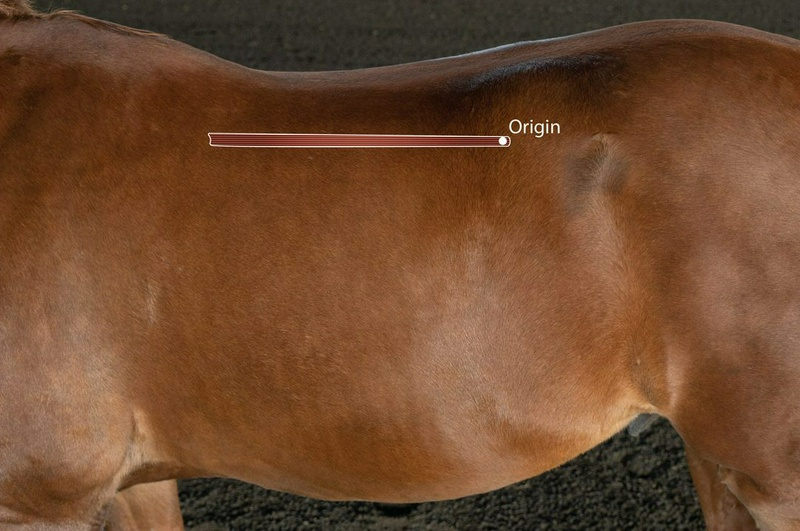
When a client raises concerns about this, I usually look at the longissimus costarum muscle—a small, narrow muscle in the back line that sits beside the outer edge of the larger back muscle called the longissimus dorsi.
The longissimus costarum muscle extends along the sides of all the ribs and is attached to the thick fascia in the lower back and to the front end, which lies under the scapula (shoulder blade), and to the last cervical vertebra.
When we try to find it with our fingers, it feels like a 1-inch ridge under the longissimus dorsi muscle.
We can only assess this muscle by hand from the last rib to just behind the scapula because it is attached under the scapula and cannot be accessed.
Image of the longissimus costarum muscle, a small, narrow muscle in the back line.
©Shane Hofeldt This muscle helps the larger back muscle along the spine and also plays a role in exhalation.
Individually, this muscle bends and flexes the horse’s spine and body to the side in the direction of the muscle’s contraction.
For example, when the left side of the longissimus costarum muscle contracts, it bends the horse’s body to the left.
When a muscle is stiff, it can contract without difficulty, but when it tries to release or let go, there is resistance against the opposite movement.
For example, if the longissimus costarum muscle on the left side is stiff, it will not release properly so that the body can bend to the right, and vice versa.
Basically, the stiffer the muscle is, the harder it is to release, and the resistance to the required movement increases.
Horses move or lean toward stiffness, so if you feel that your horse is leaning to the left, you can be almost certain that the longissimus costarum muscle on the left side is stiff.
The importance of keeping muscles free If you think about movement energy, it is like a wave passing through the horse’s body.
Movement starts at the base of the hind leg and reaches the head.
Any stiff muscle along the body disrupts the wave or flow of forward movement, and if this disruption is due to stiffness in the longissimus costarum muscle, the other muscles begin to compensate.
A horse’s movement can be compared to the coordination of the pistons in an engine.
Like pistons, muscles must act with precise timing: contraction, release, contraction, release.
When the muscles are properly coordinated, balance, coordination, endurance, and ultimately safety are achieved.
The easier your horse moves, the better it will perform, so maintaining the flexibility of its whole body is very important.
If you disrupt the timing with a stiff muscle, you disrupt the horse’s coordination and forward movement.
Muscles are made up of fine fibers, with enough space between each one, like the fibers of a high-quality cotton shirt.
When muscle fibers become tight, they move closer together and prevent sufficient blood flow that carries oxygen to the muscle.
When these fibers move closer together, the horse creates resistance and works against itself from the very first step.
The amount of resistance determines how well it can perform and how long it can work before fatigue, and this can put the horse at risk of injury.
Assessment of tightness in Longissimus Costarum I assess muscle tightness in three different ways: visual, auditory, and movement.
To visually assess muscle tightness, I ask one person to walk the horse away from me in a straight line about 75 feet away and then bring it back.
I carefully pay attention to whether its body is straight or deviates to the left or right.
You can see muscle performance better when walking, because the slower the horse moves, the more muscles it has to use.
Then, I simply listen to the trainer or rider of the horse, or both.
For example, a dressage rider may say that she did not score well on the center line or during shoulder-in in her test because her horse was deviating toward her left leg.
This gives me information about how the horse moves under saddle.
Finally, I use a movement assessment with my hands, which you can do too.
If you suspect that the Longissimus Costarum is tight on one side, find the last rib and see whether there is a small knot attached to it.
Follow the one-inch-wide Longissimus Costarum from the last rib, which is parallel to and attached to the larger back muscle (Longissimus Dorsi), and follow it to the back of the shoulder blade.
If the Longissimus Costarum is truly tight, it will move quickly under your fingers.
In the saddle, if you feel that your horse resists more when bending in one direction or tends to drift to one side or the other, it likely has tightness in the Longissimus Costarum.
Causes of Longissimus Costarum tightness There are several reasons for longissimus costarum muscle tension.
One common factor is repetitive movements.
When horses have trouble bending in one direction, many riders try to improve the bend by working more in that same direction.
Unfortunately, the result is the opposite, and this makes the tension worse.
For example, I had a client who was a Grand Prix dressage rider, and she repeatedly practiced the passage movement while struggling with it.
Repeated practice of this movement caused tightness in her horse’s muscles.
There are several reasons for longissimus costarum muscle tension that can lead to deviation.
©Amy K.
Dragoo Horses may also develop longissimus costarum muscle tightness after getting cast in the stall.
We do not always know when a horse has gotten cast, but muscle tension can be one sign.
When a horse gets cast, it tries to free itself by pushing against the wall, which can lead to muscle tension on the opposite side of its body.
A tight longissimus dorsi may cause compensatory tightness in the longissimus costarum.
An unbalanced rider or saddle can also cause longissimus costarum muscle tightness.
For example, suppose the rider always sits to the right.
A horse is always seeking balance, so it may tighten the muscles on its left side to better maintain the balance of its back and to counteract what is happening on the right side.
Ultimately, another underlying problem may be the cause of a spasm in the longissimus costarum muscle.
Horses may drift to one side to limit their weight or, due to an injury or health problem, shift some of their weight away from the opposite side.
I had a client whose horse drifted strongly to the left.
It was lame in the right front coffin bone, which improved with a joint injection.
It may have drifted to the left to take some of the weight off the right side.
Correcting a spasm in the Longissimus Costarum muscle To release a spasm in the longissimus costarum muscle, Wilson Meagher’s technique in horse sports massage uses three techniques to reduce muscle tightness.
One of these techniques is direct pressure, or simply pressing on a specific point of knotted tissue.
Identify your horse’s last rib and, with two fingers, find the knotted tissue, which may be about the size of a coin or a grape, and apply moderate direct pressure to it.
If your horse moves away from the pressure or shifts its weight toward you, the pressure is probably too much and uncomfortable for it.
In that case, relax your fingers, apply again with less pressure, and hold the pressure for five to ten seconds.
This signals the brain to send more blood to soften the tissue and reduce the spasm.
After applying direct pressure to the knotted tissue, you may find a one-inch-long muscle that feels like a ridge running toward the back of the shoulder blade.
Direct pressure to the longissimus costarum muscle by applying pressure to a specific point of knotted tissue.
©Shane Hofeldt The next technique is cross-fiber friction, which helps loosen and separate the muscle fibers.
Without lifting your fingers, run across the fibers of the knotted muscle by moving the pressure perpendicular to the direction of the fibers, like going across the grain of wood.
Since the longissimus costarum runs horizontally, work the fibers vertically back and forth for about 10 seconds.
Then briefly lift your fingers and check whether the tissue has changed or softened.
If it has changed, stop the cross-fiber friction.
If the muscle has not changed, repeat the same sequence of direct pressure and cross-fiber friction techniques again.
Applying cross-fiber friction to the longissimus costarum with moderate pressure using two fingers vertically back and forth, without lifting the fingers, like going across the grain of wood.
©Shane Hofeldt After the muscle changes, I use a compression technique along the longissimus costarum muscle to further separate the fibers so that more blood enters the muscle and helps release it.
To do this, place your fingers on the edge near the last rib and, with your fingertips or the heel of your hand, press along the muscle to the back of the shoulder blade.
Repeat this compression technique a total of five times.
The entire sequence of these three techniques should not take more than five minutes.
Applying compression to the longissimus costarum by pressing with the fingertips or the heel of the hand along the muscle to the back of the shoulder blade.
©Shane Hofeldt How to tell if stiffness is gone After using these techniques, it is important to check whether your work has corrected the problem.
If the muscle tissue has become softer, ask someone to lead your horse straight away from you for 75 feet and then back again, in the same way you did during the initial assessment walk.
Do this twice so that your horse feels the change and see whether his body has become straighter and less crooked.
The results should be immediate.
If he is straight, congratulate yourself.
You created the change by using anatomy, physiology, and three soft tissue manipulation techniques.
Finally, I recommend following these sports massage techniques with light exercise and making it part of the treatment.
After the manual work, the muscles are in a hyperemic state (with more blood flow than usual) for about six to seven hours, so a short ride within this time frame is ideal.
Warm up your horse in walk and trot, so that he moves from behind to in front toward the rein, not in a collected frame.
Then, ride at canter around the arena several times in each direction (about two minutes).
This step is the most focused exercise for lengthening all of the horse’s muscle groups — back, haunches, neck, and shoulders.
That is why trot always feels better after canter.
Canter also brings more blood and oxygen to the muscles to help lengthen them.
After canter, gently bend your horse in both directions, either on a circle or with simple lateral work to further stretch the longissimus costarum muscle.
Preventing stiffness in the Longissimus Costarum muscle There are preventive measures you can take to prevent stiffness in the longissimus costarum muscle before it starts.
Instead of doing repetitive work with your horse, vary your work.
Always work in both directions during your rides and do not do the same exercises every day.
It is important, while warming up, to canter your horse in a connected frame to prepare and lengthen the muscle groups for harder work.
Proper management can also help prevent muscle stiffness.
Slope the bedding along the walls of your horse’s stall to reduce the chance of him getting trapped.
Have a saddle fitter periodically check your saddle to see whether any adjustments are needed for better balance on your horse’s back.
If you suspect that your horse has developed muscle stiffness due to compensating for a lameness issue, contact your veterinarian to have him evaluated for a possible underlying problem.
For more information: For more tips on sports massage from Jo-Ann Wilson, click here.
About Jo-Ann Wilson Jo-Ann Wilson ©J.
Stanley Edwards Jo-Ann Wilson is a licensed massage therapist, lecturer, author, teacher, and researcher who has spent more than 30 years serving horses and riders at all levels and in all disciplines.
She has been a colleague and longtime partner of Jack Meagher, a pioneer of sports massage, and is the director of Wilson Meagher Sports Therapy, which offers training programs and clinical certifications in the Wilson Meagher Equine Sportsmassage method.
He has served as a sports therapist for the eventing teams of the United States and Canada in several Olympic, World Equestrian, and Pan American Games.
Wilson also offers online video instruction on his website and YouTube channel and holds live workshops.
For more information, visit sportsmassageinc.
com.
Wilson recently wrote and published his book titled «Keeping Horses at Their Best: A Hands-On Guide to Equine Sportsmassage».
Portions of this article were adapted from his book.
To purchase a copy of the book, click here.
Source: Practical Horseman – Health