KWPN ranks first in the dressage breeding books ranking 2026.
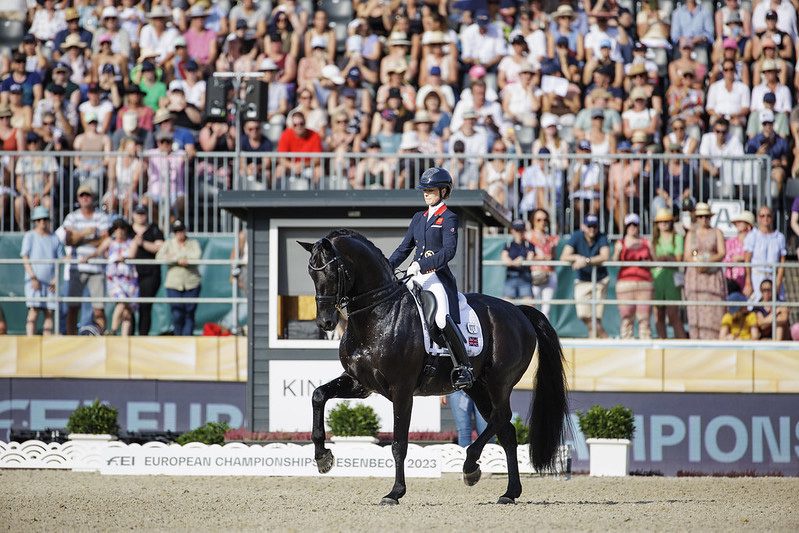
This year, Christopher Hector's analysis shows that the KWPN studbook once again topped the rankings with 13,375 points.
The top six horses that contributed to this position are: Glamourdale (by Lord Leatherdale), Gertjanb (by Dante Weltino), Fame (by Bordeaux), Flambeau (by Ampere), Indian Rock (by Apache), Great Escape Camelot (by Johnson). The Oldenburg studbook also ranked second with 12,893 points, just like last year.
The top six horses from this studbook that contributed the most points are: Viva Gold (by Vivaldi), Zantana (by Zonik), Denova (by Dastano), Maximila Bla (by Millennium), Bluetooth (by Bordeaux), Total Hope (by Totilas). The Hanoverian studbook ranked third with 11,596 points.
This studbook had also placed third in 2025.
The top six horses from it are: Freestyle (by Fidermark), Navarro (by Negro), Quick Decision (by Quaterhall), Quincy B (by Quaterback), First Class (by Fürstenball), Amanjaira M (by Ampere). The Danish Warmblood studbook placed fourth with 10,509 points, and the Lusitano studbook climbed to fifth place with 9,419 points; the best position this studbook has ever achieved.
The Lusitano horses that contributed to this score include Gladiador do Lis, Marquês dos Cedros, Lirio MVL, Irao, Jairo de Alm, and Come Back de Massa.
Christopher Hector takes a closer look at the numbers. I still remember a time when German breeders of dressage horses looked somewhat down on it when dressage breeding was just beginning to take shape in the Netherlands.
They said that the Dutch might breed exceptional show jumping horses, but if you want dressage, you must go to Germany; especially Hanover.
But how much times have changed.
This year, for the tenth consecutive year, the KWPN claimed the top spot in the WBFSH dressage studbook rankings, while the Hanoverian studbook ranked third, with two of the six horses that contributed points for this studbook being offspring of Dutch stallions.
How did the Dutch achieve this success?
First, by employing the same strategy for dressage stallions that they had previously adopted for show jumping.
While stallions in Hanover were almost all owned by the Verband and placed in the state stallion station for a not-so-high fee, stallion keepers in the Netherlands could set their own service fees and attract and retain the best of the best.
The more important point was that while German studbooks remained committed to the goal of breeding all-round horses, the Dutch quickly saw the signs and divided their breeding program into two branches: show jumping and dressage.
This trend began in 1990 when these two disciplines were recognized in stallion testing, and it became an official policy in 2005.
It is no surprise that the Dutch team is led by the world champion, Glamourdale, a horse that is the result of the precise and thoughtful breeding program of Gert-Jan van Olst.
In this case, he went to Germany to find Lord Leatherdale, a lighter and more refined stallion, to cross it with mares descended from his foundation stallion, Negro.
Ane van Olst and Lord Leder Deil told me: "In Holland, we had many stallions and mares from Jazz, Krack, and their bloodlines, so we needed fresh blood, and that's why we bought Lord Leder Deil.
Another reason was that I thought his good qualities would blend very well with the good qualities of Negro.
We had many mares from Negro, and he was a suitable stallion to combine with Negro mares.
Lord Leder Deil gives a lot of softness, presence, and a very good front to the horse.
He transfers these qualities very well to the Negro mares; mares that are often a bit more compact, have a lot of power, and have a bit less softness and flexibility in lateral movements.
The strengths of Negro combine very well with Lord Leder Deil, and this combination has been successful: Chipendale, Ordeal, Freestyle, and Glamourdale all come from this combination.
The naming of this stallion after the American Hanoverian breeders, Doug and Louise Leder Deil, is somewhat shrouded in mystery.
Once I asked Jens Meyer, who had the Leder Deil stallions, and he answered vaguely: "The matter goes back to the time when I was making a deal with van Olst.
.
.
" Jaggerbaum and Becky Moody; the one who also bred this gelding is Jaggerbaum, the second Dutch horse in terms of points, he is also from a German stallion named Dante Weltino; a stallion whose father, De Niro from Donnerhall, is considered one of the real stars of dressage horse breeding.
De Niro was a stallion that the head of the Hanoverian stallion station in Teslo had the opportunity to select as one of the top 10 stallions for which Teslo had priority at the time of licensing.
However, apparently, since Dr. Bade was determined to promote the native Hanoverian product, namely Weltmeyer, and not the offspring of Donnerhall who were just across the border in Oldenburg, the option of De Niro was not activated, and as a result, somewhat contrary to his expectations, this colt ended up with the prominent breeder, Burchard Waller.
Although there are two crossings of Weltmeyer in the pedigree of Dante Weltino, Weltmeyer himself was not successful as a breeding stallion.
Despite the fact that he bred with 200 top Hanoverian mares in his first breeding season, at a time when instead of being sent to one of the small local stations and left to chance with the mares of that region — which had been the procedure for all stallions before Weltmeyer — he remained at the state stallion center, this stallion could not produce successful performance horses.
Karl Hester and Fim?
The remaining horses of group K and P are also from completely Dutch lines; Fim from Bordeaux, Flambo from Amper, Indian Rock from Apache, and Great Skip Camelot from Johnson.
The magnificent Indian Rock, which shines these days in the United States, once again reminds us of the ridiculous WFFS saga; as Apache, his father, had his active period limited in Selimi when it became clear that he, like his son, was WFFS positive.
Indian Rock is ranked third in the table.
They have also benefited from having a relatively open studbook and from the great success of the Schockemöhle brothers in breeding horses.
Alwin, the first brother, was not only a great rider in show jumping but also a breeder; while the second brother, Werner, was a prominent researcher in the field of sport horses and the author of three books on horse breeding.
He told me: "Typically, a horse becomes as good as its breeder's ambition.
This may sound a bit crazy, but if you think about it more, it makes sense.
When breeders strive hard enough to reach the highest goal, achieving it may be possible; the history of breeding all kinds of animals shows the same.
You can breed whatever you want; you just have to be smart, tough, strong, and capable enough to do it without fear of the consequences; then it may be possible.
But people are intellectually too lazy; they say, 'We can only breed dressage horses' or 'We can only breed show jumping horses.'
This is a mistake.
" The third brother, Paul, is the most important and has transformed sport horse breeding in many ways.
He is so significant that an entire independent book should be dedicated to him.
The stallions that have played a role in the Oldenburg ranking clearly show how open-minded the breeders of this collection have been and how smart their choices have been: Netherlands, Hanover, Trakehner, Netherlands, Trakehner.
Vivaldi, their number one horse, Viva Gold, represents the most successful lineage of recent years, namely the Vivaldi line.
The pedigree of this stallion almost recounts the history of the evolution of dressage in the Netherlands: Krack C, Jazz, Olivi; however, Eugen Riesenbeck, the breeding genius who made Vivaldi famous, admits that it is still somewhat of a mystery to him where Vivaldi's legendary temperament and that of his sons exactly comes from.
He said: "It's interesting because if you look at Vivaldi's pedigree, you see Krack C and Jazz and you expect that.
.
.
it would be crazy.
But at the same time, they are so easy and pleasant to ride; and I am sure this trait starts from Vivaldi himself.
" In third place is Fürst Heinrich from Hanover, which itself somewhat indicates their inability to produce stallions; as not even one horse from their team is the offspring of a stallion from the Hanover breeding program.
Most of the Hanoverian points came from the extraordinary horse "Freyestyle"; a horse from Fiderbach/Donnrehall that brought the WBFSH Breeder of the Year title for its German breeder, Stefan Korts, for the second consecutive year; and we hope this means that the prefix "MT St. John" can finally be set aside, as that British stable had no role in breeding this mare.
Quaterback's two other horses also trace back to the East and to Writats-Dosse; where Quaterback was bred from one of their famous mare families.
His son, Quaterhall, also contributed to the Hanoverians' total score from a mare from Donrehall.
The fourth horse in terms of highest points was "First Class"; a horse from Fürstenball that this time was born from a Hanoverian mare from Bergamon.
The fifth member of the Hanoverian team is Ampere; a stallion that stands out because he is the only stallion with more than one of his offspring present in this ranking.
Perhaps due to his somewhat irregular career path, from the Netherlands to Sweden and then to the United States, Ampere has been somewhat overlooked.
His father, Rousseau, has been one of the most important blood transmitters of the great Ferro, and his maternal line is entirely Dutch: Flemming/Amour.
Ampere is the father of 68 stallion sons and 49 horses participating in the Grand Prix.
Amper Amper is also an extraordinary example of how the Dutch have taken jumping bloodlines with horses — mainly from Holstein — and created a new type of horses specialized in dressage.
Look at the fourth row of Amper's pedigree: the French Selle "Le Mexico," Holsteiner "Farn" — twice — "Pilatus," the founding stallion of modern Westphalian jumping horses, who himself was the father of "Pilot" and "Polidor," another great Holsteiner named "Landgraf," and the son of "Cor de la Bryère," "Carnaval."
In the third row, we also come across another Holsteiner that played a role in the formation of the Dutch warmblood: Amor.
As a result, the fact that such a blood combination has been able to produce a horse as refined and modern as this, while simultaneously shifting the focus from jumping horses to dressage, is considered a kind of victory in breeding.
Amper is from Russo; another stallion with a multinational background.
He was also born in the Netherlands in 1998, but has been based in the United States since 2006 after two seasons at the famous Papendahl stallion station in Germany.
Russo Russo is from Ferro, an international dressage competitor, and was born from a mare that was from Roemer; another stallion that was exported to America and became a Grand Prix dressage horse after a sporting career in jumping horses in the Netherlands.
Amper adds two more golden strands of Dutch dressage breeding to this combination: Fleming and Amor.
When the famous Dutch breeder, Wipke van der Laken, bought Fleming in Holstein during the stallion foal period, jumping horses were likely on his mind; at least the pedigree of this horse indicated such.
And so it happened that in the performance test in the Netherlands, one of Fleming's three scores of 9 was related to jumping; and when an advertisement was published for him in the 1992/93 edition of the top stallions in the Netherlands, his image was of him jumping over a barrier.
However, it ultimately became clear that his offspring shine in the dressage arena, and Fleming became one of the most important early dressage stallions in the Netherlands.
Two sons of stallion Fleming, Krack C and Lingh, were members of the Dutch dressage team, and his abilities as a dressage sire were recognized even in Germany; where in 2009, his son Fairbanks became the champion of the Oldenburg stallion evaluation and was sold for a record-breaking figure of €250,000 to Doug Lattrell, an American Hanoverian horse breeder, to be based at Hengststation Meyer.
Amor, the mother of Amper, is a granddaughter of Amor; a horse that was imported from Holstein at the age of three.
Since Amor lived from 1959 to 1990, he had a very extensive influence, and Dutch pedigrees are filled with his name; often even several times in one pedigree.
The famous Dutch breeder, Henk van Helvoort, based his breeding program on two mares from Amor and, among others, obtained the great stallion Jazz from these mares.
The first generation of Amper produced five sons that competed in the KWPN stallion selection in 2012, and these horses were very eye-catching in terms of type; they clearly bore the stamp of their father.
Three horses from Amper were approved for the performance test, and Excalibur, from the mother De Niro, achieved championship status.
Amper/Feeder Mark at the stallion show...
Currently, Amper is brilliantly represented by Larissa Plowis and her son Flambo, from a Zeolit mother, a horse that placed second in the Stuttgart World Cup with a score of 82, behind Isabell Werth and Weihegold.
555 Flambo Source page image: The Horse Magazine