Why should the leg come into play before the rein?
One of the most important principles of riding at any level and in any discipline is that rein aids should never be used without leg aids.
Many trainers oversimplify the aids when teaching the basics and tell students to use their legs to go forward and the reins to turn and stop.
However, if a rider learns to use the reins without the legs from the beginning, correcting this habit becomes very difficult; for this reason, I believe all riders should learn to use leg aids simultaneously with rein aids as soon as possible.
I say this from personal experience; as a rider who had to relearn the correct way to use their legs.
In this article, I will explain why this concept is so important and provide three simple exercises to both test and improve your leg aids and enhance your horse's responsiveness to these aids.
Legs before reins for better balance using the reins without legs is like trying to stop a bicycle using only the front brake and without the rear brake.
If you pedal at high speed, this can risk tipping over the bicycle.
Similarly, if you only use the "front brakes," meaning the reins, your horse will lean on the forehand and become heavy on the bit.
Adding the "rear brakes," meaning the legs, engages its hindquarters and encourages them to step more underneath its body.
This helps the horse maintain its balance and respond to your aids in a timely manner using its whole body; whether you ask it to turn, go in a circle, or transition to a lower gait.
For example, if you want to turn it to the right, you use your right leg to ask it to bend its body around the turn, then you add your left leg to help it regain a straight and balanced position after exiting the turn.
In this way, the horse exits the turn as balanced as it was when entering it.
The more you use hand aids without accompanying leg aids, the more the horse leans on the forehand and becomes heavier on the bit.
This is why many horses need stronger and stronger bits.
Clients often send horses for training to my stable that have very large and strong bits.
It may seem counterintuitive at first glance, but these are the same horses whose riders need to use their legs more, not less.
My goal is always to send them home with a simple snaffle bit.
This is the best sign that you have trained a horse to respond correctly to leg aids.
My goal with every horse is to ride primarily with my legs and seat while relying on the horse to respond with the lightest possible contact with the reins.
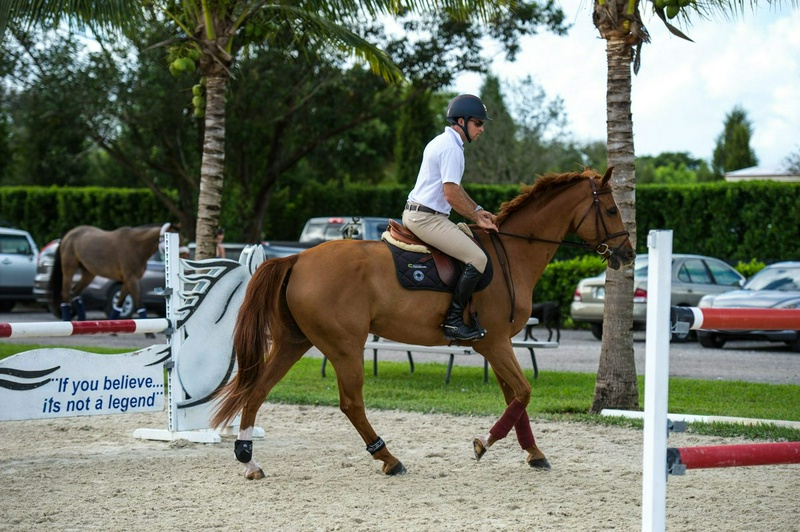
In this picture, the Westphalian gelding "Casual Pleasure" shows a balanced, engaged, and upward posture.
To achieve this, you need to create a new habit in yourself: every time you use your hands, use your legs as well.
Even when you are not making a change in rhythm or line of movement, you are likely still doing something with your hands; for example, maintaining light contact with the horse's mouth.
Your legs should also be used continuously and with a measured amount in the same way.
At least there should always be a light connection between your lower legs and the sides of the horse.
This applies to all horses, regardless of how hot-blooded or sensitive they may be.
Konkreeto Blieu, the mare I rode in the Rolex Grand Prix at the Central Park Horse Show in 2015, is a clear example.
She has a lot of Thoroughbred blood, but still, I must ride her with a lot of leg.
If you have a very sensitive horse, you might consider using smaller spurs or even riding without spurs, but you should know that using your legs is absolutely essential.
One of the best ways to gauge whether you are using your legs correctly and whether the horse is responding properly is to perform the backing movement.
A horse that obediently backs up in response to your rein and leg aids, without any signs of tension, has truly understood your aids.
Another benefit of this exercise is that repeating the backing movement engages the horse's back muscles, strengthens them, and helps relax them.
Therefore, this is a very suitable exercise to include in your regular training and preparation program for the horse.
Exercise 1: Test to ask your horse to take five steps backward in a straight line using the following method (Warning: Do not perform this exercise if you are riding with any type of restrictive rein aids or equipment, such as draw reins, double bridle, fixed martingale, or chambon): 1.
Start from a walk.
Sit quietly and balanced in the center of the saddle, keeping your upper body relaxed and still while maintaining a light contact on the reins.
2.
Then give a little more leg aid to increase the horse's "forward intention"; that is, create the feeling that the horse is moving more actively forward and onto the bit.
How you use your legs and the intensity of it depends on your horse.
Some horses may only need a light pressure from the lower leg, while others may require you to tap their sides several times with your leg or spur.
3.
When you feel this forward intention, increase the pressure evenly on both reins so that the horse stops; all the while, continue the leg aids.
Imagine you are inflating a bicycle tire that has a hole.
Your legs are bringing air into the tire.
Your hands should apply pressure on the hole to prevent air from escaping.
The amount of pressure you apply with your hands depends on the amount of air you are putting into the tire with your legs.
4.
When your horse has completely stopped, just as you used your lower leg and hand aids to request the stop, apply those same aids again; at the same time, keep the rest of your body calm, balanced, and relaxed on the saddle.
While applying pressure to the reins to prevent forward movement, squeeze or give a gentle tap with your legs.
Continue these two aids until the horse takes one step backward.
Then repeat the aids and use your left and right leg and hand equally to back the horse up in a straight line.
When you apply these rein-back aids, a typical horse will usually show one of three reactions: either it backs up, or it runs forward, or it resists your hand, locks its shoulders, and gives the feeling that it has turned to stone.
If it runs forward, increase the rein aid.
If he gets stuck, do not try to force him to move.
It is clear that he still has not properly learned to move backward.
If you put more pressure on him, it may trigger a dangerous reaction like rearing up.
Instead, ask someone on the ground to help execute the exercise I explained in exercise 2.
Some horses may only take two or three steps backward and then stop.
The bodies of these horses are tense because their muscles are not used to this kind of movement.
This movement may even be painful for them; just like when you haven't been to the gym for a long time and suddenly want to do a heavy workout.
If your horse locks up like this, immediately send him forward and let his muscles relax.
Then stop him again and ask for just a few more steps backward.
Never apply so much pressure that he becomes frustrated or upset.
1.
To assess the understanding of Casual Pleasure, the 9-year-old gelding Westphalian, I am performing a simple rein-back exercise using leg aids.
I start from the walk; I sit quietly and symmetrically in the center of the saddle, keeping my upper body relaxed while maintaining a light contact with the reins.
Then I increase the leg aid slightly to create the feeling that he is moving towards the bit with more activity.
As can be seen from his hind leg, he steps deeply under his body, responding well to these aids.
2.
In the next phase, by shifting a little weight of my upper body backward and increasing uniform pressure on both reins, I ask him to stop; during all this time, I continue the leg aids.
Casual Pleasure has raised his head slightly just before stopping, but this does not concern me.
When he first came to my stable, he was very weak and stiff in the back.
It was difficult to release his back muscles.
He has become much stronger in a short time, but I still do not expect him to maintain the rounder body shape and relatively vertical head carriage of a more advanced horse.
At this stage, focusing on the response and activity of his hind legs is much more important.
3.
When Casual Pleasure comes to a complete stop, I soften the reins for a moment to reward him for his correct response to my aids.
His head is still up, but many people make the mistake of focusing too much on the head position of their horse.
This can be misleading.
A horse that keeps its head low and round may still be weak in the back and unbalanced.
In top riders' horses, you see very different shapes of head carriage.
But one common feature in all these horses is the engagement and appropriate activity of the hindquarters.
4.
Then I gently tap the sides of Casual Pleasure with my legs while simultaneously applying pressure on the reins to prevent him from moving forward.
Make sure there is a straight line between my elbow and his mouth, and I use both hands equally to make my intention completely clear.
Although this horse has not been with me for long, we practice backing up regularly.
So he is already quite familiar with these aids.
5.
He immediately responds by taking a step backward.
I repeat the same hand and leg aids to ask him to continue moving softly and in a straight line backward.
Again, at this stage, I am not concerned about his head position.
He offers something much more important: a submissive response to aids, a soft and round backing, and an engaged and active hindquarters.
Exercise 2: Teach your horse to back up. If your horse resists backing up or backs up with great resistance, try the following exercise to improve his understanding of the aids.
Only perform this exercise when you are an experienced rider with a secure seat.
Otherwise, before executing it from the saddle, first teach him this concept from the ground; or ask a professional to teach the basics to your horse.
1.
Create a triangular corridor; place two straight obstacles at one end, 5 or 6 feet apart, and at the other end, bring them closer together to form the apex of the triangle.
Another way is to use a fence or wall of the arena and a straight obstacle positioned at an angle to it, with one of its bases next to the wall, to create a triangle.
Set the height of the obstacles to 3 or 4 feet so that there is no risk of the horse getting its leg caught on them.
2.
Ask your ground person to stand at the apex of the triangle, holding a longe whip and pointing it towards the ground.
3.
Guide your horse into the open side of the triangle at a walk.
Using the same aids I explained earlier, ask him to stop a few feet before your ground person.
4.
Next, use the aids I described to ask your horse to take a step back.
At the same time, the person on the ground assisting you should make a encouraging sound with their mouth and move the whip strap on the ground in a serpentine manner; active enough that the horse is slightly surprised and takes a step back.
If the horse does not step back, ask your assistant to move the whip strap closer to the horse's front legs.
If that still doesn't work, ask them to gently touch the horse's chest with the hard part of the whip.
Be patient and be careful not to push the situation to the point where the horse becomes frustrated or anxious.
5.
When he finally takes one or two steps back, immediately praise him and stop the pressure of the leg and hand aids.
Then ask him to take one or two steps forward to release his back muscles again.
6.
Repeat this exercise several times until the concept is established in the horse's mind.
Then finish the training session for that day.
With practice, you can do this without the help of a ground person and ask the horse to take several more consecutive steps back.
Always focus on keeping the horse's body straight and maintaining his calm.
The stronger his muscles become, the easier this exercise will be for him.
He will also generally respond better to your leg aids.
1.
One of the best methods for teaching a horse to back up correctly in response to the rider's aids, without creating resistance and tension in his body, is to use a narrow corridor made with obstacle bases and poles.
To demonstrate this method, I enter this temporary corridor with Casual Pleasure and give him a little time to calm down and get used to it.
My assistant, Eric Molina, is standing directly in front of us holding a whip pointed towards the ground.
©Amy Key.
Drago 2.
Then I use the rein and leg aids simultaneously to ask Casual Pleasure to take a step back.
At the same time, Eric makes a cheering sound with his mouth and moves the whip strap on the ground in a serpentine manner; just enough for the horse to take a step back.
Since this horse is specifically familiar with my aids for backing up, I hardly need any pressure from the reins.
(If this horse had less experience, I would use direct and consistent pressure on the reins as I demonstrated in exercise 1.
) As soon as it starts to back up, I immediately loosen the reins to reward it.
Eric also steps towards us, ready to follow us down this aisle and reinforce my aids with his presence and the whip.
©Amy K.
Drago 3.
If your horse does not back up immediately, ask your aid to gently tap its legs or chest with the whip as Eric demonstrates here.
Notice how Casual Pleasure still looks so relaxed and calm.
It is very important that you never scare or stress your horse during these exercises.
To truly benefit from this exercise, it must remain calm both physically and mentally.
4.
When your horse finally takes one or two steps back, immediately pat it and release the pressure from your leg and hand aids.
Then ask it to take one or two steps forward to release the muscles in its back.
Repeat this exercise several times to solidify the concept in the horse's mind.
If necessary, each time you ask for the rein-back, have your aid continue to gently tap the horse's chest or legs with the whip as Eric does here to reinforce the effect of your aids.
When your horse performs the rein-back well with the ground person's aid, you can try it on your own.
Exercise 3: Transition from Trot to Halt When the horse performs well moving backward, take this concept to the next level and practice downward transitions; always ask it to come forward to your hand before applying rein aids.
Use your legs enough to feel your horse taking the bit.
Do not worry about overdoing it; you can never use your legs too much.
Then, with the same amount of pressure on the reins, ask for the downward transition.
Start with simple transitions like trot to walk and canter to trot, then progress to canter to walk and trot to halt.
Remember: hands without legs, never.
1.
Downward transitions are another great way to reinforce the horse's correct response to leg aids and also strengthen its back muscles.
To prepare for the transition from trot to halt, I close my legs to ask for the same forward inclination that I requested from the horse in the rein-back exercise.
Since I have the added advantage of forward movement here, maintaining roundness along the top line of its body is easier.
2.
Next, I shift my upper body weight slightly back and increase the contact on the reins a bit more.
I continue both leg and rein aids until…
3.
…
the horse reaches a good and balanced halt.
Notice how its back remains rounded and in response to my leg aids, it has brought both hind legs under its body.
About Daniel Blumen Daniel Blumen, a Grand Prix show jumping rider, was born in Medellín, Colombia.
He started riding at the age of 3 and competed in the junior category in Colombia, Germany, and the United States.
Blumen moved to Wellington, Florida in 2007 and continued his career as a professional rider.
He represented his home country, Colombia, at the 2010 World Equestrian Games, the 2011 Pan American Games, and the 2012 Olympics.
In 2015, Blumen won the $212,000 Grand Prix at the CSI*** level of the Rolex Central Park Horse Show with Conconcreto Billyo, and last year he also competed at the Olympics with Apardi.
He credits a significant portion of his training to two legendary Olympic riders: Canadian Eric Lamaze and Brazilian Nelson Pessoa.
Blumen now spends about half of his time in Brussels, Belgium, and the other half in East Norwich, New York, where he and his cousin Ilan run their business, Blumen Xtreme.
Source: Practical Horseman – Training