Wolfram Wittig's formula for breeding dressage horses
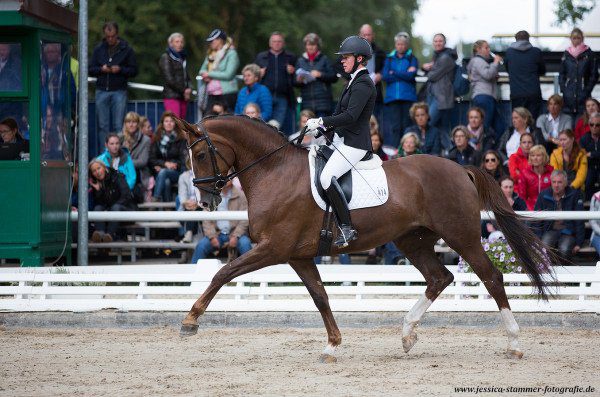
Report – Chris Hector | Photos: Raz New and Jessica Stamer Frakoni W in the Bundeschampionat; this time with Kira Woldfording in the saddle.
It was not surprising to see a video on Facebook of Brigitte Wittig winning a young horse dressage class with a stunning young mare named Frakoni W; and it was even less surprising when it was revealed that this mare was bred exactly based on the same formula that Wolfram had explained to me the last time I visited him.
I always enjoy turning onto the driveway of Wolfram and Brigitte Wittig's home near the town of Raden, Germany.
The stables are very well-built and tidy, but there are no signs of extravagance in them.
There are no golden handles here; just spacious and practical stables, and green pastures with mares and young horses.
Wolfram himself is the same way; unpretentious, full of earthy wisdom, and with a sharp sense of humor.
The collection that has formed here is unique.
I do not know of another place where the connection between high-level competitive riding and horse breeding is so complete.
It seems that the riding hall is a test tube for measuring the success of Wolfram's breeding program.
A large part of this breeding program comes from the stallion that was at its heart: Breitling.
This chestnut stallion passed away in 2015, but his legacy remains fully alive in Wolfram's breeding lines.
I was particularly interested to see where Wolfram would go next with his program.
.
.
After Breitling's death, Wolfram used the stallion Paul Schockemöhle, Foundation (Fidertanz 2 / De Vito), and if we are to judge by that handsome four-year-old chestnut stallion that the working student from Denmark is riding, it seems that this cross with Breitling has really paid off.
.
.
Wolfram says, "For me, this means natural balance."
And so it is.
Yes, the horse's nose is slightly behind the vertical, but the horse presents itself and follows with a more elongated form.
Now it brings its nose forward, but does not fall on the forehand.
Wolfram has entered a long and comfortable trot with his horse Boston/Bismarck, and like any horse person anywhere in the world, he starts with a horse that is just a bit behind the vertical; this is exactly what real trainers do in the real world and has nothing to do with rollkur.
Good training is logical.
No one needs to tell you why the rider is doing this; you can see the thought process in action.
.
.
A little shoulder-in at the canter, everything calm and unhurried; a very shallow half-pass towards the wall, and this soft and fluid gelding walks forward.
Another half-pass in canter, this time with a bit more flexion, an easy flying change, then a half-pass in the other direction, two or three straight steps, a seamless flying change, shoulder-in at the canter along the long side, a very calm and very clear diagonal walk.
.
.
Now Wolfram has brought the gelding to the passage and raises him a bit more to the vertical; in the passage, a calm and pleasant cadence is seen, a few initial short steps of the progressive piaffe, returning to a calm walk, and now a short and initial passage.
Wolfram has the same quality that the great and late Herbert Rehbein had; that he embraces the horse with his body and gently guides it towards collection with soft pressure.
This horse has recently had a period of rest, so that's enough for today.
Belgian rider, David Engelen, enters the arena with Royal Rubinstein, and Wolfram shows another side of his work this time when he asks for more collection in the canter.
The changes are in two times; Wolfram gives commands in quick succession, and David certainly does not need a headset.
Now the single-time changes, and David releases the reins and walks calmly in the walk and then, just as calmly, enters the passage.
“Tick, tick, tick, tick”; if anyone needs proof that the rhythm of the piaffe is faster than the rhythm of the passage, just listen to these “ticks” that sound like a machine gun in rapid succession.
And to keep the age range balanced, there is also a four-year-old chestnut horse present; again from Foundation and from the mother of Breitling, and it hasn’t been long since it was saddled and started working under saddle.
This is another well-moving horse; it’s no surprise that Wolfram says: “Foundation really does a great job of breeding with my Breitling mares.
” “Now here’s something for you; everyone talks about LDR, or short necks.
Now look, I’ll show you a bit of work in hand.
People say there must be a secret in the work in hand; let me show you.
.
.
” The example horse for this demonstration is a 12-year-old mare; from the stallion Breitling and from a mother of the Warcante lineage.
Wolfram’s point in the work in hand is that the horse only has a headset on.
Getting Wolfram in front of the microphone and having a conversation with him isn’t that easy; this witty and quick-witted person sometimes suddenly becomes quiet.
What is your opinion about the trend that promotes this message that low, deep, and round is exactly the Rolkur and has been scientifically proven to be harmful to horses?
This statement is very foolish; all horse owners start their horses just as you do, meaning low and a bit behind the vertical line.
.
.
“For me, the main goal is to keep the horses healthy.
My focus isn’t on low, deep, and round or things like that; keep the horses healthy and make sure you have a happy athlete.
” But you work all your horses at the start, relatively deep and a bit behind the vertical line.
.
.
“Yes, but not by pulling.
They are in a relaxed state; sometimes they are behind the vertical line, sometimes in front of the vertical line, and this situation is not fixed.
In no other sport do they expect every picture to be perfect, but in horse training, it seems that every image must be perfect, and that is not possible.
” “This should be possible, otherwise it means they have been trained incorrectly.
” You also have the ability to keep the horses calm; even with a young horse, you can ask for short steps and then release the reins, and the horse remains completely calm.
.
.
“This is part of the training, and I hope we can reproduce it every time because it’s important not to restrict the walk.
If you have a good walk, maintain that good walk.
You train them; up and down, up and down; that’s what training is, meaning strength and calmness, strength and calmness.
” How did you get into dressage?
Who first taught you to ride.
.
.
“If you watch the horses in the pasture, you learn a lot from the horses themselves.
They don’t run for a full hour, but at the same time, they don’t stay still in one place; it’s always a combination of different states.
Nature teaches us much more than many trainers can teach us.
"How did you start your work; did your family have horses?"
"No, I started riding at the age of 13.
At 20, I passed the exams and became professional, and three and a half years later, I became a riding instructor.
After that, I also passed the master breeding exam."
"Which trainers?"
"For me, Walter Biedermann from the Spanish Riding School was very important, but he lived and worked in Germany.
This, in my own words — sorry to say it this way — was a very good combination of that somewhat old-fashioned method with the modern sport horse style in today's competitions.
He was a very good teacher.
"After that, I trained a lot with Mr. Rahbain, Mr. Bolt, Klaus Balkenhol, Uwe Heinmann, Jean Bemelmans, and...
...
You have to keep an open mind all day long.
"My training method is such that I am a breeder of horses myself, so my entire focus is on keeping them healthy and fit.
"When you look at your collection and see 19-year-old horses performing changes at every stride — as Barkley shows above — it seems you have been successful on this path.
...
"I really love this.
My mares are still here; at 25 and 26 years old, they are still here, along with their offspring; the whole family is still here.
"Breitling was an amazing stallion considering the very few mares he covered and the number of grand prix horses he produced.
...
"For me, more important than Breitling was his father, Bismarck.
I had four grand prix winners from Bismarck; two stallions, the first Burlington and then Breitling.
I was always almost sure that my horse was not a modern horse; I know this, I’m not blind; but in my opinion, success never goes out of fashion.
It doesn't relate to the appearance of the horse; it only depends on quality, rideability, character, and movement gaits.
"But the most successful grand prix horses — like Valegro — don't look that modern, and in high-level sport, we don't see so many horses with very, very long necks and delicate bodies.
...
"If a horse is efficient, no one asks, 'Is it suitable for the catwalk?'
The problem with young horse classes is that if the horses are not very modern, their sale becomes difficult, and in young horse classes, they want different things from them; not the things that will later be judged in the grand prix.
It's good for the market to have new young horse champions every year, but later, grand prix horses are certainly different from young horses.
"Then, for me, you have an extraordinary sport horse like Gigolo.
He performed flawlessly with Isabell; he was amazing.
Then you have Bonfire of Anky, Salinero, Sachmo, Parzival, Totilas, Valegro; all different horses, but top-class horses, not young horse class winners.
"Why do you love Foundation so much?
"This horse was present in the selection of Hanoverian stallions, and there they said: 'No.'
I was a member of the Oldenburg evaluation committee, and there I saw him under saddle; so it was about three months later, and Anja Engelbrecht was riding him.
He is a big horse; how was this girl supposed to handle his size?
It was unbelievable.
These beautiful movements, and always balanced; it never seemed difficult for him, it was always easy.
Passing my criteria for a horse to be used as a stallion is a difficult task for horses, but he has overcome this barrier.
"What does he pass on to his offspring?"
"Especially mentally, he is very good and has very beautiful movements."
"When you are riding, you are always trying to straighten the horse, and it's not easy to see it while riding, but you can see it in the photos."
"If the horse is straight and its croup is not deviated inwards or outwards, this is not related to the neck, but to the body.
The body starts from the shoulder, and in this way, you straighten the horses; you bring both sides to the same level, that's it."
"You have done a lot of exercises on Helphus with your six-year-old horse."
"Some days we are supposed to train Helphus, other days piaffe/passage, and the next day we move on to the pirouettes.
He is a young horse."
"Later, you put all of this together.
It's not possible to put everything together with a six-year-old horse; in that case, its body will no longer respond, and it's not my job to make it have movement irregularities."
"I showed you this because they always talk about how hard it is to work in hand, but for me, it's nothing at all."
"What has brought German dressage to this position?"
"I think it's a combination of very good breeding products because we have very, very good studbooks, as well as training and practice.
I am very happy that we now see some good riders starting to breed their own horses.
For me, this combination makes Germany very powerful: breeding, training, and history; these three points are, in my opinion, the reason we have been so strong and successful."
"When you started working with the Thoroughbred mare, Devisa, people told you this was impossible."
"It is important for me when I talk about something to ask myself: Can you prove it?
I can't say, oh, I have a lot of experience on paper with young horses or breeding!
For me, everything makes sense in practice, not on paper; there are many people who know a lot on paper, but they don't prove it.
This has no value."
"We have had champions of the Bundeschampionat, world champions, winners of the Burg-Pokal, winners of Louisdor, and winners of Aachen and Hickstead.
I like everything to be proven here.
Talking about it doesn't matter, and believe me, I never look back; I know what we have done, but I never look back, I look forward.
For me, what matters is the next horse; that one is history.
The next horse is important, I have passion for the next horse.
Older horses are good; I tell my students to ride horses that are thirteen, fourteen years old, I like that, they get the job done, but for me, a four-year-old, five-year-old, six-year-old horse, that is my job."
"Look at Isabel; she starts with young horses.
Yes, she was lucky with Weihegold, but she usually starts her work with young horses.
She has been trained to ride young horses and can handle the challenges.
If you only ride older horses, you can't deal with the problems because older horses don't make mistakes, they don't buck or anything else, but Isabel knows how to deal with these issues."
Kira Wolfharding and rider Damour; finalist of this year's Nürnberger Burg-Pokal "That's why I like to work with Kira Wolfharding or Matthias Bouten; you know, they like to manage it and have the ability to handle it.
"Brigitte and another crossbreed of Breitling/Fabriano competing at the Grand Prix level "My wife can ride six or seven horses a day; she can handle it.
You ride the rest and they like to compete, but until they learn how to manage it, they are not good riders.
They can't build the next horse.
You have to have it in you to love doing it; then you can support others as well.
" "It's important for me to judge myself every time.
I don't want to sit on a horse like a hunchback; look in the mirror, criticize yourself every time, prove yourself, judge yourself.
And if you don't ask yourself whether what you are doing is really right or not — because you hear so much criticism that this horse is too low, that one isn't good enough, it's out of fashion.
Everyone criticizes you, but.
.
.
Prove yourself!
It's easy to say, easy to write, but proving it in reality is harder; however, I love it.
" "I'm lucky in Germany because if I have a question, I can ask my colleagues; maybe I can ask Rudi Szeilinger because he is always straightforward.
When I ask Rudi, he says: this is good, this is nonsense.
He is not like some others who say oh, how wonderful and fantastic everything is.
He is straightforward; he says good or bad.
That's important.
He is not someone who talks about the past; he likes to prove it.
" "Those who like to criticize quickly forget what they have done in the saddle; they forget very quickly.
At that moment, the past was so wonderful that it seems like World War I must have been something amazing too?
I can't agree with that.
.
.
" "To be a coach, first of all, you need a lot of basic knowledge: how the horse works.
Then you need to know when to teach and when to accept; the whole structure and mentality of the horse is only for one thing: to escape.
The entire mechanism of the horse's body works this way; joints, everything, all in that direction.
Then we start training the horse's body; that's why I don't like to say we ride horses, we actually train the muscles, ligaments, and tendons.
" "Day by day we try to keep the horse compact, but sometimes we forget the fundamental principle of the horse, which is to escape.
You can ask the rider; pulling is always easier than letting go — but keep the horse lively, let it kick, all of this is not a problem.
If horses escape, be happy; if you always have to use forward aids, this is no longer riding, it's a path to slavery.
" "If you know how this works physically with horses, then you become familiar with different training methods and understand that there is not just one way.
There are many different ways; there is just not one hard and fast rule, in my opinion, such a thing is not possible.
" Do you change your training style depending on the rider you are working with?
I have seen that you work with Kira and you hardly say anything, but today you were very directive with David; do different riders react in different ways?
"Different riders, different horses, different levels; all of these come together and after a few training sessions, you hope the riders have understood your philosophy, otherwise, you always start from the same point and that is not right; one likes to see progress.
If you always start from the same place, from the same point, it becomes boring.
" Matthias Bouten had two riders with three horses at the Nürnberger Burg-Pokal?
"Four horses with three riders.
Matthias Bouten had two horses, as did Marcus Hermes and Kira Wolfriding.
It's a good team and if you watch them during the dressage test, it should look beautiful and easy.
In my opinion, they are not weightlifters, they are more like dancers; and if the work is seen this way, I am happy.
If you see Matthias or Marcus or Kira while riding, it is more of a two-way communication system, not a fight; fighting is not my way of riding.
Why should we fight with the horses?
Why?
If they fight against us, they will always win.
They are stronger, more powerful, and the rider will always be the loser.
" Marcus Hermes and Abglen Wolfram, what amazes me is that when you see someone riding correctly — like that Danish boy who is here now; he is neither famous nor anything else, but his work is right — watching him is enjoyable because the horse is soft behind, is good in hand, and when you ride like this, you get rewarded.
But those who ride their horses in a way that makes them afraid and use tension to create movement, the horse's back becomes stiff, they need the muscles of their arms, and when they ride, they do not look happy; so why do people choose this bad and aggressive method when the right way is much more pleasant for both the horse and the rider?
"I am not saying 'good' or 'bad', but if you get extra points, if you get good scores, even if the work looks rough or is not pleasant for the horse, why should you change your system when you get a good score?
"But now this issue is changing; judges no longer give big scores to tests that seem tense and aggressive?
Now judges are more looking for harmony...
"This is a relatively difficult question.
I would be very happy if they could recognize whether the horse is healthy or not.
This is the first step...
It should be noted that at this point in the conversation, we are all laughing out loud.
He said, "Because the duty is to protect the horses, not to protect the judges.
The rider only does what he gets a good score for; that's it.
A football player plays to score a goal.
That's it; a rider likes to get a good score.
A show jumper also likes to be without faults.
If you get rewarded for a few lucky images, I do not criticize; they must believe it is right, because they have to look at themselves in the mirror every day.
We must learn to communicate with each other; we are all in the same boat and now we must learn to row in one direction, because this sport is an amazing sport, we have an amazing animal, and we are the only sport where both men and women participate, and we all compete together.
Our age is not limited like a footballer whose career ends in their mid-30s; we must learn to convey this to public opinion — this is more important than anything else.
Even in show jumping, you don't see that many good female riders; this is ideal for us — but no one talks about this, we discuss the low, deep, round position and all that nonsense, while we are not really promoting our sport well.
» Source: The Horse Magazine