Ways to Boost the Confidence of Show Jumping Riders
To build the confidence of riders, you must ensure that the exercises you design cultivate the necessary skills to respond to any challenges they face in show jumping.
Success in this path increases the rider's level of confidence and self-belief to perform what is asked of them in the competition.
Improving confidence means placing riders in an educational position that is both controlled and challenging.
A controlled environment helps ensure they can handle whatever you put in front of them.
This very aspect enhances their ability to face the competition test; when they step out of the controlled environment to participate in a competition.
I always tell these riders that at home, in the Stonehenge stables, 90% of what we do is under our control.
The reason I say 90% is that when you approach the jump in the counter, the control is in your hands.
But once the horse leaves the ground, you no longer have complete control.
That remaining 10% relates to the nature of this sport.
However, in competition, the rider faces a lesser degree of control.
As soon as you pass the start timers, you must navigate the course from the first jump to the last.
The hope is that you can execute every practical and possible choice along that path in the best way to have a successful round, without knocking a rail and within the allowed time.
To achieve this goal, you need skill, you need confidence, and that very small part that remains is luck; because the horse might hit the jump with the tip of its hoof at any moment, and the rail could fall.
Keep the height of the jumps low so that if a mistake occurs, the horse can easily recover from it.
Therefore, confidence is one of the key elements to ensure everything goes as you want, and the exercises we do at home are designed with this goal in mind.
For this purpose, I have arranged a series of cavalletti, a pinwheel, and gymnastics along with a few curved lines and several other jumps.
These exercises are performed at a low height, and their aim is to teach step management on the course, emphasizing balance and a 100% connection between the horse and rider.
When I train my students, I first ask them to work on each exercise separately, then walk a bit, and then combine all the sections step by step.
When working on these exercises, view them as a diverse set in which you choose how and in what combination to use the jumps.
All the distances mentioned in this article can be adjusted according to the level and needs of the coach, rider, and horse.
Also, keep the height of the jumps low; none should exceed 3 feet, and most should be much shorter, so that if a mistake occurs, the horse can easily recover from it.
In this exercise, I have combined cavalletti, pinwheel, and gymnastics along with a few curved lines and several other jumps.
I ask my students to first work on each section separately, then walk a bit, and then combine all the elements step by step.
Cavalletti and pinwheel are always worked on in light dressage before we start these exercises with our students so that the horse and rider can become comfortable with each other and feel coordinated.
After that, we move on to cavalletti, pinwheel, and then gymnastics exercises.
When I work with a rider, I might explain: "Very good, you need to enter a bit more calmly with your horse and be patient.
They might miss a step or two, but let them find their own way.
You just need to focus on the jumping position and feel the horse's mouth a bit.
You need to be precise.
If your horse is going to get anxious, you need to use your voice.
Is your horse a bit lazy?
You need to use your lower leg.
You need to apply a cue that is suitable for your horse.
"Doing these exercises allows me to assess the mental state of the horse and rider at all stages and see what they are ready for that day.
Most riders have consistency in their daily training, but just like horses, we also have better and worse days.
When you work on flatwork and then on cavalletti before moving on to other exercises, I can determine if there is a level of anxiety or not.
When I work with a group of two or three, everyone is different; some go too fast, some go too slow, so I need to compensate for these differences and constantly change my approach to ensure that I give each one what they need.
Sometimes you face a horse that is really lively and energetic, so you need to spend more time on cavalletti before moving on to the next stage.
If you skip this stage, that horse and rider are not ready to try another exercise.
Be patient in the exercises.
Your horse might miss a step, but let them find the solution themselves.
Most of the time, our work with students on cavalletti is a counter exercise; whether with poles on the ground or with raised 12-inch cavalletti.
Cavalletti creates a very minimal obstacle for the horse to perform the exercise.
After warming up on flatwork, Caroline takes her 12-year-old horse, Sisca V.H. Lindenhof Z, of the Zangersheide breed, over the cavalletti in counter.
Cavalletti creates a minimal obstacle for the horse to perform this exercise.
© Nancy Jaffer When we complete this part of the work with cavalletti, we move on to the pinwheel exercise.
This exercise consists of four obstacles at a height of 10 to 12 inches arranged in a circle; like a clock face with its hands at 12, 3, 6, and 9.
The distance from each obstacle to the next is six strides, and this arrangement gives you more space to work and adjust.
For a less experienced rider, this exercise can also be set up with rails on the ground.
We start the work with counter over two components of the pinwheel, and when this part goes well, I add the other two components.
This exercise teaches you how to ride your horse on curved lines.
For example, if the horse tends to go left, meaning when executing the pinwheel to the left, you need to work harder to keep them in the middle of the obstacles; so they don't hit the ground and turn those six strides into five and a half strides.
The same applies if you are going to the right with the pinwheel and your horse drifts to the right.
You need to apply this principle to any inclination and direction in your horse.
This experience comes in handy when you are in a competition and your horse, while jumping a six-stride arc to the right, tends to go left.
So you need to know how to release the inside rein to make those six strides more natural.
If you don't do this, these six steps may turn into seven steps or stretch out so much that the jump seems a little scary.
Starting with gymnastics after practicing the pinwheel, we move on to gymnastics.
I like to work on combinations with canter because this helps teach the horses the placement of their legs, balance, and real coordination.
It also provides the rider with the ease of entering the exercise without needing to go fast.
The distances are measured so that the horses can achieve both collection and extension.
I believe in repetition.
In my opinion, repetition is one of the most important guidelines for progress because it forces you to work with the same pattern and check what you did right or wrong and how to correct it.
If you constantly change the pattern, you never get the chance to resolve the issue you previously couldn't solve.
If you get the answer to that question wrong the first time, by repeating the exercise, you have the opportunity to do it correctly next time, and all of this helps build confidence.
Repetition is one of the most important guidelines for progress.
So how can you do it correctly?
By repeating the exercise until you can perform it completely comfortably.
This gives you, as a rider, the confidence that you can perform this task in the future because you know your horse, you know how it will react, and how to compensate for it; whether going right or left.
The gymnastics pattern shown above includes entering with canter over a cavaletti and then a cross-rail; after that, a counter step to a vertical jump and another step to an oxer, and then the option to choose one of the two curved lines; one towards a vertical jump and the other towards an oxer.
If you go right after gymnastics, you go five steps to the vertical jump and then six steps to another vertical jump that is part of the pinwheel, and then six steps to the next two vertical jumps of the pinwheel.
Returning to canter, you keep the horse along the long straight side to reach the single cavaletti part of the gymnastics and cross over the gymnastics again.
When you go both the five-step and six-step curved lines, you will see on the map that the distance has a fixed size.
This allows you to work on your horse's adjustability by covering the same distance with a different number of steps.
Here, you turn a smooth and open five-step into a neat and good six-step.
The next time you enter gymnastics, you go left and walk five steps to the oxer; then from there, you connect in six short steps to a pinwheel jump and then to the next two pinwheel jumps.
After that, you go in six open steps to a one-step vertical/vertical combination and then reach an oxer in three suitable steps.
I ask riders to stop the horse in a straight line when the exercise is over; never turn.
Every time you land, the horses are thinking about turning; therefore, when the exercise is finished, you let them know the work is done by straightening the horse.
Straightness is the key to the work.
Another option is to do one more complete round in the pinwheel pattern before going to the one-step vertical and then the oxer.
All these paths simulate what happens in a competition.
Imagine you have a vertical jump in a curved line to the right that reaches a large oxer in 6 strides, and then a line that turns left and reaches the next jump in 7 strides.
However, when your horse leans to the right or left, this number of strides changes.
Let's assume my horse tends to go left.
From jump 1 to 2, I need to use the skills I've learned in the pinwheel and gymnastics exercises to take these 6 strides normally; I need to release the right rein and ride a slightly straighter line.
If I don't do this, I will cover a longer distance than the distance this exercise requires from center to center.
As a result, since my horse has leaned left, I face an extra half-stride.
Then from jump 2 to 3, I need to make sure it doesn't go so far left that it takes this line in 6 and a half strides.
Similarly, if my horse tends to go right, from jump 1 to 2 I need to stay slightly wider so that I don't take the line in 5 and a half strides.
After jump 2 to 3, I also need to ensure it doesn't go so far right that it takes the line in 7 and a half or 8 strides.
This is called "tracking," and you can really feel good about it even over short jumps.
Our weekly schedule at Stonehenge is that we collect the ring on Sunday and prepare it for flatwork on Tuesday.
On Wednesday, we work on a normal course.
We don't do gymnastics exercises every week.
Although these exercises are very beneficial, if you overdo them and constantly change the distances and layouts, they can become boring and annoying for the horse or rider.
I always believe in balance and the right measure.
Excess in anything is too much.
Over the course of a full week, we do these exercises in each session with each course 2 or 3 times, and that's completely sufficient.
Next week, I will work on a normal course, but something that is much gentler and more consistent.
This pattern is somewhat aggressive, even though the jumps are short.
Tips for success: never do gymnastics exercises when your horse has its competition bridle on.
The competition bridle gives you much more control than the bridle you practice with at home.
This is the ultimate tool you have when entering the course; a place where control is less than in the home environment.
At home, when we jump over smaller jumps and in a controlled environment, we use a bridle that has less severity in terms of the bit and the strap that goes over the nose.
This is very important when doing those difficult exercises in a curved line.
If you mistakenly pull on the mouth of a horse that has a competition bridle, you may have a very significant effect; an effect that you definitely don't want.
These exercises should be adjusted according to the rider's level, in terms of jump height.
You do the same type of work for Grand Prix riders that you do for less experienced riders; you just change the distances and the level of complexity.
For a rider with limited field experience, the pinwheel exercise is likely done with poles on the ground, which makes understanding the course a little easier for the rider.
The outer line is also set up with cross rails and a gentler distance.
If this method works better for you, start everything with poles on the ground and don't hesitate to do so.
The distances and measurements presented in our chart are based on the dimensions of the arena.
Our arena in Stonehenge is 350 by 280 feet.
If your arena is smaller, you need to scale everything down.
I do not recommend placing all these exercises at once in a small arena; as you may encounter a situation similar to the effect of ping-pong.
You can perform the exercises in sections.
I will definitely do the pinwheel exercise, but if you don't have room for the framework, set up a three-bar jump instead.
For gymnastics, you can set up a cross-rail from the canter, with one stride to a vertical jump, and one stride to an oxer, then three strides to another vertical jump.
Before you turn around and start gymnastics again, add two more jumps after this gymnastics.
The same type of mechanics that Caroline Anarala, who is featured in the photos of this report as a show jumper, had in mind after her last mare reached the ceiling of her abilities in the lower and medium amateur-owner jumping categories, was to dream of competing in the higher amateur categories and small grand prix.
She never thought this goal would be attainable until September 2019; when she purchased the 12-year-old "Ciska VHC Lindenhof Z" of the Zangersheide breed; a horse that was jumping at a height of 1.45 meters in Europe.
Max Amaya and Caroline Anarala Max said, "The fact that the horse is above the required level gives Caroline the opportunity to learn this at a slightly more advanced level.
A horse of this quality demands a different kind of riding.
A bit more demanding and a bit more complex.
When that is the task, that is where you start to grow as a rider."
Caroline pointed out that the exercises she performed for the photos are designed to help her progress.
She said, "These exercises help because even though they are hard for me, they make the other things seem much easier; because when I enter the course, I apply the same type of mechanics.
This helps me better understand what is happening."
25-year-old Caroline, who studied humanities at New School, is from Ramson, New Jersey; about half an hour away from Stonehenge, and she has been riding there for four years.
Caroline, who has also worked with a sports psychologist, previously thought to herself, "Everyone is doing these big things and I feel really bad about myself," so it was important for her to combat this mindset.
She said, "The most important point is to stop comparing yourself to others; something that is really a serious issue in the world of horses.
" Remember that you are doing this because you love riding and love the horse.
Everyone progresses at their own pace.
She learned, "You just have to learn to feel secure and happy in that.
" "When you start doing this, you gradually see your own path and where you might ultimately end up.
This is very encouraging."
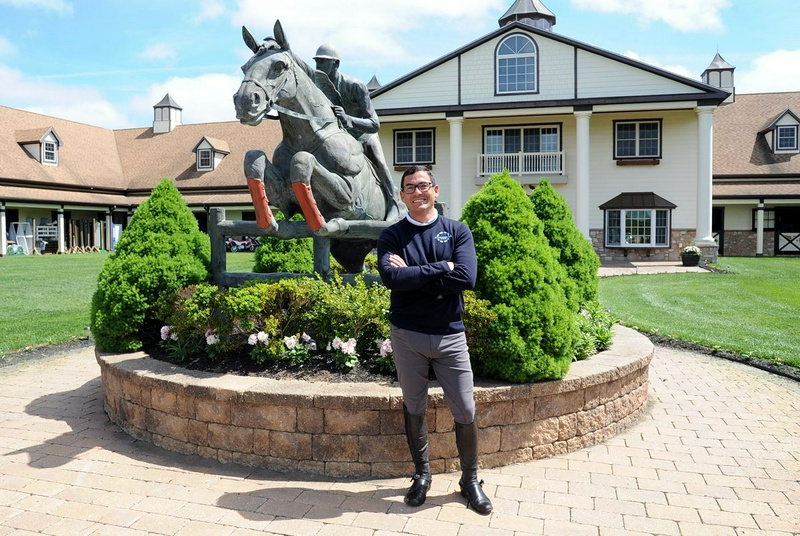
About Max Amaya, Amaya has trained top show jumping riders, including Brian Guttal-Marto and Charlie Jacobs, participants in the FEI World Cup finals, at his Stonehenge Stables in Colts Neck, New Jersey.
He has also been part of champion teams in all the equitation finals in collaboration with Bacon Hill Show Stables nearby and Stisha Madden.
He entered show jumping after his grandfather, who served in the Argentine cavalry, introduced him to the sport in his hometown of Argentina.
When Max came to North America, before going to Beacon Hill, he worked for Mario Deslauriers, the champion of the FEI World Cup Final in show jumping.
He competed with Church Road in over 50 Grand Prix events and rode at the FEI World Equestrian Games in 2006; then the following year, he competed in the Pan American Games as part of the Argentine team.
Amaya, who is now a U.S. citizen, has focused on training young, amateur, and international riders.
This article was first published in the summer 2021 issue of Practical Horseman.
Source: Practical Horseman – Training