Strategies for Improving Contact with the Bit
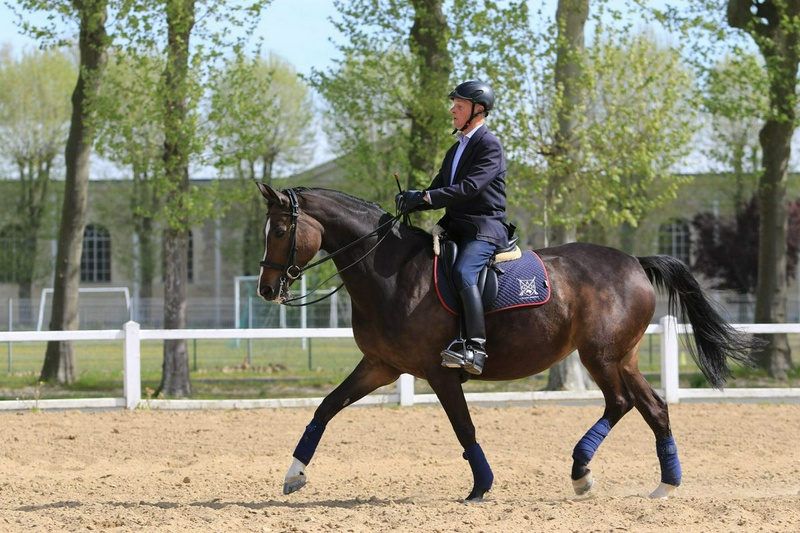
From a technical perspective, "contact" refers to the connection between the horse's mouth and the rider's hand.
However, riding goes far beyond merely technical issues, as we are dealing with a living being.
Riding requires a continuous connection with the horse, and to form this connection, we must reach a common language with it.
Contact is one of the essential components of this language, and it is obvious that respect and trust are essential elements of good contact.
In equitation; that is, the art and practice of horse riding, everything depends on the quality of contact: the horse's balance, changes in its body form and direction of movement, as well as the quality of collection.
Contact is also a two-way relationship between the horse and the rider: the rider can only achieve good contact when the horse feels comfortable and relaxed and moves with appropriate natural balance.
Colonel Christian Carde works with his Oldenburg mare, Milady — from De Niro-Finer Stern — a horse that is seen throughout this article in the images.
Silke Rothermann states that contact should never be created with force, as the horse's mouth is naturally very sensitive.
Instead, it should be imagined like the connection that forms when a father takes his child's hand to cross a busy street: secure, gentle, and calm.
This type of contact is only possible when the horse's mouth is relaxed and free.
If this is the case, the horse — in the French expression — "chews the bit."
In other words, the horse makes a slow and soft movement with its tongue similar to chewing, which causes the bit to rise and consequently produces a small amount of saliva.
Therefore, the mouth provides very important information about the horse's mental and physical state to the rider, and the quality of contact becomes an indicator for assessing its well-being while working.
When the horse moves with balance and correct contact, it shows its calmness and coordination with the rider.
Elements of good contact lead riders to automatically think of their hands when they hear the word "contact."
However, it is important to know that the rider is always in contact with the horse with their entire body; not just through the hands, but also with the arms, shoulders, pelvis, and down to the heels.
It should also be remembered that softness and flexibility in the rider's joints are essential for good riding.
The hands are only part of this overall picture.
Good contact also requires that the rider's hands do not remain rigid and fixed above the withers, but rather follow the natural movements of the horse's head and neck to some extent; a matter that allows the rider to maintain continuous communication with its mouth, regardless of the horse's condition or body form.
Good contact does not cause excessive frothing, but only creates a slight layer similar to "lipstick" around the horse's lips.
Silke Rothermann states that the connection with the horse's mouth largely depends on the rider's feel, but there is a fundamental and simple rule that everyone must adhere to: riding with excessive tension in the reins, which is also referred to as "backward riding," is incorrect.
The connection with the horse's mouth is always determined by the amount of tension in the reins; a matter that is decided by the rider — not the horse.
This issue also depends on the length of the reins that the rider chooses.
The correct length of the reins is one of the main determining factors for creating good communication, but at the same time, it has its specific characteristics for each horse, and the rider must feel it when taking the reins softly.
The length of the reins should not prevent the horse from using its neck.
However, the rider must be careful that the reins are not too long, as in this case, the connection loses its precision, and the rider may be tempted to pull their hands back to feel the horse's mouth.
Having the reins too long or too loose does not automatically mean creating a soft connection.
A good connection is stable, but from the very beginning, it should be as soft and light as possible.
The more the horse achieves better balance with increased collection, the more it carries itself, and as a result, the connection becomes so light that ultimately one can ride with just what is called the "weight of the reins."
When the horse is in balance and good form, the rider gains release of the reins; a situation that allows the horse to move with complete reliance on itself while maintaining the lightest contact; the same thing that is also referred to as the "weight of the reins."
Silke Rothermann ultimately, one should not overlook properly sized and adjusted riding equipment, as ill-fitting gear can create many problems.
In the discussion of connection with the horse's mouth, the choice of bit and noseband, as well as their proper adjustment, is of vital importance.
If we truly believe that riding is a kind of conversation with the horse, we should not "close the horse's mouth" by excessively tightening the noseband.
The combination of correct exercises, the sensitive hands of the rider, and an attitude in which the rider undoubtedly considers the horse a partner makes closing the horse's mouth with the help of tools not only unnecessary but also reprehensible.
Only a calm and relaxed mouth leads to a good connection.
A rider who considers riding a "conversation" does not tighten the noseband.
This is uncomfortable for the horse and does not allow its mouth to be relaxed; while this relaxation is a prerequisite for good connection.
Silke Rothermann why walk exercises?
The goal of all exercises is to achieve a type of connection in which, as soon as the hands are calmly placed above the withers, the horse should rise with a rounded neck while the poll is the highest point and follow the rider's hands.
The quality of this connection should be uniform, elastic, and soft on both reins.
To achieve this goal, the walk in the tradition of French riding to which I belong plays an undeniable role, as this gait does not create a balance problem for the rider.
In the walk, unlike the trot and canter, the rider can sit more calmly, deeply, and softly in the saddle, and thus coordinate their movements more easily; a subject that leads to more precise aids.
Riders are sometimes tempted to establish contact with pressure, while this contact should always be soft and accompanied by confidence.
Accompanying the natural movements of the horse's head and neck in the walk allows for such contact.
This slow walk also serves as a reliable indicator for measuring the quality of contact, as errors related to contact become most evident in this gait: heavy hands and inappropriate contact cause stiffness in the horse's back, resulting in an irregular walk and may take on a simultaneous movement; that is, the four-beat rhythm gradually becomes disrupted and the walk becomes irregular or "lateral."
These problems should not be ignored, as they affect the overall way the horse moves and should be addressed immediately upon occurrence.
To create correct contact, the horse must be able to show lateral bending.
Lateral bending also helps in establishing good contact, as it softens and flexes the horse's neck muscles.
When we talk about lateral bending, we mean a slight bend of the horse's head to the left or right, without the neck being noticeably engaged and without the horse tilting its head.
This bend should only be to the extent that the sparkle in the horse's eye can be seen on the desired side.
Achieving and maintaining this position is much easier for the horse at this slow walk.
Exercises that test and strengthen lateral bending and help soften the poll joint facilitate good contact.
Ultimately, the walk is an ideal pace for teaching new points to the horse.
If the quality of contact in the trot and canter is not appropriate, the rider should return to the walk.
The walk may be a slow pace, but it should never be sluggish and lifeless.
In all exercises, the horse should be active in two ways: physically, by taking energetic steps and active strides; and mentally, by responding to the slightest cue from the rider.
Below are three exercises to help find quality contact.
Exercise 1: Lateral bending on a circle François Robichon de la Guérinière (1688-1751), who is considered the "father of classical riding," mentioned in his prominent work École de Cavalerie that practicing on a circle encourages the horse to yield.
If the rider guides the horse's croup slightly to the side while simultaneously applying a gentle resistance on the outside rein, the horse is likely to respond to the inside rein and come onto the bit.
In this photo, Colonel Card's hands are not level, as he has lifted his left hand off the reins to support the hindquarters slightly with a very light tap of the whip.
Thus, lateral bending is not only essential for correct riding on curved lines or executing lateral movements, but it also plays an important role in bringing the horse to a soft position on the bit.
This encourages the horse to release its mouth and yield in the lower jaw; a subject that leads to the characteristic chewing movement.
Through exercises aimed at correct lateral bending, the horse is encouraged to accept the bit and move with consistent contact.
Lateral movements are very suitable for achieving this goal and at the same time help the horse become softer and more flexible.
The exercise I will explain next should be performed several times in both directions at the beginning of a training session, as it simultaneously releases the horse's mouth and engages its hindquarters.
1.
Gently gather the reins and ensure that the horse is sufficiently elevated according to its level of training and moves in an active walk; a walk characterized by the horse's active strides.
In this exercise, the horse should be as elevated as possible, but only to the extent that it is appropriate for its level of training and physical structure.
For more information on this topic, refer to Kim Herslow's article titled "Find the Right Frame in Dressage" in Practical Horseman Magazine.
2.
Then ride a circle with a diameter of about 10 meters and keep the inside rein slightly shorter than the outside rein to create the correct bend, and remember to use outside aids as well.
Using outside aids helps maintain the correct bend and prevents excessive bending, as the correct flexion occurs when all your aids act in harmony.
At the same time, use both legs to move the horse forward energetically.
3.
With the inside leg, push the horse's hindquarters out of the circle so that the inside leg of the horse slightly crosses over the outside leg.
Since horses naturally tend to yield inward, your horse will soon respond to the lateral flexion you have asked for on the circle by yielding in the mouth.
Be careful to allow this yielding inward by slightly releasing the outside rein.
You should not allow the horse to tilt its head or bend too much inward; this is something you prevent with the outside rein.
4.
As soon as your horse responds to the flexion by softening on the reins, allow it to gradually stretch forward and down.
Make sure the horse follows your hand and do not let it pull the reins from you; something that some horses tend to do due to past experiences.
This stretching is beneficial not only for maintaining softness and preventing muscle fatigue for the horse, but it is also a good test to see if it accepts contact and trusts your hands.
A properly trained horse will show a tendency to move with a forward and downward head and a rounded neck as soon as we no longer influence it with our hands.
Exercise 2: Transitions in Extended Walk This exercise is very useful for assessing the quality of communication with the bit, as the horse must confidently follow the rider's hand and accept the bit.
This movement seems simple at first glance, but it requires a lot from the rider, as they must be very careful not to disrupt the horse's walk rhythm.
The stretch of the head and neck in the extended walk should be done with light but continuous contact.
In this case, the horse maintains activity while stretching its body with a rounded top line.
Here, Colonel Karde has started to shorten the reins to bring the horse back to the collected walk.
1.
Start on a straight line with an active collected walk; the horse should be elevated and in soft contact.
2.
From there, using your legs, ask the horse to lengthen its strides and enter the extended walk; then gradually lower your hands forward and down and release the reins in such a way that contact with the horse's mouth is always maintained.
You may need to raise the reins a little higher, but most of the time, lowering your hands forward and down is sufficient.
3.
To ensure that the horse's free, smooth, and calm movement is not disrupted, follow its movement with your entire body; from your hands, arms, and shoulders to your hips.
Ideally, you should be able to feel the rhythm of the horse's back movement and synchronize your body with that rhythm.
You are not allowed to be faster than the horse.
4.
Then, by gradually shortening the reins while maintaining the horse's activity, bring its walk back to the collected walk so that the strides become shorter but with more elevation.
A horse that can lengthen its strides should also be able to shorten them.
Collecting and shortening the reins should be done smoothly so that the return to the collected walk is executed correctly.
To achieve a true collected walk, maintaining activity in the horse's strides is essential.
5.
As a result, the horse shortens its strides and walks with more elevation while softly chewing the bit.
After the extended phase, the horse has been brought back to the collected walk.
The rider must focus on soft contact so that self-control and the correct rhythm can be achieved; something that easily disappears when contact is established with force and is not accepted by the horse.
If you practice these transitions regularly in the walk, your horse will not only show smoother transitions but will also lengthen its strides as soon as you open its neck.
To open the neck, you can lower your hands forward and down and, if necessary, raise the reins so the horse can stretch its body line.
The rider's legs, by requesting more activity, initiate the transition from collected walk to extended walk.
A simple rule that can help you master this exercise and control the length of the horse's neck is this: the length of the horse's strides determines the length of its neck!
Variety of practice: Execute these transitions on large circles and with a slight bend of the horse as well.
Exercise 3: "La Volte" "La Volte" is the name of an old French exercise in which the horse performs a series of different lateral movements in the walk, following the rider's hand smoothly and fluidly each time.
This exercise is suitable for more advanced horses and riders; that is, those who can execute lateral movements including leg-yield, travers (bringing the hindquarters in), and half-pass in the walk, smoothly and fluidly.
Despite the many benefits of this exercise, the rider must respect the individual limitations of the horse in lateral movements.
The horse must always remain active and walk forward with a willingness.
It is better to reduce the angle of lateral movements and ask for fewer steps than to compromise on the quality of execution.
Half-pass in the walk, like all lateral movements, requires good lateral bend of the horse; a horse that responds to the inside rein.
1. Start the exercise to the right on a 10-meter circle.
2. Go shoulder-in for about half the length of the first half of the circle, then change to travers in the second half.
3. Then pull the horse forward and down along the line of the circle and then calmly gather the reins again.
Complete the circle and continue to the side of the arena.
4. Execute a leg-yield to the right across the diagonal of the arena until you reach the long side of the arena; at this point, you are now moving to the left.
5. After passing the corners of the short side, prepare for a half-pass in the walk to the left and execute it along the diagonal of the arena until you are again on the long side of the arena moving to the right.
6. Change to travers there and...
7. Pull the horse forward and down.
8. Give your horse a chance to rest and then start and execute this sequence from the left side.
Good contact is not only the most important issue in riding for the reasons I mentioned earlier, but it is also an infallible sign of the horse's well-being while being ridden.
A horse that moves in the correct frame — a frame that results from good contact, balance, and effort — is a horse that shows calmness and coordination with its rider.
Sidebox: The time of yielding Yielding, or releasing, is a two-way and essential action between the horse and rider to achieve good contact.
The rider must yield with their hand at the exact moment the horse yields; a task that requires a lot of feel and extensive experience.
Achieving this moment precisely cannot happen overnight, but every rider must understand how important this matter is and strive to feel the moment when the horse gives and accepts contact with the bit.
If he fails to give repeatedly, or even deliberately ignores this moment to quickly lower the horse's head, he not only adopts an incorrect method and reaches an improper contact but also destroys the horse's trust in his hands and prevents this contact from being as soft as it should be.
An experienced rider anticipates this moment, when his horse is about to give, and just slightly before the horse does this, he gives by opening his fingers.
This is the ideal state and certainly not possible for all riders, but at least we should give at the same moment the horse gives.
A less experienced rider may not even be able to reach this stage, but he must try to feel the horse's mouth so that he can also give shortly after the horse gives.
About Christian Card Silke Rotherman, Christian Card was born in Bordeaux, France, into a horse-loving family and throughout his long career in equestrian sports, he served competitions in dressage from all angles.
After graduating from the prestigious Saint-Cyr military academy, he joined the renowned Cadre Noir of Saumur in 1965.
Before choosing dressage as the discipline in which he achieved his greatest successes, Card competed in show jumping and eventing at the highest national levels.
With his gelding Budioun named Suliter, he was a member of the French team from 1977 to 1981, became the French dressage champion in 1979, and that same year was part of the French team that finished second at the annual CHIO Aachen competition.
After retiring from active competition as a rider, he was the coach of the French national team in dressage from 1985 to 1989.
Two years later, he returned as a senior rider of the Cadre Noir and remained in this position until his official retirement in 1999; after that, he also served several times as a Level "I" judge in the FEI.
Card, who has been an active clinician in Europe and North America for over 15 years, is now spending his retirement in Saumur, France, where he trains his Oldenburg mare, Milidi, the same horse whose picture appears in this article.
This article was first published in the Winter 2020 issue.
Source: Practical Horseman – Training