Noseband tightening and unstable gallop; two common mistakes in equestrianism.
If you are a horse person, you are likely a very conservative individual.
What I mean by this term is not its political meaning in contrast to liberalism; rather, it is its literal meaning: a tendency to maintain the status quo.
When the welfare of your horse is at stake, there are very strong reasons for this conservatism.
If you change without consideration, the consequences can be severe, and if you make a mistake, it is your horse that pays the price with its health and soundness.
If wisdom is the ability to foresee consequences, we all strive to be wise about our horses; because they entrust their welfare to us completely.
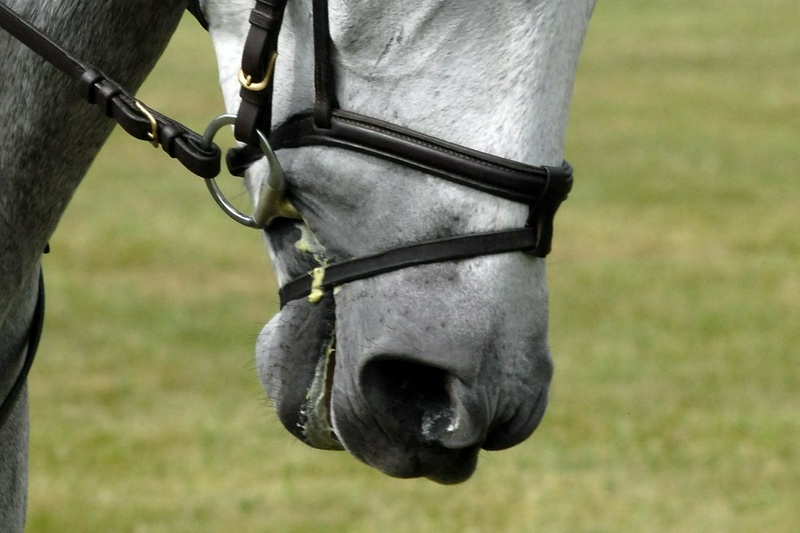
In this photo, there is not much to like.
It is hard to fit two recommended fingers under the noseband.
When this noseband eventually loosens from the nose of this poor horse, you will see grooves that have formed due to excessive tightness on its sinus cavities.
The open mouth of the horse and the tension on the reins indicate that it is not self-carrying.
Tightening the horse's mouth usually creates the same kind of dull and lethargic reaction that we see here.
Looking back at my professional past, I see that I have always resisted the trends and changes in the horse world.
Some trends, especially in terms of appearance and equipment, do not harm horses much; although luxury and bling often indicate the rider's need for attention rather than genuine concern for the horse.
Some other trends, however, are more bothersome; rollkur comes to mind.
Some, like the use of the outdated interval training pattern, which involves short bursts of maximum pressure, harm horses in a regrettable manner.
Unlike humans, horses do not monitor their own movement health.
If you ask a good horse to go to the point of exhaustion at a gallop, it will willingly hurt itself for you.
Modern eventing riders might say they use an interval system to prepare their horses, but what they really mean is employing an alternating pattern of training and preparation.
Despite the benefits of conservatism, we must always be open to improvements in the care and training of our horses; especially when these changes are supported by scientific research.
I mean two topics I have written about before: the use and misuse of tight nosebands in dressage, and the unsafe and unstable state of galloping that has gradually entered our training.
A noseband for all?
Nosebands are one of the things that often annoy me during coaching.
For example, flash nosebands are seen everywhere in the world of eventing.
Almost every horse I see has one on.
The flash noseband does not sit well on the horse's head; it is essentially a type of ineffective funnel noseband, so it is almost always tightened excessively, resulting in a noticeable indentation in the tissue over the nasal bone and sometimes even leaving small sores on the lips.
Moreover, these types of nosebands can disrupt the horse's natural swallowing mechanism and create exactly the resistance they were supposed to eliminate.
I don't know which bothers me more: overly tight nosebands, or the thoughtless use of equipment, without considering whether this tool is appropriate for this horse at this stage of training.
Not all horses in the world of eventing need a flash noseband, nor do they perform well with it.
However, when I ask riders if they have tried other nosebands, or even no noseband at all, they look at me as if I just landed from a mother ship.
It is clear that it has never occurred to them to try something else.
After all, they saddle and bridle all their horses this way, so it must be right.
Ah.
In the past, I have expressed my opposition to the use of overly tight nosebands more from a practical standpoint than a scientific one.
My argument has been that both in the regulations of the Fédération Equestre Internationale (FEI) and in the rules of the United States Equestrian Federation, a horse softly chewing the bit is considered a positive sign, and judges reward this behavior with good scores in dressage tests.
A practical definition of classical training is that we should not ask a horse to do something it does not do in nature.
It is clear that tying a horse's mouth shut with a strap is an unnatural behavior and does not lead to a classical result in terms of bit acceptance, softness of contact, or self-carriage.
Naturally, we all want the best possible score for our horses, but when we tighten the noseband as much as possible, we are actually preventing the horse from accepting the bit correctly.
Given all this, it is understandable that a series of recent articles on www.eurodressage.com caught my attention and led me to study scientific research on the effects of tight nosebands on horses.
That researchers' findings indicate that tight nosebands are uncomfortable and constitute mistreatment for horses is not surprising.
However, new scientific knowledge means that we can now prove something that was only suggested in the past.
If it has been proven that our current methods, however unintentionally, are uncomfortable for horses, then we must immediately adopt new methods based on the latest findings.
What surprises me is that this does not happen: riders and trainers do not change their methods in response to new information.
We do things in a specific way just because we have always done them that way, and learning new methods is a hassle for us.
This mindset is very common in the equestrian world and represents a significant barrier to improving the health and training of our horses.
Continuing to ride inefficiently in line with the continued use of uncomfortable nosebands, eventing riders still learn an inefficient and unstable form of canter long after the Royal Veterinary College London (in collaboration with the British Racing School) has identified that the most effective and scientifically correct canter position is very different from what many eventing trainers teach.
William Fox-Pitt, as he does everything in the saddle, also canters; technically, his form is nearly perfect.
His stirrup leathers are vertical, which allows the stirrups to properly bear his weight.
His ankles and knees are bent and clearly act as shock absorbers.
The stability of his lower leg, even at high speed, is the reason his elbows can correctly follow the oscillation of his horse's head and neck.
Although I prefer the rider to have a slight curve in the lower back when going at a gallop, as this gentle curve aligns with the natural form of the human spine, William is tall enough that the dropping of his shoulders and slight rounding of his lower back can be overlooked.
Taller riders usually do this because it brings their center of gravity closer to their horses.
Note that William's support comes from the spring of his knees.
He is not standing with straight legs on the horse; a position where, with each step, his body weight would be transferred to the withers of Parklin Hawk.
His reins are correctly adjusted and are not resting in a bridge-like manner on the horse's neck.
This allows his arm and shoulder to act like a spring and pivot.
William has come to understand that form follows function, which explains why he always looks so stylish and fluid in the saddle.
His movement mechanics are so accurate that he can focus on getting the best performance from each of his horses.
| © Amy Key.
Drago, this is confusing to me from several angles.
First, the various associations and organizations involved in managing and promoting eventing do not show a clear curiosity about the fundamental principles and mechanics of this sport.
Moreover, it seems that trainers have little ability to critique and evaluate when conveying mechanical principles to their students.
They appear satisfied to merely repeat what they have heard along the way.
We need a continuous review of our fundamental principles; a review that is done with an eye toward correction and improvement, especially when these changes and corrections are based on scientific research.
Unfortunately, such a thing is not seen in practice.
Currently, many eventing riders stand with straight legs on their horses, leaning their body weight on bridge-like hands resting on the horse's neck, and blindly gallop towards the drop.
This lack of curiosity and also the absence of a desire for improvement harms our sport.
The standing position in a gallop can harm eventing just as much as "Chris Reilly's" approach harmed the hunter/jumper world; a method that produced generations of riders who cannot maintain a connection with their horse's mouth.
If we do not learn from the mistakes of others, we are doomed to repeat them.
When I watched the Rolex Kentucky Three-Day Event last spring, it was clear to me that many riders' problems with the course stemmed from severely incorrect positions in the gallop.
Four-star horses are inherently spirited and lively, and when we bring them to peak physical condition, they develop a look and reaction to speed and fixed obstacles that is not suitable for everyone.
Time and again, I saw riders entering the arena standing completely straight in their stirrups.
As their horses galloped very aggressively, they would often lean back in a futile attempt to slow down and prepare for a difficult combination, relying on the reins.
When a rider stands completely straight and pulls on the reins, their horse usually reverses its body; the head comes up, the back drops down, and it becomes stiff and locked.
This form when approaching an obstacle is almost guaranteed to cause trouble, and Rolex riders who used this method were very prone to errors.
When you compare this with the situation of stylish cross-country riders like William Fox-Pitt from Britain and Andrew Nicholson from New Zealand, the differences are quite striking.
Interestingly, good results always seem to come from adhering to sound fundamental principles.
Therefore, based on scientific findings, the foundational principles of many of our American riders in Chaharnal and show jumping in cross-country are flawed.
It is evident that we need serious study and corrective actions.
Perhaps it is time for the United States Equestrian Federation and the United States Eventing Association to collaborate with organizations like the North American Racing Academy of Chris McKinnon or the British Horse Racing School.
These two organizations are as reputable in their field as our instructors in dressage and show jumping, and we should benefit from their expertise.
I know there are coaches and theorists across the country who disagree with me, but to date, their views have only been that; opinions, not scientific evidence.
Until further research proves that standing in the stirrups is the most efficient way to gallop, I will continue to teach based on current findings.
In conclusion, I find it strange how little eventing riders study and spend time on the cross-country aspect of their sport.
Riders happily spend six months in a dressage barn learning how to sit correctly in a trot.
They eagerly take the opportunity to work with show jumping coaches to improve their timing and skills in the arena in that discipline.
But when it comes to in-depth study about riding at speed over fixed obstacles, nothing happens.
It makes sense for these riders to engage with a steeplechase barn.
There, they could learn how to gallop correctly, control their horses using leverage instead of sharp bits, and gain a proper understanding of rhythm and speed; an understanding that makes their speeds on the Rolex cross-country course seem like a stroll in the park in comparison.
Although eventing is a high-risk sport, we must take every action to manage this risk based on expertise.
Repeating our mistakes with the expectation of a better outcome is a good definition of madness.
Those outside our sport have said they think we are crazy for going cross-country.
Let’s not let them be right.
It is time for change.
About Jim Wofford Jim Wofford, a veteran writer of the Practical Horseman column, competed in three Olympic Games and two World Championships.
He also became a five-time national champion of the United States.
In addition, he was a highly respected coach.
For several decades, from 1978 onward, at least one of his students was present on all of the U.S. Olympic, World Championship, and Pan American teams.
He passed away on February 2, 2023.
This article was first published in the September 2012 issue of Practical Horseman.
Source: Practical Horseman – Training