Increasing the horse's confidence with gymnastic exercises
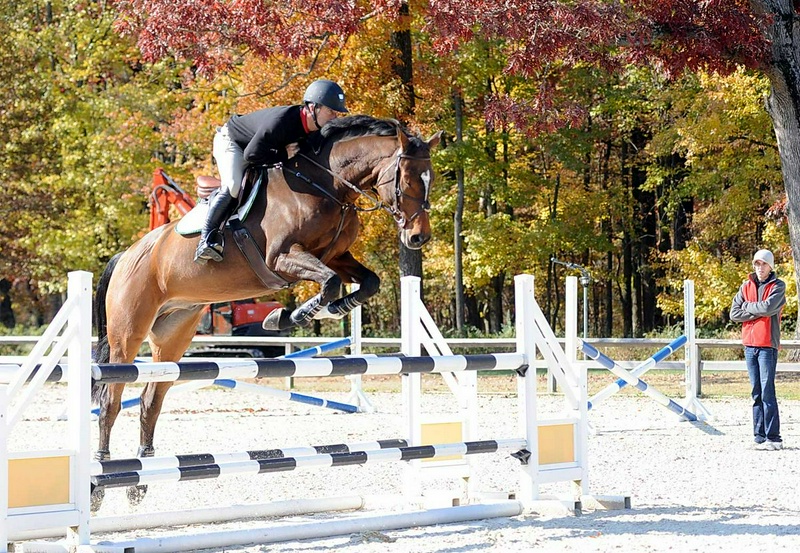
My father, who was a building contractor, worked on the family’s 28-acre farm in Oma, County Tyrone, Northern Ireland, as a side job in breeding and preparing young horses; for this reason, I also started riding very early at the age of 6, along with my brothers.
When I was 13 years old, a pony reared up on the road and fell on me, breaking my thigh bone; an incident that caused me to be hospitalized in traction for six months.
During this period, I started reading books and became familiar with gymnastics exercises from those books.
I still read those books; including "Show Jumping Exercises" by Anthony Paalman and in recent years "101 Jumping Exercises for Horse and Rider" by Linda Allen.
I use these resources, along with my own ideas, as a foundation for completing the gymnastics exercises that I now set up twice a week at Hermitage Farm in Bedminster, New Jersey, where I train.
Gymnastic jumping — that is, systematic exercises using two or more obstacles placed in a line and spaced one to five strides apart — is a constant part of my program, as it both boosts the horses' confidence and teaches them to jump better.
Repeating jumps from equal distances helps the horse with balance, as it gets used to jumping with a steady rhythm.
On the other hand, with a slight change in the gymnastic setup, it can also help address training challenges; including deviations from the line, lengthening a short stride, or balancing the work of uncoordinated legs.
In this article, I will show how to ride a practical gymnastic exercise — vertical line, vertical, oxer — an exercise that teaches the horse to be both cautious and to gain more jumping ability.
First, I will explain how I introduce horses to gymnastic jumping and gradually how I reach this three-obstacle line.
For more advanced horses, I add a curved line at the end of the basic gymnastics to curb the horse's tendency to play when it thinks its work is done, keeping its focus after finishing the jumps of the straight line.
I will also explain how gymnastic exercises can be used to address common training issues.
Before explaining my gymnastic jumping program, I want to remind you that you should always have someone with you.
When I work on jumping, I have someone in the arena to adjust the obstacles and observe my work from the ground, but more importantly, it’s for safety reasons.
I do not believe in jumping when I am alone, and this is a rule that everyone in our stable follows.
Anything can happen — the horse might get stuck or become frightened — so make sure someone is present with you.
Start simple, then expand it into the gymnastic line of vertical-obstacle–vertical-obstacle–oxer that I mentioned, ultimately you will jump from a vertical obstacle to a vertical obstacle with a distance of 33 to 36 feet between the two obstacles, which, considering the landing stride and take-off stride, is equivalent to two strides.
This exercise encourages your horse to push off from its hindquarters and gain strength from its back joints.
Then there is a distance of 45 to 48 feet to the final oxer, which becomes three strides and causes your horse to open up and stretch.
Although the goal is to consider each horse's step as 12 feet when working with distances; the same standard that most course designers use; in gymnastics practice, you should adjust the distances according to your horse's stride length so that he is comfortable with it.
You can ride this exercise in both directions to develop different skills.
If you start with vertical obstacles, three strides to the oxer may seem a bit long because your horse needs to be more precise over the verticals and land a bit closer to the second obstacle.
When you start with a square oxer, those three strides are taken a little shorter because your horse enters the line with a greater jumping range, lands a bit further in the line, and then needs to focus on the verticals.
This is exactly like what course designers do; they ask you to move forward over one obstacle and then shorten your horse's stride for the next obstacle.
But as I mentioned, the most important point in any type of gymnastics work is to start small and easy for your horse and gradually progress.
First, lay the poles on the ground in the same pattern that you will later use for the crossrails so that you have practiced what you will do with real obstacles in gymnastics practice.
Do not move on to a more difficult layout until your horse comfortably passes through the current exercise and has corrected the issues you want to address.
The goal is not to "surprise" him while he is making mistakes.
If he knocks down and falls every time, he learns nothing, and you also cause him anxiety.
In the end, he will not enjoy this work; while the practice should be enjoyable enough for him to gain the most benefit from it.
For this reason, I start this gymnastics exercise with young horses by trotting over a simple pole on the ground.
My focus is on maintaining a steady rhythm, keeping the horse in a straight line, and passing through the center of the pole.
At the end of the arena, I choose a point like a tree or a fence as a target and keep my eyes fixed on it throughout the distance.
This helps me maintain my balance along the line.
Without a target, the rider may drift left or right.
After trotting over the pole, I change the direction and pass over the same pole in the opposite direction.
To prepare my horse for jumping gymnastics, I first trot him over a pole on the ground and make sure he stays straight and aligned during the approach, while passing over the pole and afterwards.
The next step is to canter over the same pole.
Then I add a second pole, repeat the same process, place a third pole, and go through the same steps again.
A young horse may lean left or right when approaching the pole; therefore, I may need to repeat this exercise several times and focus on keeping him straight.
When the horse moves calmly and straight over a single pole, I pass it at a canter and from a steady rhythm, keeping my gaze on my focal point.
When my horse is calm and smoothly passes over that single pole at a canter, I add a second pole at a distance of 33 to 36 feet and on a straight line, and I trot back and forth over both.
When I start working with inexperienced horses, I always set up gymnastic exercises on straight lines, as this teaches them to move straight.
If you are riding in an indoor arena, you can bring the obstacles about a foot closer, as horses do not take steps that large in an enclosed space.
Again, when my horse has calmed down in the canter, I go over both ground poles in a straight line and with three strides in the canter.
If all these steps go well, I add a third pole on the ground at a distance of 45 to 48 feet from the second pole.
I again pass over all three poles in both directions at the canter and then go down the line once with three to four strides in the canter, and then I change direction and travel the same line with four to three strides.
When it seems my horse has calmed down and is going straight over all three ground poles in the canter, I convert the second pole into an oxer and then perform the exercise in both directions at the canter.
I pass over the first pole at the canter, allow my horse to take three strides, jump the oxer, and then reach the final pole with three or four strides.
Although I am looking for the right distance for the first element, it is not a big deal if I do not see it.
It does not matter what distance I achieve; as long as my horse passes the first element, it is positioned correctly for the right distance to the next element.
The structure of the oxer helps the horse stay centered over the obstacle and prevents it from drifting left or right.
To ride this obstacle correctly, you must keep the horse centered over the obstacle and also be centered on the horse.
At this stage of the exercise, I place a pole or a small obstacle, for example, with a height of 6 inches, after a turn and at the end of the gymnastic line.
This gives me the opportunity to finish the exercise neatly and cleanly, and it also makes my horse think about what it is doing, rather than getting playful, kicking, or leaning on the bit after landing from the gymnastic line.
When my horse jumps this gymnastic line well despite the middle element being an oxer, I also convert the last pole into an oxer and perform the exercise in both right and left hands at the canter; that is, I first pass over the ground pole and then over two oxers.
When I change the direction of the exercise, I first go over two oxers and then the ground pole at the canter.
Finally, I convert the first ground pole into an oxer so that all three ground poles have been converted to oxers, and then I travel the oxer line in a direction where I can ride from the first oxer to the middle oxer with two strides and then to the last oxer with three strides.
Then I change direction and jump the line back with three strides to two strides.
My horse easily cleared three jumps at the canter, so gradually I replace the poles with cross-rails and start with the middle pole.
After passing through the gymnastic line with a cross-rail, I also convert the last pole into a cross-rail and pass through the exercise at the canter, and finally, I convert the first pole into a cross-rail as well.
When I pass over the cross-rails at the canter, my focus is on maintaining my body position, and I let my horse find its way through this exercise.
If I feel I have gotten a bit close to the obstacle while jumping, I do not compensate for this with more pressure from my leg.
I let my horse find its own rhythm and take-off point.
The jumps are not so big that they scare him.
I choose a point at the end of the arena to focus on and think about my balance and staying with the horse's movement.
I leave the focus on the jumps to the horse itself.
When my horse gains confidence over the cross rails, I gradually turn the cross rails into a vertical jump.
First, I convert the middle cross rail into a small vertical jump, a maximum of 2 feet or 2 feet 6 inches.
(When I build the vertical jumps, I keep the height of all jumps the same.)
At this stage, I place ground poles on either side of the vertical jump, about a foot away from the base of the jump.
This helps my horse better gauge the distance to the jump.
I go back and forth over the exercise again.
Then, I turn the last cross rail into a vertical jump with ground poles and jump back and forth over it until my horse is comfortable with it.
Next, I also convert the first cross rail into a vertical jump and go back and forth over it.
When he gains confidence over the line of vertical jumps, I turn the last vertical jump into an oxer.
How quickly I progress from the poles to the final gymnastics entirely depends on the horse itself and how it copes with the exercise.
If I am riding a 4-year-old horse, reaching the stage where we can jump this final gymnastics might take a week or two, while a 5-year-old horse can complete the entire gymnastics in two weeks.
After my horse confidently goes through the three cross rail gymnastics, I gradually convert the cross rails into vertical jumps to reach a line that includes two vertical jumps and then an oxer.
My horse enters the gymnastics, and I remain centered above him, focusing on the focal point at the end of the arena.
My horse reaches the second vertical jump with two strides and is now ready to collect himself on his hind legs to take off.
Even though he is finding his own way over the jumps, I still maintain a light contact and keep my focus on a point at the end of the arena.
After my horse jumps the vertical jumps with precision, he needs to stretch his body and lengthen his stride for three strides to the oxer.
This exercise simulates a class where the course designer asks you to keep the horse cautious, then open his stride and show his jumping scope.
When we do this exercise in the opposite direction, the three strides from the oxer to the vertical jump will be slightly shorter because my horse has used his jumping scope to jump from the square oxer and lands a bit further along the landing line.
After that, he needs to collect himself and jump carefully over two vertical jumps.
2950 my horse comfortably went over those three poles at a trot and canter, so I start replacing the poles with crosses, beginning with the middle pole.
After going through this gymnastics with a cross jump, I also convert the last pole to a cross, canter through the exercise, and finally convert the first pole to a cross jump.
Adding a bending line when your horse confidently jumps the three-element gymnastics in a straight line, you can then add a bending line to keep his attention.
If you consider the end of the three-element gymnastics as the number 12 on a clock face, place the vertical obstacles about 60 feet from the center of the axis, to the left and right of the gymnastics; one at position 10 and the other at position 2, both at a 30-degree angle.
Having a jump on each side of the gymnastics allows the rider to go left or right.
Don't worry too much about perfect accuracy when measuring the arc, because when you get to the competition arena, everything is not flawless.
If the distance for four strides is a bit long or for five strides a bit short, your horse can manage it.
Also, by staying on the outer or inner side of the arc line, you can add a stride or take one away.
To go through this gymnastics in the opposite direction and starting from the axis, place two more vertical obstacles 60 feet from the first vertical obstacle in the gymnastics line, to the left and right at positions 4 and 8 at a 30-degree angle so that when you finish the gymnastics from the other side, you also perform the same exercise.
When I teach students, I wait until they are approaching the first element of the gymnastics and only then tell them which direction to go after finishing the gymnastics straight, and I want them to take a few strides in the arc line.
In this way, they are forced to think a little faster.
And if the horse does not listen to them, they will not reach the result I want.
Addressing your problems, you can target a horse's weaknesses through the type of gymnastics you create.
Problem 1: If my horse does not jump well over the vertical obstacles, I move the ground poles forward so that they are about 18 inches away from the obstacle; this gives him a little more space to take off.
Problem 2: If I am riding a horse whose stride is a bit short, I reduce the distance between the poles and then the obstacles so that he can comfortably pass through them.
Eventually, I increase the distances, hoping that his stride will stretch out to cover each stride of 12 feet; because most of the courses we jump are measured for horses with a 12-foot stride.
For a fast and spirited horse that wants to go through a gymnastics line a bit quickly, I add half a foot to the distance for each stride; thus, the 36-foot distance increases to 37.5 feet to prevent him from getting anxious.
But once he gets used to doing this exercise, the goal is to reduce the distance again.
Problem 3: If my assistant coach tells me that my horse's legs are not balanced when jumping over the obstacle — for example, his right leg is hanging a bit — to correct this, I raise the right side of the obstacle about two holes higher.
Most horses prefer to jump from the lowest part of the obstacle.
Problem 4: If my horse is going off the straight line, I do the same thing.
If he constantly wants to go to the right, I make the right side of the obstacle higher to encourage him to jump from the center of the obstacle.
To jump from the higher part, he has to work harder, so he has to return to the lower and central part of the obstacle.
The direction of movement is very important, because when the course designer measures his line, he does it in a straight line.
If you have a horse that tends to lean left or right when jumping over this gymnastic line, instead of the three-stride distance from the middle vertical obstacle to the oxer being 48 feet, the horse has turned it into 50 or 52 feet due to its deviation; therefore, it is not in the ideal point of takeoff.
In fact, it is 2 feet or more farther away.
This means the jump arc will be wider and flatter for you, increasing the likelihood of knocking the rail down.
Problem 5: If I want to improve my horse's balance, I set the oxer at an angle, so that the back rail is 6 inches higher than the front rail.
Just be careful not to ride the exercise in the opposite direction until you have changed the positions of the rails.
Gymnastic exercises are very helpful for increasing the horse's confidence and teaching it to jump better.
To keep the exercise interesting for your horse, follow a gradual process from ground poles to cross rails and then to larger obstacles so that both of you can benefit from all its advantages.
This article was first published in the July 2014 issue of Practical Horseman.
Source: Practical Horseman – Training