How should a horse see the obstacle for jumping?
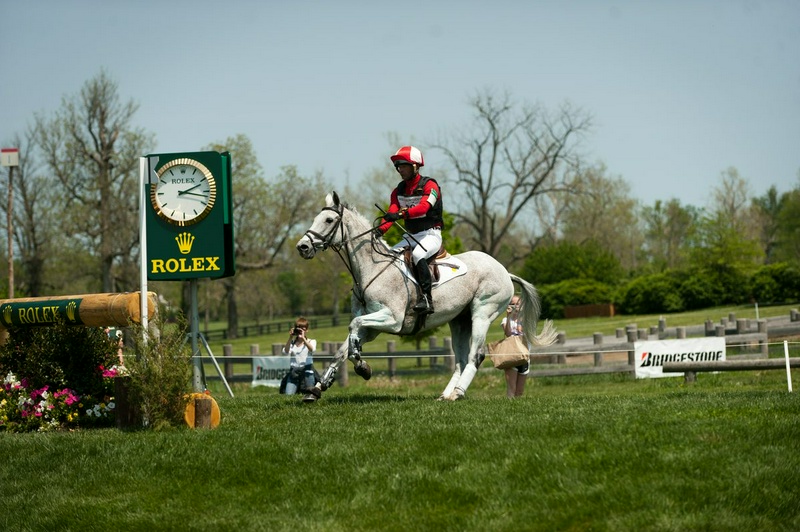
Let me ask a question: if I work a horse on the lunge, can it jump over an obstacle at the same time?
Certainly.
If I send the same horse over an obstacle on the lunge and a rider is in the saddle, what about that?
The answer is the same.
Very well, if I put a blindfold on the rider and give them a neck strap, can the horse still jump?
Jim, what do you mean by that?
It’s obvious that the horse can still jump.
But what if I blindfold the horse itself?
Have you lost your mind?
No, I haven't lost my mind.
.
.
At least not more than usual.
I just want to make sure we agree on one point: the horse must see the obstacle.
If we accept this, the implication is that to achieve the jump we want, we need to know what our horses see and how they see it.
I think it’s important for riders to see the obstacle as well, but I’ll get to that later.
For now, let’s talk about the horses first.
Although I have consulted several veterinarians and a few veterinary reference books, I will set aside most scientific terms and share what I have found in simple language.
Humans have binocular vision; that is, we can change our field of focus without moving our heads.
Horses, unlike humans, have monocular vision; that is, their field of focus is fixed.
They see objects in focus, but to change the focal point, they must change the position of their heads.
Essentially, a horse focuses along the plane of its nose.
You can see this when you release a horse in the paddock: it runs around for a minute or two, then usually stops and raises its nose to scan the surroundings for potential threats.
From this point, we have concluded that it is important for your horse to see the obstacle.
My point is that now we know how it must hold its head and neck to see the next obstacle in focus.
Once we understand how your horse focuses with its eyes, we need to determine exactly where it focuses.
If we pay attention to the behavior of horses, the answer becomes clear very quickly: your horse looks at the top rail of the obstacle.
You may have heard a lot about the ground line, but the reality is that when a horse learns how to jump, it shifts its focus from the ground line to the top rail.
How do we know this?
Very simply: your horse can successfully jump a vertical with a hanging rail or even a two-bar oxer; obstacles that have no ground line or filler at all.
Now that we’re talking about oxers, we know that horses can focus their gaze on the target; but what do we know about depth perception?
How does your horse gauge the amount of effort needed to clear an open obstacle?
Because horses have monocular vision, scientists say they cannot estimate depth in the same way that humans do with binocular vision.
Although scientific findings usually guide me, in this case, I am more convinced by my observations of what horses actually do when jumping.
The practical answer about depth perception in horses is that although they do not see depth exactly like we do, they somehow recognize it and respond correctly.
Every rider, even with limited experience, has felt their horse's body change at the moment of takeoff from the ground.
Many times, horses, when they suddenly realize they have miscalculated the width of an oxer or the width of a ditch, make a sound with more effort.
Just as it is with depth perception, horses do not perceive color like humans; however, they react to color as if they see it.
In past years, experts told me that horses see color in a monochromatic spectrum of gray.
Recent research shows that horses have dichromatic color vision, while humans have trichromatic vision.
This means horses do not see color like we do and cannot distinguish as many different colors.
It doesn't matter.
We don't need to know exactly how horses see color.
What is important is to accept that they see color and train them accordingly; for example, keeping in mind that they react to color in competitions, especially if a horse is a 4-year-old inexperienced one that has just come from the farm to the competition environment for the first time.
Another aspect of horses' eyes is their ability to see in varying light and dark conditions.
This is particularly important for eventing and hunting riders, but hunter and show jumping riders should also pay attention to the implications of changing light and shadow patterns in the early morning or late afternoon when competing in a stadium environment.
Again, I will try to summarize the scientific terms related to rod and cone cells into a part that is useful for us.
Since a horse's eye has a larger lens, it sees better in the dark than we do, but its lens takes a little longer to adjust to conditions.
Horse experts have observed this from generation to generation.
For example, we teach inexperienced riders that if an obstacle is placed right at the beginning of a shadowed section after bright sunlight, they should take the turn a little wider or slightly reduce speed when approaching the obstacle so the horse has a chance to adjust its vision to the new lighting conditions.
In my opinion, the most important point in all this information is that your horse turns its nose towards the rail in order to see the obstacle in its focal view.
This point should immediately shape our perspective on the correct form of the horse when approaching the obstacle.
Many trainers still insist that the horse should approach the obstacle in a dressage form, meaning "on the bit."
However, scientific research shows that for the horse to see the obstacle in its focal view, it must approach it with its nose forward; while you guide it in a way that I refer to as "on contact," not "on the bit."
I know this may be a new method for you, but I hope that, considering the scientific information we have gathered, you will be willing to try it.
And one final point: Horses develop their "timing," meaning the ability to predict and influence the remaining steps to the obstacle, in the same way that humans acquire this ability; as I will explain shortly, by focusing on jumping.
Every time your horse moves its head and neck while approaching the obstacle, it should take another step after its head and neck have stabilized to refocus its gaze and recalculate its steps to the next obstacle.
You have probably heard from your trainers that they want your hands and the head and neck of your horse to be calm and steady as you approach.
If the horse's head is moving, it becomes difficult for him to see the obstacle.
Meanwhile, what about the rider's eyes now that we are talking about things we have heard in the past?
Most riders are still trained to look over the obstacle.
Many trainers are very adamant about this and say that a rider who looks at the obstacle itself predicts the jump and their gaze drops down during the leap.
However, I do not agree with the method that suggests looking away from the obstacle; again, based on scientific studies and the books I have read.
My perspective changed in the mid-1970s after I read the book "The Inner Game of Tennis" by W. Timothy Gallwey.
At that time, I was playing a bit of tennis at the club level and wanted to improve, so as was my usual habit, I turned to books to find the answer.
The author argued well that one should focus on the tennis ball until the moment the racket makes contact with it.
I instinctively connect things I read in other fields with horses, so it was natural for me to be curious about what would happen if, instead of looking beyond the obstacle, as I had been taught since childhood, I looked at the obstacle itself that I was jumping.
Scientists say that to measure distance, we need a fixed reference point.
As a result, if we look at the top of the jump, we are actually staring into infinity, but we no longer have that fixed reference point to help us understand how many steps remain until the take-off point.
I immediately realized that if I looked at the obstacle while approaching, my timing improved; however, now during the flight, my gaze was down and on the obstacle, not looking forward after landing.
After some trial and error, I understood that I should keep my gaze on the upper part of the obstacle until that part disappears from view between my horse's ears; at that moment, I should shift my gaze forward to the next obstacle.
Over time, I concluded that I should look at the same point that my horse is looking at, and based on this, I developed the following guidelines for my students regarding the five main types of obstacles: 1. Vertical: Look at the top of the pole, board, gate, and so on.
2. Parallel (also referred to as oxer): Look at the front pole of the oxer unless its height is less than or equal to half the height of the back pole; in that case, I want the rider to shift their gaze to the back pole.
3. Ascending (triple bar): Look at the back pole, which is the tallest pole.
4. Pyramid (hogs back, roll top, etc.): Look at the middle pole, which is the highest part.
5. Water jump (or open ditch): Look at the back rail or wall.
In the past, my teachings about the use of the rider's eyes were solely based on my personal opinion.
Fortunately, there is now scientific research that specifically addresses the use of the rider's eyes during jumping.
Nottingham Trent University in the UK recently conducted a study whose findings state: "When approaching a jump, riders quickly shift their focal point from the ground in front of the obstacle to the obstacle itself and then to the ground beyond the obstacle."
However, it was found that the more experienced show jumper fixes their gaze on the obstacle much earlier than other riders; up to 3.05 seconds earlier than the less experienced non-competitive rider, before taking off.
The top rider also significantly held their gaze on any fixed point for a longer duration.
"This study emphasizes the importance of what is referred to as 'anticipatory eye movements.'
Now I have scientific backing for one of my favorite teaching phrases: 'If you can't see the obstacle, you can't see your horse's stride.'
Although I don't agree with it, looking over the top of the obstacle has been a common and widespread method and has worked quite well in practice.
.
.
Until the first related distance entered the course design.
From that point on, this method no longer had its previous effectiveness, as the rider now needed to be aware of the remaining parts of the stride and influence them.
If you can't see the obstacle, it is difficult to do this.
Wafford wrote: "After a bit of trial and error, I realized I had to keep my gaze on the top part of the obstacle until that part was out of sight between my horse's ears; at that moment, I needed to shift my gaze forward, to the next obstacle."
About Jim Wafford Jim Wafford, a veteran columnist for Practical Horseman magazine, competed in three Olympic Games and two World Championships.
He also won the U.S. national championship title five times.
Additionally, he was a highly respected figure as a coach.
Since 1978 and for several decades, at least one of his students was present on all U.S. teams in the Olympics, World Championships, and Pan American Games.
He passed away on February 2, 2023.
This article was first published in the December 2012 issue of Practical Horseman.
Source: Practical Horseman – Training