Ford has seen almost every problem that may arise in the stable up close and places a strong emphasis on the safety of the horses and the people who work around them in the area of horse care and stable management.
In the cold months of the year, he has a precise and rigorous program regarding the use of blankets, including how to put them on, take them off, maintain them, and fold them.
Here are his top 10 recommendations.
1.
Reconnect the leg straps The biggest issue Ford sees with using a blanket is the leg straps being left dangling.
After opening each leg strap, he always brings it to the outside of the horse's leg and fastens it again on that side.
This way, when you want to put the blanket back on the horse, the straps do not swing dangerously.
He said, "Leaving these straps loose and swinging is a safety hazard.
I have had instances where the straps got caught in the ceiling fan spinning above.
Many times the strap has hit my face or struck the horse's eye.
Reopening and closing it again only takes two seconds."
When removing the blanket, Ford always first opens the leg straps, then goes to the chest fastenings or buckles, and leaves the belly straps for last.
He said, "In my opinion, if the horse gets scared and the chest part is open, the blanket can slide off the back of its body and come off easily.
But if the belly strap is open and the horse gets scared and the blanket shifts, it may bunch up around its neck, which is more dangerous."
2.
Cross the leg straps Ford never likes to see a blanket that does not have leg straps or a tail strap to keep it in place.
He said, "This is entirely related to safety.
It only takes a horse to roll over or a strong wind to blow for the blanket to shift on the neck and scare the horse."
The leg straps should always be crossed in the middle so that if the horse lies down, the blanket does not slide to the sides.
Ford said, "The goal is to keep the blanket balanced when the horse rolls."
"Not crossing them is dangerous because if the blanket slides and the leg strap is lower than the hock joint, the horse may start kicking or one of its legs may get caught in the strap."
3.
Make sure the blanket is the right size A blanket that is too large may slide to one side; as a result, its effectiveness in keeping warm decreases, and it may also scare the horse.
A blanket that is too tight can cause uncomfortable rubbing on the withers and shoulders.
If its length is short, the horse's belly and hindquarters are exposed to the cold.
The best way to ensure that the blanket does not slide and shift is to buy a blanket that fits perfectly.
Ford reminded, "Keep in mind that each brand fits the blanket differently on the horse."
Some blanket brands are made for horses with broader or narrower shoulders, and some are shorter or longer in length.
Research and, if possible, try several different brands to find a model that has the best fit for your horse and provides the most comfort and warmth for him.
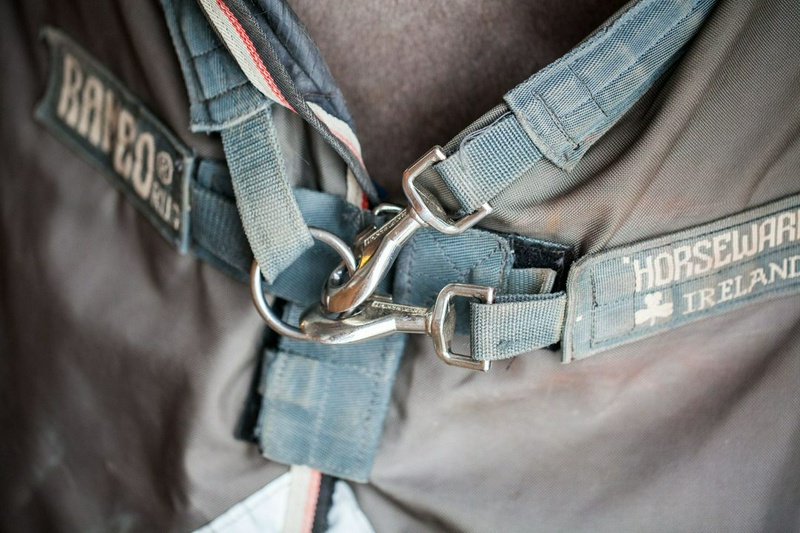
You should fasten the chest straps of the blanket in such a way that the clips face inward and towards the horse.
The clips should not be fastened outward.
These clips may get caught on a barrier or the stable door and create a safety hazard.
4.
Always position the chest clips inward. Some blankets fasten at the chest with a buckle instead of a clip.
If your blanket has a clip, you should always position the opening side facing inward and towards the horse's chest.
Otherwise, there is a high chance of the clip getting caught on something.
Ford said, "The clip side should be as close to the horse's body as possible so that if he pushes against a barbed wire fence or a mesh door, there is no chance of him getting caught on the door or fence.
I've seen this happen!"
Some blankets have neither a buckle nor a clip at the chest and must be put on over the horse's head.
Some horses may not be comfortable with this or may need to be gently introduced to it.
Ford recommended that if you are using blankets that are put on over the head, do this inside the stable and never put the blanket on him when he is free in the pasture.
The blanket should not hang from the horse's neck while it is still unsecured, as it can become dangerous if he spooks and starts running in the pasture.
5.
Prevent static electricity. When removing the blanket in dry winter weather, static electricity may build up; an occurrence that can give an unpleasant shock to the horse and put you at risk of being trampled.
Ford uses a product called "No Shock Anti-Static Grooming Spray" for horses that are more sensitive, which is sprayed on the horse's body to reduce static electricity.
He also removes the blanket in a specific way to prevent static electricity from building up.
He said, "Fold the blanket into three parts and really lift it off the horse.
Fold the back half forward, then fold the front half backward, and lift the entire blanket off the spine.
Just don’t pull it and take it off the horse."
6.
Do not leave blankets on the ground. Crumpling the blanket and throwing it on the ground or over a fence is neither aesthetically pleasing nor safe; it may pose a hazard to your horse, causing him to slip on it or get caught in its loose strap.
Always fold the blankets neatly and hang them in a place where they won't cause any obstruction.
See the methods for folding lightweight and heavyweight blankets at the end of this article.
7.
Readjust the blanket on the horse every day. Sometimes the weather is so unfavorable that riding is not possible, or life's busy schedule takes away the opportunity to saddle up; however, the horse should not be left with a blanket or stable rug for several consecutive days.
Ford said, "It's just like wearing clothes; it shifts.
You should take the blanket off every day to check for any problems that may have developed underneath, such as rubbing or damage.
If it stays on for too long, it creates pressure points.
Therefore, for the horse's comfort, it is better to put the blanket back on him every day and position it correctly if you can."
8.
Keep the blankets clean. A clean blanket is both warmer and more durable.
Just as you wouldn't want to wear dirty clothes, your horse also has no desire to wear a dirty blanket.
Stable blankets can easily be washed in a washing machine, but maintaining a waterproof turnout blanket can be more challenging, as the more it is washed, the less waterproof it becomes.
If your horse has lain in urine or manure, or rolled in dirt and mud, Ford recommends hanging the blanket up and spot cleaning with a simple bucket of warm water and a sponge.
If it has developed an unpleasant odor, a mixture of water and vinegar helps eliminate bad smells.
If water is seeping through the turnout blanket and making your horse's body damp underneath, there are products available to restore its waterproof properties.
Otherwise, it may be time to purchase a new turnout blanket.
9.
Pay attention to the insulation of the blanket. Horses can naturally keep themselves warm even in very low temperatures, but if the weather is cold and rainy, you should consider a waterproof cover for unshorn horses.
When they get wet and their hair lies flat against their skin, they may catch a chill because the long hair coat can no longer stand up and provide adequate insulation.
However, if the weather conditions are harsh enough that you feel you need to put a blanket on an unshorn horse, Ford prefers that the horse wear something more than just a lightweight sheet.
He said, "If you just add a sheet, you haven't actually added insulation, and the horse is likely to get colder that way.
A simple sheet in those conditions just flattens the hair; therefore, it's better to use a medium-weight blanket that has an insulating layer."
Unshorn horses typically have heavier blankets during the cold months, and Ford never likes to see unshorn horses wearing just a sheet even on warmer winter days.
10.
Don't overcomplicate it. One of the most confusing decisions for horse owners is often what blanket to put on their horse based on the weather conditions.
Temperature, humidity, precipitation, and access to shelter all play a role in this decision, and of course, we all want our horses to be comfortable.
Sometimes the temperature fluctuates greatly throughout the day or night, and you may not be able to change the horse's sheet in time.
On one hand, you don't want your horse to get too cold, and on the other hand, you definitely shouldn't put so many sheets on it that it sweats.
What should you do in this situation?
Ford said, "I usually look at the weather and see what the temperature is like for most of the night.
The low might be 30 [degrees], but it only reaches 30 at 5 AM.
I check what the temperature is between 10 PM and 2 AM and choose a sheet for the horse based on that.
Horses might only get a little warm during the night or might be a bit cold an hour or two before you come to check on them in the morning.
People really get too caught up in this."
Method for folding a lightweight cooler or thin sheet:
1. Check that the leg straps are fastened, then hold the cooler up.
2. Fold it in half, so the chest and tail are aligned.
3. Fold the neck side towards the center.
4. Fold the belly side towards the center.
5. Hang the sheet so that the folded edge is facing out.
Method for folding a cooler or heavy sheet:
1.
Start by holding the blanket up.
2.
Fold it in half widthwise.
Make sure the belly straps are inside the fold of the blanket and the leg straps are reattached.
Then, using your hand as a guide, fold the blanket in half lengthwise as well.
3.
Align the neck section with the tail section.
4.
Hang the blanket so that the folded edge is facing out.
This article was first published in the October 2017 issue of Practical Horseman.
Source: Practical Horseman – Health