7 important signs that you should call the veterinarian immediately
When should you contact a veterinarian?
And when can you manage health issues that may arise for your horse on your own?
After Kevin Keane, a veterinarian, and Stephen Simpson, the senior groom of Boyd Martin, met in a session to brainstorm about their presentation planning at the Boyd and Silva Martin Camp in Windora 2026, they concluded that this topic could be beneficial for participants in the camp from several aspects.
Keane, the founder of Sports Medicine Associates of Chester County in Pennsylvania and former veterinarian for several Olympic equestrian teams, told attendees in his speech on the last day of the camp: "We are not going to vet anyone in 45 minutes.
We want to provide guidelines to help you understand when to contact your veterinarian, because in many situations regarding horses, timing is critical.
" He added: "My goal is to make you a more informed owner for your horse, so you can determine when it is really necessary to contact the veterinarian and what information you should provide to them.
" Here, we review the seven main reasons from Keane's perspective for contacting a veterinarian and also explain the actions you can take until the veterinarian arrives to achieve the best outcome for your horse.
1.
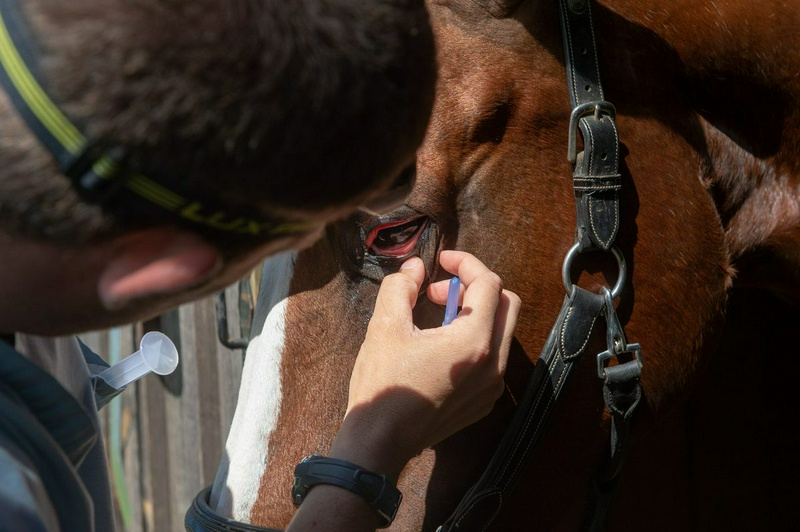
Eye Problems Keane considers any type of injury or eye problem in his clinic an emergency situation, as eye-related conditions can deteriorate rapidly.
He said: "It may not be a serious issue, but until I examine the horse myself, I cannot confirm that there is no injury to the eye.
" For example, if a wasp stings near the edge of your horse's eye, the area may appear swollen and protruding, without the eye itself being affected.
Signs of eye pain in horses include keeping the eye half-open, swelling, tearing, discharge, or keeping one eye completely closed.
Keane noted: "If I see a blue or gray discoloration when looking at the horse's eye with a flashlight, or if there is blood in the anterior chamber of the eye, that is a sign of a serious condition.
" One of the most common eye injuries in horses is a corneal ulcer.
Keane says veterinarians use fluorescein dye in the horse's eye to diagnose this condition; this substance adheres to the corneal tissue and reveals any ulcers under blue light.
Corneal scratches are usually treatable with drops or antimicrobial ointments, but Keane says if left untreated and in some cases, the situation can worsen significantly.
He explained: "In parts of South Florida where strong fungi exist, horses can quickly become infected with fungal or bacterial eye infections; a problem that is much more difficult to treat and usually leads to poorer outcomes.
" 2.
Uncontrolled Bleeding Keane said this is probably one of the scariest situations for horse owners and always requires an emergency call to the veterinarian.
He said: "I have seen horses in the hunting field bleed severely after cuts.
A horse's body has about 40 liters of blood, and when you see even 3 liters of blood, it looks like it could fill a field.
To stop severe bleeding, when the veterinarian is not present in the field, you should apply pressure to the wound or use a tourniquet depending on the location of the injury.
The stock tie was originally designed for the hunting field to serve as a tourniquet in emergencies.
"If your horse has an accident that involves one of the femoral arteries — the arteries that extend from the groin along the inner thigh to the knee joint — Kain emphasizes that there is no time to hesitate.
He explained, "You really shouldn't waste even a moment before the horse bleeds out from the leg, because the femoral artery is very large, especially as it gets closer to the groin.
"During Kain's presentation at the 2026 Windora Camp owned by Boyd and Silva Martin, his goal was to help participants determine when they really need to contact a veterinarian, as timing is crucial in many situations.
In such cases, Kain packs the wound tightly with sterile gauze and then wraps the leg as tightly as possible with a special veterinary bandage, acting as a tourniquet.
He said, "In the approximately 45 years I've been doing this, I've concluded that this method is incredibly effective for stopping uncontrolled bleeding.
Of course, the tourniquet should not be left on the leg for too long, as it disrupts blood flow to the limb, but it stabilizes the horse enough that you can transport it for veterinary care.
"3.
Tears and Cuts Kain said when it comes to tears and cuts, some injuries are serious and some are not.
In his view, if the severity of the tear is such that it requires stitches — meaning the edges of the skin are separated — you should contact a veterinarian.
Kain said, "From experience, I've seen people either exaggerate the severity of these types of injuries or underestimate them.
Once, someone called me late at night and said their horse needed stitches.
When I arrived, I was faced with a massive tear where half the skin was gone and it probably needed about 400 stitches.
But the general rule is that if the edges of the skin are separated, you should contact a veterinarian to bring them back together.
"4.
Colic Most horse owners will face colic at some point.
But Kain said it is important to remember that colic, which technically refers to general abdominal pain, sometimes has nothing to do with the horse's digestive system.
The liver, kidneys, and uterus are all located in the abdominal cavity.
Horses that experience colic may show signs such as pawing at the ground, biting at their sides, curling their upper lip, restlessness, or getting up and lying down repeatedly, and some types of colic cause more severe pain than others.
Kain considers colic an emergency, as he needs to assess the severity of the horse's problem to determine the appropriate treatment.
Kain explained that the causes of colic in horses are multifactorial.
He said, "The digestive system of horses is very primitive and has not changed much in over 3000 years, but the way we feed them has changed significantly.
Our horses are designed for continuous grazing, but we usually feed them like our dogs and cats; one meal in the morning and one meal in the afternoon or evening.
" Kain said one of the best things you can do in daily management is to simulate that natural and ideal environment for the horse as much as possible.
He noted: "This can include keeping the amount of grain concentrate feed low or providing hay in a slow feeder with small holes to mimic grazing and increase saliva production.
This can help prevent stomach ulcers and other gastrointestinal issues.
" Keen considers colic an emergency condition, as it is necessary to assess the severity of the horse's problem to determine the appropriate treatment.
In mild cases of colic, he may be able to treat the horse with an anti-inflammatory medication like Banamine® or reduce pressure using a nasogastric tube through the horse's nose to deliver fluids or medication to the stomach.
However, more severe cases of colic may require surgical intervention.
5.
Feed impaction in the esophagus Keen explained that feeds with a very high dry matter content can sometimes cause a problem known in horses as "feed impaction in the esophagus."
This condition occurs when a mass of grain is so dry that the horse's esophagus cannot direct it to the stomach.
He said: "This condition can be very uncomfortable for horses and usually causes them to cough.
We consider this an emergency condition because horses usually cannot pass this mass of feed on their own.
" One sign of feed impaction in the esophagus is that feed comes out of the nostrils; since horses breathe through their noses, feed should never be present in the nasal cavity.
Estef Simpson, the experienced groom of Boyd Martin, assisted him during Keen's lecture at Windora Camp.
He said: "A nasogastric tube can be used for flushing and helping to remove it, but the diameter of the horse's esophagus is relatively small, and for this reason, this tube often only reaches the top of the feed mass.
This means that hundreds of flushes may be necessary to moisten it enough for it to move from its place and reach the stomach.
" Moistening the horse's feed with about half a quart of water can greatly help reduce the occurrence of this problem.
6.
Lameness regarding lameness, it can sometimes be more difficult to determine when to contact a veterinarian.
Keen said: "I have had instances where someone called in severe concern because their horse was not putting any weight on its leg at all.
But when I arrived and took the horse on the longe line, it had no problem and was probably just stepping awkwardly and putting pressure on its nerve.
This condition is somewhat similar to hitting your finger hard; it hurts a lot at first, and usually, a person says something they shouldn't, but then it gets better.
" Lameness has very different severities.
In the United States, veterinarians use the American Association of Equine Practitioners lameness scale, which grades lameness on a scale from 1 to 5.
Keen explains that grade 5, the most severe condition, is when the horse puts no weight on the limb at all.
He compares grade 4 to a hoof abscess; a condition where bearing weight on one leg is clearly very painful for the horse.
Grade 3 lameness is fully visible at the trot, grade 2 is continuous but mild lameness at the trot, and grade 1 is intermittent and subtle lameness.
Keen said: "It is important for riders and veterinarians to look at lameness with a critical and detailed eye.
The approach we take in sports medicine is to improve functional issues, so we need to see the big picture."
Suppose a horse might be slightly lame, but after the jumps, it prefers to land on one lead rather than the other.
This gives us more information, so it is important that all members of your horse care team pay attention to such details.
» Lameness has varying degrees.
In the United States, veterinarians use the American Association of Equine Practitioners lameness scale, which grades lameness on a scale from 1 to 5.
Keen defines lameness as an emergency situation when it is severe enough to disrupt the horse's ability to move comfortably at a walk.
He said, "We recently treated a breeding mare that had severe abscesses in both front hooves, and we couldn't even get her to take a step.
The weather was also hot and humid, and she was quite far from the water trough, so we were concerned about her hydration.
Ultimately, we used a diagnostic nerve block to numb her knees so she could move enough to load onto the trailer and be transported to the clinic for treatment.
» While it was clear in this case that the mare's owner should contact a veterinarian, some abscesses can be milder and treated with Epsom salt or poultices.
If you suspect your horse has an abscess and its digital pulse is strong, Keen recommends contacting your veterinarian.
He said, "When a horse has a digital pulse, it usually indicates a severe infection or inflammation, and hoof abscesses are almost always accompanied by a digital pulse.
If your horse is reluctant to walk and has a digital pulse, I recommend contacting your veterinarian.
» He added, "Part of our oath as veterinarians is to alleviate the pain and suffering of animals, and I operate on that basis.
If a horse is in distress, we want to help it.
» 7.
Neurological issues Keen considers any change in a horse's neurological status an emergency.
The reason is that neurological signs can indicate several different conditions.
For example, equine herpesvirus (EHV) can present with neurological signs.
He noted, "Equine herpesvirus is highly contagious and can necessitate quarantine and lead to the cancellation of competitions.
EPM is also a concerning issue.
We have had horses that were completely normal at 5 PM during feeding, but the next morning we find them leaning against the stall wall or having trouble standing.
» Horses with severe neurological issues increase the risk of injury for stable staff who may work with them and also for other horses.
Keen said, "If other horses follow them, they themselves are more at risk of injury, or they may not be able to access feed or water.
» Vital signs: Knowing your horse's normal status When you want to determine whether you need to contact a veterinarian, it is helpful to know how to measure your horse's vital signs and have an idea of its normal condition.
Vital signs assess the basic body functions of the horse; including temperature, pulse, and respiration, as well as other indicators such as mucous membranes, capillary refill time, and gut sounds.
All of these can provide clues about your horse's overall health status.
Normal vital signs for an adult resting horse are as follows: Temperature: 99 to 101.5 degrees Fahrenheit (37.2 to 38.3 degrees Celsius).
Keen explains that a horse's body temperature changes based on the level of activity, but the ambient temperature has little effect on their body temperature.
He said, "The reason is that horses, like humans, are designed to sweat to cool their bodies.
" The normal range of a horse's body temperature is 99 to 101.5 degrees Fahrenheit.
If your horse's fever persists or its body temperature reaches 103 degrees Fahrenheit or higher, you should contact a veterinarian.
Keen recommends keeping a glass mercury thermometer in your horse's first aid kit; a recommendation that came after several digital thermometers of his ran out of battery while in use.
He said, "Before use, be sure to shake the mercury thermometer well and wait three minutes for an accurate reading.
" In most cases, if the horse's body temperature is between 101 and 102 degrees Fahrenheit, it can be monitored without the need for a veterinarian visit; however, if the fever persists or the horse's temperature reaches 103 degrees Fahrenheit or higher, you should contact a veterinarian.
Pulse: 28 to 40 beats per minute.
To take the horse's pulse, you can use a stethoscope to listen to its heart on the left side of the body, just behind the elbow and in the narrow area.
To determine the number of beats per minute, count the heartbeats for 20 seconds and then multiply by three.
Keen reminded the participants in the camp that as pain increases, the horse's pulse also rises, and this can be very important in cases of colic.
He said, "If the horse's heart rate is around 44, it usually does not indicate severe abdominal pain or systemic pain.
On the other hand, horses with small intestine lesions may have a heart rate around 70 to 90, and in cases of small intestine twisting, this number may even reach 110.
Therefore, these are useful points to keep in mind when deciding to contact a veterinarian.
" To take the horse's pulse from the lingual artery, apply pressure with your index or middle finger, then count for 20 seconds and multiply the resulting number by three.
If you do not have a stethoscope, you can take the pulse from the lingual artery; a cord-like structure that passes from the underside of the jaw, at the intersection of the cheek and jawbone.
Keen said, "Apply pressure with your index or middle finger on the artery, then count for 20 seconds and multiply by three.
Of course, you need to be careful.
This artery has a lot of movement, and as soon as the horse moves, it constantly shifts; a factor that can make getting an accurate number more difficult.
" Digital pulse: The digital pulse of the horse — meaning the pulse that can be felt from behind the pastern — does not reflect the horse's heart rate and does not necessarily indicate systemic problems.
Horses should not have a digital pulse unless there is inflammation or infection present.
To check for the presence of a digital pulse, place your hand near the middle of the pastern to locate the artery.
Keen says if after holding your fingers in that spot for 8 to 9 seconds you feel no pulse, that is a good sign.
Breathing: 10 to 24 breaths per minute.
To measure the number of breaths of the horse, you can watch the movement of the ribcage going in and out, pay attention to the opening and closing of the nostrils with each inhale and exhale, or listen to the sound of breathing by placing a stethoscope on the side.
Count the breaths for 20 seconds and multiply that number by three to get the breaths per minute.
An increase in the number of breaths can be a sign of respiratory problems, including equine asthma.
To check the horse's gut sounds, place your ear or stethoscope on both sides of its belly — both in the upper and lower sections.
The digestive system of a healthy horse typically produces regular digestive sounds, but prolonged silence can be a sign of abnormality or colic.
Mucous membranes: healthy pink color.
Pale or grayish-white gums can be a sign of illness, while bright red gums may indicate dehydration, infection, or toxin entry into the body.
Capillary refill time: 2 seconds or less.
To check the horse's capillary refill time, lift its upper lip and gently press your thumb on the gum, right above one of the teeth.
Then remove your thumb and count how many seconds it takes for the gum color to return to its normal state.
If the color does not return quickly to the gum, the horse's circulation may be affected by a physical problem.
Gut sounds: gurgling and rumbling sounds similar to gas movement.
You can check its gut sounds by placing your ear or stethoscope on both sides of the horse's belly — both in the upper and lower sections.
You can check its gut sounds by placing your ear or stethoscope on both sides of the horse's belly — both in the upper and lower sections.
The digestive system of a healthy horse typically produces regular digestive sounds, but prolonged silence can be a sign of abnormality or colic.
Here you can find more information on how to accurately take a horse's vital signs.
For more information about Windora Camp, click here.
Source: Practical Horseman – Health