Helping the horse to regain balance after jumping
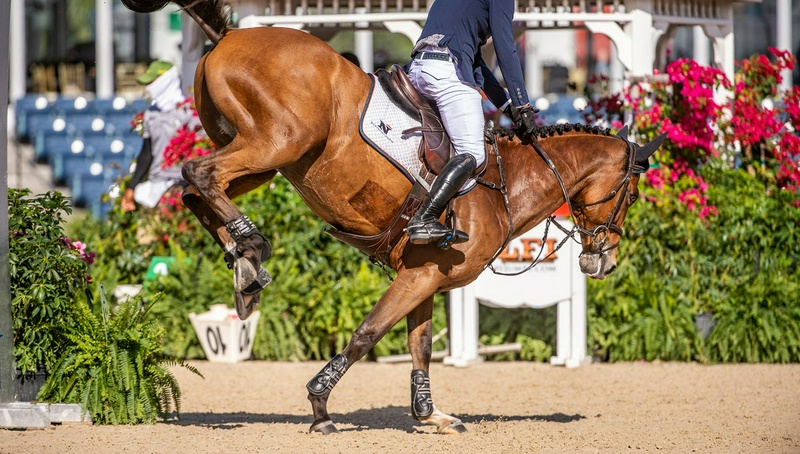
Imagine when running downhill, your body leans forward and your speed continuously increases.
It takes a little time for your legs to come back under your body, regain your balance, and slow down.
This feeling is almost the same as what your horse experiences every time after landing from a jump.
It needs time for its hindquarters to come back under itself and regain its balance so it can continue softly and calmly in the canter — something I call "finishing the jump" — a time that you provide by staying on the center of balance and maintaining a good release.
Unfortunately, many riders have developed the habit of pulling on the reins before the jump, in the air, or during the landing.
This not only disrupts the horse's balance but also prevents it from focusing on its task, as its mind is occupied with the pressure it is supposed to feel in its mouth.
As a result, instead of landing softly and continuing in balance in the canter, it may become quick, kick out, or become restless and unmanageable.
Like any other habit, a rider cannot correct it until they become aware of it.
That’s why I want to give you a simple jumping exercise where you approach the jump at a trot, release your hands over a small cross, land, and then while cantering away over three ground poles, maintain that release for three more strides.
I have achieved results very quickly with this exercise, even with professional riders who had developed the habit of pulling on the reins, because this exercise does two things at once: it opens your eyes to the reality of how quickly you want to pull on the horse’s mouth after the jump.
It helps you build a new and softer habit; a habit where you wait for your horse to have at least three strides to regain its balance and finish the jump, then make contact again.
To help your horse "finish the jump" so it can regain its balance and continue softly and calmly in the canter, you need to give it time by staying on the center of balance and maintaining a good release.
In the picture: Laura Kraut and Dorado 212 at the 2026 Winter Equestrian Festival in Wellington, Florida, USA.
And if we want to talk about breaking a vicious cycle, being less reactive always plays a big role in calming the horse.
When the horse is no longer worried that you are pulling on its mouth in the air or during the landing, it realizes it can focus instead on executing a good and complete jump.
The best part is that since the jump is very small, you can repeat the exercise enough times to do it correctly and feel confident; and it won’t take much time.
In fact, you will probably recognize the incorrect habit of wanting to pull on the reins the very first time.
Do the exercise a few more times while staying on the center of your horse’s balance and maintaining the release — the ground poles also help you remember this point — and unless you really have a serious issue with your body position, you should be able to eliminate that habit in one session.
When this happens, you are on your way to helping your horse build a flawless jump.
Your horse becomes more alert, evaluates the jump with confidence, and eagerly approaches the obstacles.
Its rhythm and speed remain consistent, reaching a comfortable point for take-off and continuing without change on the other side of the jump, while smoothly regaining its balance.
Because it trusts you not to pull on the reins during the jump or landing, it uses its body fully and generously, jumps with good height, and may even give you a little more safety margin between the jump and its legs; while it pulls its neck into a rounded shape and forward to create a nice line from the tip of the nose to the tail.
It lands softly, not what is commonly referred to as "crashing"; which to me means the horse lands lifelessly and has no forward movement, either because you have fallen back and pulled on its mouth, or because it doesn’t know how to continue forward after the jump.
Who can perform this exercise? Any rider who has a solid two-point position and has started jumping can try this exercise.
Set up according to the diagram below, placing a ground pole.
9 feet in front of it, create a small cross-rail to help you stay centered.
After the cross-rail, place three ground poles; the first two poles should be spaced 10 feet apart, and the third pole should be spaced 12 feet apart.
After the last ground pole, consider a few more steps for the horse to the end of the arena.
These measurements should be suitable for most horses.
Since I don’t know your horse and its way of moving, adjust the poles so that it can comfortably clear the first pole after landing from the cross-rail and then stretch just a little more for the next two poles; something that helps you stay up, follow the horse's movement, and not give up.
Check points for your success in position.
When your foot is free and hanging, the bottom of the stirrup should just touch your ankle bone; this indicates that the stirrup length is appropriate to shift your weight down towards the heel, maintain the correct knee angle, and in the two-point position, rise just enough from the saddle.
Also, make sure to keep your elbows in front of your hips and your hands in front of your chin, while holding the reins in such a way that your thumbs are up and angled slightly inward.
Think for yourself.
I’ll give you a few guidelines, but your horse may be one of those that naturally likes to go faster than the others.
In that case, you may need to connect with the reins earlier.
If the horse is a bit quick and sharp, it might be necessary to give it a round of walking to calm down each time you do this exercise.
And if the horse is slow and lazy, it might be better to wake it up by quickly returning to the trot and repeating the exercise consecutively without a break.
Think about what to do after the exercise.
If your arena is very large or you are riding in a grass arena, you can let the horse go for several steps after the jump.
If you are riding in a small arena, you need to gather the reins again before reaching the turn that comes up very quickly and change the counter lead if you need to.
However, even in a small arena, if you teach your horse that after the jump it is allowed to continue in the canter and find its balance again, it will be more accepting of your requests, as there is no reason for it to worry about what will happen with its mouth.
How to ride this exercise Before starting this exercise, warm up your horse on flat work.
Then, in the right rein, take a lively sitting-rising canter with a brisk rhythm and long, good strides.
About five strides before the jump pole, get into a two-point position.
Maintain leg pressure and have a light contact with the horse's mouth to encourage it to come to the jump pole, reach the cross jump, and maintain its balance upwards during the jump.
Fix your gaze on the path you want to take after the jump; it’s fine to also keep the jump itself in your peripheral vision.
When the horse jumps, release your body and allow it to close your hip angle.
Keep your hands in front of your chin so that your fingertips can reach the horse's neck, and as it creates freedom in the reins with its neck, press your fingertips on either side of its mane.
While maintaining the two-point position, keep your weight in your heels, maintain a closed hip angle, and during the landing and continuing the horse in the canter over three ground poles, keep the fingertip pressure on its neck.
After the third ground pole, make a decision.
If the horse remains calm and does not pull on the bit, pull the reins, or speed up, and moves away from the jump in the canter, just very softly, gradually, and smoothly re-establish contact with the reins.
Before reaching the turn, return to the canter and repeat the exercise.
If the horse speeds up or becomes unsettled, calmly bring it back to a walk, walk for a while until it calms down, then take the canter again and repeat the exercise.
Gradually but surely, by maintaining freedom in the reins and never suddenly taking the reins away from it or interfering in its jump, you convince it that there is nothing to fear from your hands.
And since you do not give it anything to lean on, it gradually gets used to balancing itself and holding its body.
When you can confidently maintain a closed hip angle over the ground poles and apply pressure on the horse's neck, and it finishes each jump calmly and softly, turn the cross jump into a small vertical jump.
When this stage goes well, perform the exercise in the canter.
Remove the canter pole and set up three ground poles at a distance of about 11 to 13 feet apart depending on your horse's stride.
Even though you are now in the canter, try not to get excited and start pulling on the reins.
Focus on maintaining your body position until you reach the cross jump and keeping freedom along with movement on the landing side of the jump.
When this stage goes well, remove the ground poles after the landing and while keeping your hands free, ask your trainer or one of your friends to count to three for you.
After that, do the counting yourself.
Finally, go through a line in the canter.
I think you will see that when your horse knows there is nothing to fear from your hands, it will navigate the lines calmly and with long strides; and the reality is that when you do not push the horse forward in the lines, your rounds in the competition arena will also be much smoother.
About Patrick Spanton Patrick Spanton is a successful trainer and rider whose students and horses have achieved hundreds of championships at the level and medal finals.
He grew up in Vancouver, British Columbia, in a family unrelated to horses and equestrian sports, but at the age of 12, he began working with Leslie Reid, a two-time Olympian and gold medalist at the Pan American Games.
At 18, he started working at a show jumping horse sales stable near Aachen, Germany.
Before founding Patrick Spanton Training Stables, he was the trainer and rider at Rainbow Canyon Ranch, working alongside Mary Gati.
Patrick now lives outside of Rio de Janeiro, where he trains high-level show jumping horses and conducts clinics throughout the United States, Canada, and Brazil.
This article was first published in the Summer 2021 issue of Practical Horseman.
Source: Practical Horseman – Training