A higher counter, not a faster one; the correct way to execute an increase in stride length.
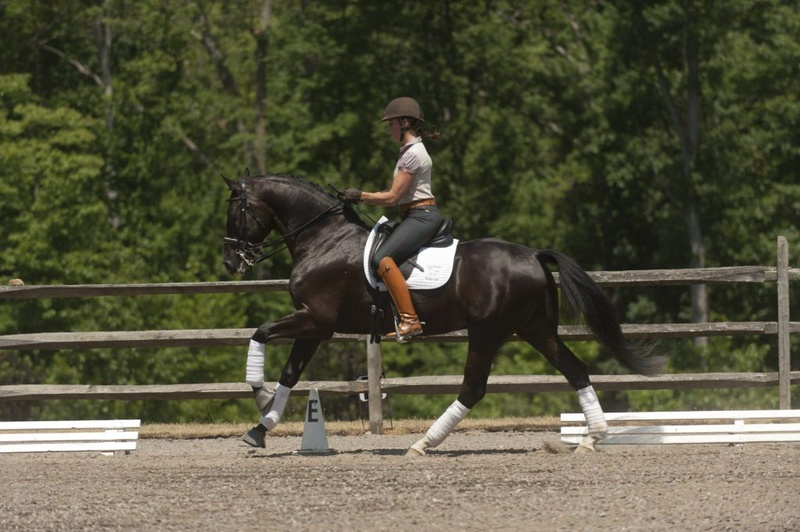
When a horse demonstrates a very good execution of lengthening the stride in canter, the effect it leaves is not limited to the technical correctness of lengthening the stride and stretching its body frame; it comes from the way it pulls from its back and neck towards the reins.
It also conveys the sense that it is "breathing" throughout its body and directing energy from its hindquarters upwards, towards its back and shoulders, to create big and smooth strides.
When the horse transitions from working or collected canter into lengthening the stride, its tempo actually slows down; because it requires more time to take each extended stride.
When it returns to working or collected canter, this tempo speeds up again.
Lombard V, an 8-year-old Danish Warmblood owned by Hope Greenfield, demonstrates an excellent example of lengthening the stride in canter: he raises his stride and body frame and pulls from his back and neck towards the reins.
He also creates the impression that he is directing energy from his hindquarters upwards, towards his back and shoulders, to produce big and smooth strides.
Most importantly, in this ideal execution of movement, the horse shows no signs of tension.
Even slight stiffness in his body creates a completely opposite result: a faster tempo of movement without increasing the stride length.
This is the most common mistake we see in the competition arena.
When riders come out of the corners and suddenly apply pressure, their horses hold their breath and rush through the arena without actually increasing the stride length at all.
Although lengthening the stride in canter is a precursor to a more developed canter that is more powerful, expressive, and uphill, and requires considerable training to shape, you can introduce its basic concept quite early in your horse's training.
As soon as the horse understands that the leg means moving forward and the rein means slowing down, you can ask it to go a little forward and then back again in the same canter.
This is an excellent training tool for daily work that you will use at all levels.
This exercise helps your horse find a greater connection between your legs and hands and become "more fluid" in its body; the same quality I referred to as the forward flow of energy from the hindquarters.
It also keeps its mind active and makes it say to itself: "What's next?"
To teach your horse to lengthen the stride, rather than just speed up, you need to master three skills.
First, you must keep it straight and aligned in its body.
If its body is crooked, for example, if the hips are turned inwards, part of its power is wasted sideways.
To maximize its power, both hind legs must step directly underneath its body to push it upwards and forwards.
The second skill you need to master is the ability to initiate forward and backward transitions with your seat and light pressure from your legs.
In this article, I will explain how to do this.
It is easier than it seems.
Finally, you need to allow your horse to relax while lengthening the stride and breathe through its back to feel free, lift higher under you, and produce bigger strides.
I will also explain how to do this.
Let's start with an exercise to lengthen the stride on a 20-meter circle.
On the circle, it is easier to maintain the feeling that you are driving the horse from the inside leg to the outside rein.
This is very important because the outside rein is your speed control rein.
When you accompany it more, you allow the horse to move forward.
When you increase the contact on it, you reduce its speed.
The better your connection on this rein, the better control you will have over the horse's speed.
However, the steps I will explain for creating a lengthened stride are the same whether you are on a circle or in a straight line.
Step 1: Check your alignment.
Start with your own body position and make sure the shape your body creates on the horse is completely symmetrical; that is, the right side of your body should be in harmony with the left side so that your weight is evenly distributed over the horse's spine.
Ask yourself: "Are my shoulders level and parallel to the ground?
Are my elbows level?
Are my hips level?
Are my seat bones level?
Are my heels level?"
Your horse will go off the line wherever you have a weakness in symmetry; therefore, keep reminding yourself to stay balanced.
Then check your horse's alignment.
Mirrors are essential for this.
When you are cantering on a line perpendicular to the mirror, the horse's shoulders should cover your view of its hind legs.
If not, the horse is not straight.
Using your reins and legs, try to realign its hindquarters with its shoulders.
If you don't have a mirror, ask a friend to assess your alignment as you canter towards them.
Also, check that your foot placement is correct; the inside leg should be on the girth and the outside leg slightly behind the girth.
Step 1: Before lengthening the stride, I check whether my shoulders, elbows, hips, seat bones, and heels are all level and parallel to the ground.
I also check that my horse's body is straight.
Then I ride his lumbar in a working canter along the long side of the arena.
Step 2: Collect and go!
When riders prepare to lengthen the stride, they usually think: "Forward, forward, forward!"
But to create that force you want to be released in the movement, the horse must shift its weight onto its hindquarters.
To help him, do this: start on the edge of the arena and in a working canter, plan to make a 20-meter circle in the middle of the long side of the arena.
A few strides before reaching that point, ask him to shorten his stride a little; think of "small steps."
Do this by counting the strides in your mind; one number for each stride, with a short and clipped rhythm: "one, two, one, two."
While keeping your upper body neutral and not leaning forward or backward, allow your hips and lower back to swing forward and backward in that same rhythm.
This helps your horse transfer more of its weight onto its hind legs, resulting in more carrying power.
Imagine its tail is dropping towards the ground, as if the horse is lifted on its back wheels.
At the same time, use quick and relaxed leg aids, in sync with the horse's canter stride, to create more energy.
Here, relaxation is the key.
If you constantly press your legs against him, the horse feels that he cannot fully open his chest for deep breaths.
So instead, keep the upper part of your legs relaxed on the saddle and apply leg aids with a quick movement of closing and then releasing at the lower part of your legs.
Think of gathering the horse's belly underneath you with each step to encourage him to jump higher at the upward part of each stride.
Between each light leg aid — at the downward part of the counter stride — separate your entire leg from the horse's body and draw it towards the ground.
However, do not overanalyze the timing of this leg aid.
Your body's natural rhythm helps you apply this aid at the right time.
Step 2: When I reach the point where I'm supposed to start the circle, I mentally count the counter steps with a quick and crisp rhythm: "one, two, one, two" and at the same time, I let my seat sway with this rhythm to ask Lombard 5 to shorten his stride and bring more weight onto his hindquarters.
Step 3: Let the strides become bigger.
As you enter the circle, gradually slow down your seat's sway and think of a slower rhythm in your mind: "one and two and three and four."
For some reason, counting with higher numbers helps me create bigger strides.
This is where you need to trust that your horse is trying to synchronize his tempo with you.
This may not happen immediately, but with practice, he will do it.
Now think of extending the counter with each stride.
Instead of suddenly shifting him from gear one to gear four, gradually and smoothly change gears; first to two, then from two to three, and continue like this, all the while allowing him to breathe through his back.
Follow the horse's mouth movement with your hands and maintain a light contact so that the energy coming from his hindquarters circulates back into his body.
Step 3: After we enter the circle, I slow down my mental counting; "one and two and three and four" and I sway my seat with a larger and slower movement to encourage Lombard 5 to take bigger strides.
At the same time, with each stride, I close and open my legs on either side of his body to maintain energy from the back.
Step 3 (continued): When Lombard responds by lengthening his strides, I continue the larger and slower movement of my pelvis and ask for more length with each stride.
Step 4: Bring him back to the previous state with your seat.
As you approach the wall of the arena again, ask him to return to a working or collected counter.
Instead of using the reins first, focus on changing the rhythm in your seat.
Speed up the swaying movement again to create the same rhythm of "one, two, one, two" that you had before the strides got bigger.
Give the horse a few strides to respond to this change.
You will be amazed at how much he tries to synchronize himself with your rhythm.
In the meantime, keep your legs in the correct position and continue to apply a light and collecting pressure on your calves to maintain the jump in his counter.
In the downward transition, think of him lowering his tail while simultaneously coming up higher from the shoulders.
If you start this transition with your seat, you encourage him to respond first from the hindquarters.
The result of this will be a softer and more engaged transition.
When his hind legs take shorter and quicker steps, he remains balanced in front of his body as well.
However, if you use the reins first, he will resist against the reins, shorten his neck, and instead of lowering his hindquarters, he will raise them.
If he does not respond at all, use your fingers on the reins by pressing and releasing to return to the counter work.
As the horse's training progresses, you will notice that in the downward transition, you actually need to give him more rein to prevent his neck from shortening.
After that, pass through the short side of the arena and repeat the exercise on a new circle, this time from the other side of the arena.
By repeating this exercise, you will see that your horse responds more to the aids from your seat in both upward and downward transitions.
Step 4: Near the end of the circle, I return to the rhythm of counting faster and the swinging movement of my seat and ask Lombard to transfer his weight back onto his haunches and shorten his stride.
My leg aids continue to ask him to produce energy from behind, and I add a little pressure on the reins.
Notice that he has gathered his body again, but his neck has not shortened excessively.
The reason is that before the reins, I asked him to gather with my seat.
Increasing stride length in a straight line When the increase in stride length on the circle is going well, try the same steps I explained above on the long side of the arena.
First, check your body symmetry.
Then, at the corner, think about "loading and moving" and ask your horse to increase the number of steps.
For example, instead of taking three steps through the turn, see if he can do it with five or six steps.
After you start increasing the stride length with your slower seat, try to make each step a little longer than the previous one; in such a way that your seat moves with a rhythm that is slower and more extended each time.
Along the long side, check your straightness; all components of your body position should be uniform and level with the ground.
Then, just before the downward transition at the next corner, check this again.
With your seat, ask the horse to shorten and quicken his stride and move in this corner by adding more steps.
Be careful not to lean your body inward as you approach the second corner.
Your change in balance also affects the horse's straightness and may even cause him to change leads in the downward transition or counter canter.
Repeat this exercise several times while circling in the arena.
Ask for an increase in stride length on each long side and return to counter work on each short side.
After a few repetitions, you will notice that your horse anticipates the far corner before reaching it and gathers and balances himself.
Apply this same concept of back and forth between forward and gathering throughout your daily exercises; both to increase the horse's physical engagement and to help him respond more accurately to your aids.
The degree of increase in stride length and gathering that you ask from the horse depends on his level.
For example, with my Grand Prix horses, I want a completely stretched canter and then I bring them back to a collected canter; that is, a very gathered canter.
In this way, I ask them to show the full range of their strides.
Apply the same concept in the competition arena; not just for the actual movement of lengthening the stride, but in any other part of the test where you can showcase your horse's canter a bit more.
For example, in the corners, ask for a slightly faster tempo to improve its balance, then give a bit more space on the short sides of the arena to produce a larger and more impressive canter.
Steps 1 and 2: As I did on the circle, I first check our straightness and then in the corner, by asking for a slight shortening of the strides, I prepare his lumbar for lengthening the stride in the straight line.
Here he has shifted his weight well back and loaded his hindquarters with energy.
Step 3: Then I increase my seat movement more and accompany my hands forward to encourage his lumbar to lengthen his strides.
In each stride, I only ask for a bit more length.
Step 3 (continued): Note that when the lumbar 5 fully lengthens the strides, I have still kept my upper body in a neutral position.
My seat moves with each stride, but my upper body remains steady throughout.
Step 4: As I approach the next corner, I shorten and quicken the range of my seat movement to ask the lumbar 5 to collect again.
Rhythmic aids from my legs ask him to bring his hind legs underneath his body in a springy manner.
Since I have used my seat instead of the reins, he remains very comfortable and soft in the contact; therefore, I can allow the reins to be a bit looser.
As a result, he has maintained good balance in this transition and also in entering the corner.
Correction for slow and lethargic horses: With practice, most horses respond well to the seat aid I explained above for starting the canter.
However, if your horse is inherently a bit slow, it may initially need a little encouragement with the whip.
This may seem counterintuitive at first glance, but the most effective time to use the whip is in the working or collected canter and before asking for a longer stride.
When you load the canter, use the whip gently behind the leg and in rhythm with his strides to encourage him to spring from behind and transfer energy forward.
This helps him build the necessary power to lengthen his strides; then you can enable this lengthening by simply moving your pelvis in a slower rhythm and accompanying your hands.
If his strides still do not lengthen, give him another tap as you start the seat aid.
Praise every effort he makes, even if it’s just one or two longer strides.
Then gradually expand this; first ask for three longer strides, then four strides, and so on.
When you ask for a downward transition, use the whip again.
For horses, gathering their bodies back and returning to a working or collected canter is more difficult than simply moving forward.
Therefore, when you increase the speed of your seat movement, gently encourage him with the whip to ask for "jump, jump, jump" again.
Proper use of the whip: Since executing a downward transition from canter with longer strides requires a lot of energy, a whip strike can help create more engagement.
Here, exactly at the moment I want the downward transition, I strike Lombard 5 times.
In the following strides, he created more lift in his stride, allowing him to collect while maintaining balance.
For strong horses: Horses that become heavy on the bit when lengthening their stride—especially former racehorses who associate pressure on the reins with going faster—sometimes do not respond well to the necessary aids for the downward transition.
For such horses, introduce the circle into this exercise.
For example, in the working canter, enter the long side of the arena and immediately perform a 10-meter circle.
When you return to the side line of the arena, increase the length of the stride for about half the length of the arena.
Then, simultaneously with requesting the downward transition to working canter, perform another 10-meter circle.
This helps stabilize your aids for the downward transition and encourages the horse to collect its strides to maintain balance.
In the second half of the arena, ask for an increase in stride length once again and then perform another 10-meter circle.
As his responsiveness improves in the downward transitions, eliminate the middle circle and try to continue the lengthening of the stride along the entire long side of the arena between the first and last circle.
Eventually, you will be able to perform this exercise without any circles.
What happens if you use the reins before the seat in the downward transition: Here I made a mistake and instead of first asking for the downward transition with my seat from the lengthening of the stride, I initially made this request with my hands.
You can see that Lombard raised his head and opened his mouth in response to this action.
For horses that have a cold and stiff back: If your horse is a bit stiff or tense in the back while warming up, try lengthening the stride in canter in a half-seat position.
Rise a few centimeters off the saddle and keep your weight balanced on the lower part of the legs, being careful not to lean on the reins to maintain balance.
This encourages him to round his back and move from behind with more energy and stretch.
Make sure he continues to open his body frame and pulls his back and neck forward in contact with the bit.
For horses that have a cold and stiff back: For horses that have tension in their back while warming up, riding in a lengthened stride canter in a half-seat position helps them move softer and loosen up.
Here I have completely lifted my weight off the saddle, but at the same time, I have kept Lombard connected between my legs and reins to remain well-formed and soft on the bit.
About Lauren Samis: Lauren Samis, a Grand Prix dressage rider, has won bronze, silver, and gold medals from the United States Dressage Federation.
In 2007, she represented the United States at the Pan American Games with the Dutch Warmblood gelding Hyperion Farms, Sagacious HF, winning individual silver and team gold medals.
She is a serious supporter of the Riders4Helmets advocacy group and always wears a helmet while riding, even during Grand Prix competition.
She is also recognized as an importer of talented European dressage horses.
Lauren is the founder of Semis Sales LLC; a business that operates in the field of training dressage horses.
Lauren provides training, education, and coaching services in dressage at the Grand Prix level globally.
This article was first published in the September 2012 issue.
Source: Practical Horseman – Training