Correct approach to overcoming the corner obstacle in cross-country
Jumping from a corner obstacle is seen everywhere!
Today, we encounter this obstacle more than ever on cross-country courses, as it rewards precise and forward riding.
At the same time, it penalizes the horse and rider with a 20-point deduction for not passing the obstacle or refusing, rather than a fall.
The main test that the corner obstacle presents to the rider at any level is this: Can you keep your horse between your hands and legs and ride him in a straight line?
What is this obstacle: The term "jumping from a corner obstacle" seems clear at first glance, but not all corner obstacles are the same.
At lower levels, riders are asked to jump a narrow section of an obstacle that resembles a thin slice of cake.
Some corner obstacles at the training level are practically nothing more than a vertical obstacle with a slight width.
On the other end of the spectrum, corner obstacles in four-star competitions like the Badminton and Burghley horse trials have an angle greater than 90 degrees, making the width of the obstacle at the "tip" of the corner a real challenge.
Just as the width of the corner obstacle depends on the level of competition, its height is also determined based on the level of competition.
The tallest corner obstacle you will see at the training level is 3 feet and 3 inches high.
This height reaches 3 feet and 11 inches at the four-star level.
And while previously riders could usually consider a straight and hypothetical line through an obstacle to approach a corner obstacle and stay on that line, course designers at higher levels have become much more clever in using bushes and other elements.
These additions often force the rider to approach the obstacle at a more difficult angle than their ideal position, thereby opening the way to deviate from the line.
For example, at last year's World Equestrian Games in Aachen, Germany, the fastest route to the corner obstacle forced riders to jump the front of the obstacle at a greater angle than their usual and comfortable one.
This is one of the technical question differences between the corner obstacle and the arrowhead or chevron; obstacles that can usually be jumped almost completely straight.
The topography of the ground can also increase the degree of difficulty; especially ground that slopes down from the tip of the corner obstacle, as the downhill pull can take the horse off the line needed for the jump.
The hardest courses also use related obstacles; for example, a large and wide table with a curved line leading to a corner obstacle; to make passing this type of obstacle more difficult.
On flat, straight, and forward is the first step for a successful jump from a corner obstacle is to be able to ride your horse straight and forward.
Practice keeping him between your hands and legs and riding on flatwork in a straight line.
Both you and your horse must understand that when you close your hands and legs, he must move straight and forward.
The key to achieving this goal is "throughness."
When your horse is through, you feel that in one or two strides you can lengthen or shorten his stride, raise the front hand, or bend him; all while maintaining a consistent and elastic contact with the bit, without releasing the horse or the bit or escaping from the bit.
When you can ride your horse forward and towards your hand, you can ride him straight and ahead of your leg.
Exercises such as lateral movements and transitions up and down between the gaits, as well as within each gait, help the fluidity of movement and the flow of energy in the horse's body.
I tell my students: "Whatever your horse offers you, ask for the opposite from him."
If he is too forward, practice downward transitions.
If he wants to be straight and stiff, do lateral movements and circles.
When you can ride your horse between your hand and leg, you can approach jumping over vertical obstacles and oxers at an angle; the same thing you will do when jumping over corner obstacles.
Be very precise about exactly which point of the obstacle you are jumping from and what line you want your horse to follow; at an angle to the left or right.
When angled approaches to regular obstacles become comfortable and stable for you, it is time to introduce real corner obstacles into your practice.
You can build simple practice obstacles anywhere; in the arena or in a grass field.
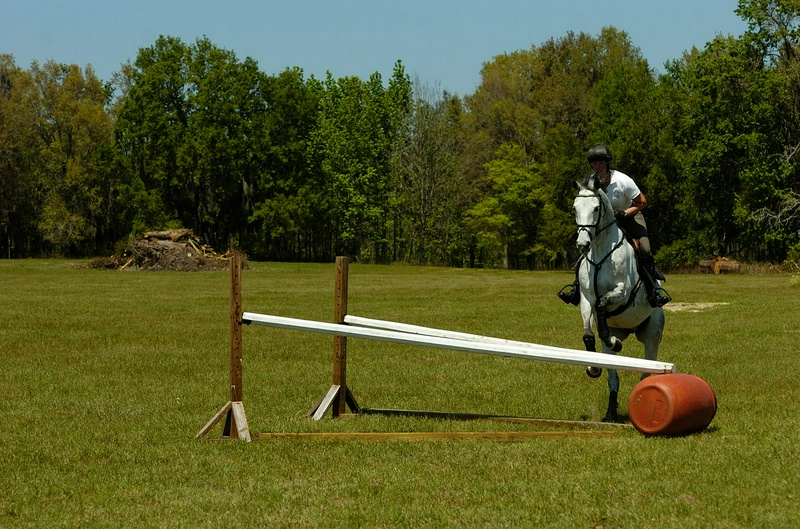
To create the corner obstacle question similar to what you see in these photos, you need two obstacle standards, two jump poles, two ground poles, and one plastic barrel.
Start by building a narrow and simple corner obstacle.
The standards are about 4 feet apart and the poles meet at the barrel; the barrel, when placed on its side, is about 2 feet and 6 inches high.
The ground poles under the jump poles give my horse, Wac O' Mon, a clear idea of the shape of the obstacle.
Now review the above photos again to see how I start practicing corner jumps at home.
Amy Tryon reached the highest levels of eventing while being a full-time firefighter for 13 years; until she retired in 2006 to fully focus on training horses and teaching students.
She won a team bronze medal at the 2004 Olympics with her former racehorse, Poggio II, and achieved team gold and individual bronze at the 2002 and 2006 World Equestrian Games, respectively.
She represented the United States again with Poggio II at the 2008 Hong Kong Olympics.
In addition to her other horses at the Advanced level, Woodstock and Le Samurai, she also competed with two former racehorses, 6-year-olds named Leland and Coal Creek.
Amy passed away suddenly at the age of 42 in April 2012.
She is survived by her husband, Greg.
This article was first published in the June 2007 issue of Practical Horseman.
[PHOTOGALLERY uniquename=”galleria-azur”] Source: Practical Horseman – Training